WOLFENSTEIN: THE NEW ORDER REVIEW – “HELL, YES”

Everybody says that 2014 was a poor year for video games, but the more stuff I try from it the more I find this hard to believe. Good or bad, at least it’ll have some mention in history. 2015 feels like it should have been renamed “The Year Of The Bland,” as most of the line-up has been functional but unimpressive titles getting added to major franchises like another prisoner being shackled to the end of a chain gang. Even the few good games like Fallout 4 and Tales From The Borderlands haven’t been revolutionary in any way, just well-made games that did exactly what we thought they’d do and nothing more.

The reason I currently feel endeared to 2014 is that I finally got round to playing Wolfenstein: The New Order, currently on Steam Sale for an impressive five pounds down from thirty-five, which is what prompted me to crack open my wallet, lean back to let the moths fly out, and shell over the cash for another venture into occupied Europe.

Wolfenstein is one of those series that I’d always known about but never really gotten into, but for those of you who are interested, it’s basically about Nazis building robots and monsters in the midst of World War II, whilst the allies work on kneecapping these little projects under the blanket of secrecy. If you go and watch the first scene of the Hellboy movie, you’ll have a good idea of what I’m talking about – mysterious artefacts mixed with ever-advancing science, psychotic German officers in leather coats and personalised gasmasks, allusions to hidden societies and a group of down-to-earth, culturally-diverse soldiers who are here to kick Kraut arse and save the world at the same time.

2015-11-27_00033

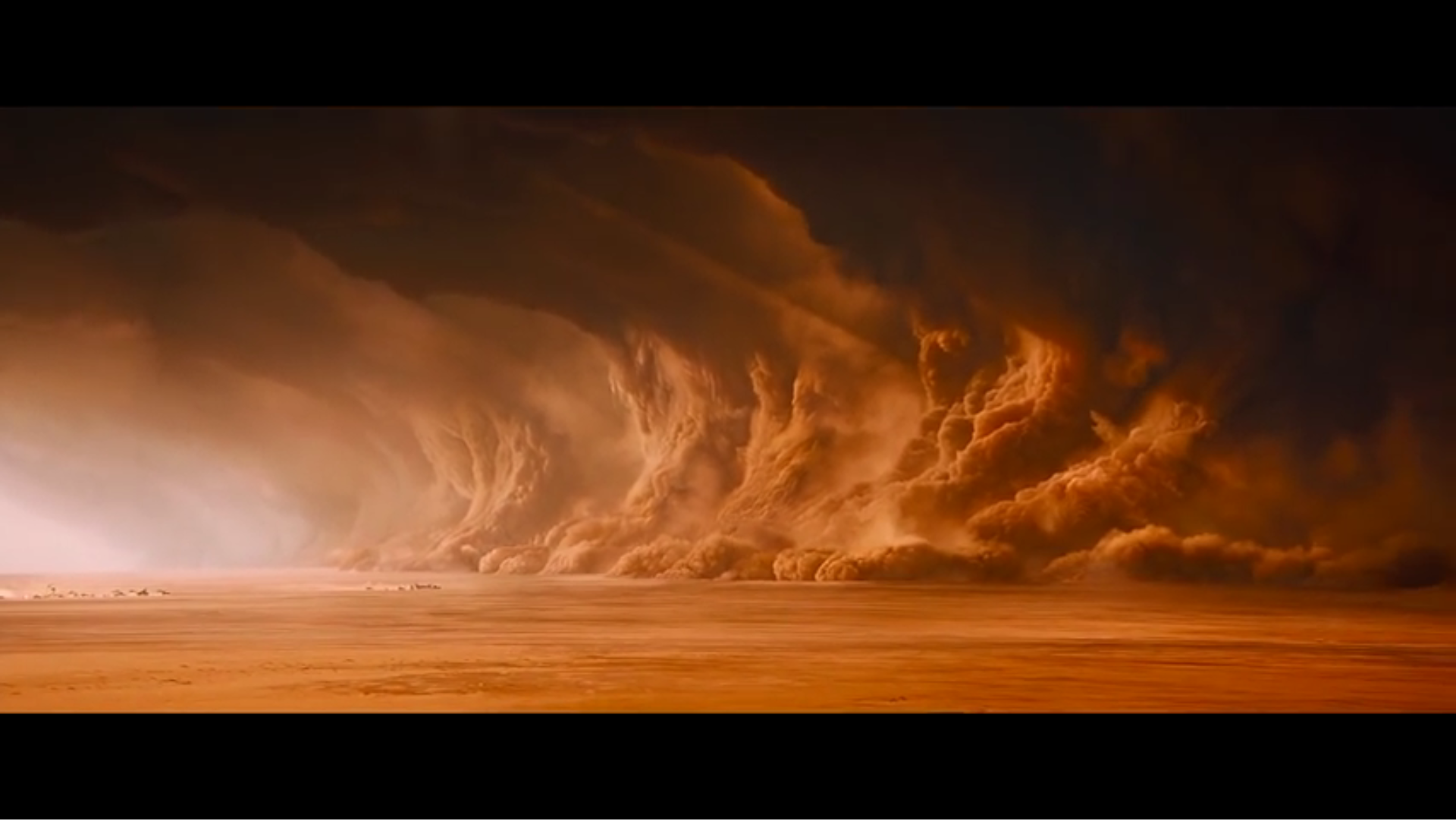
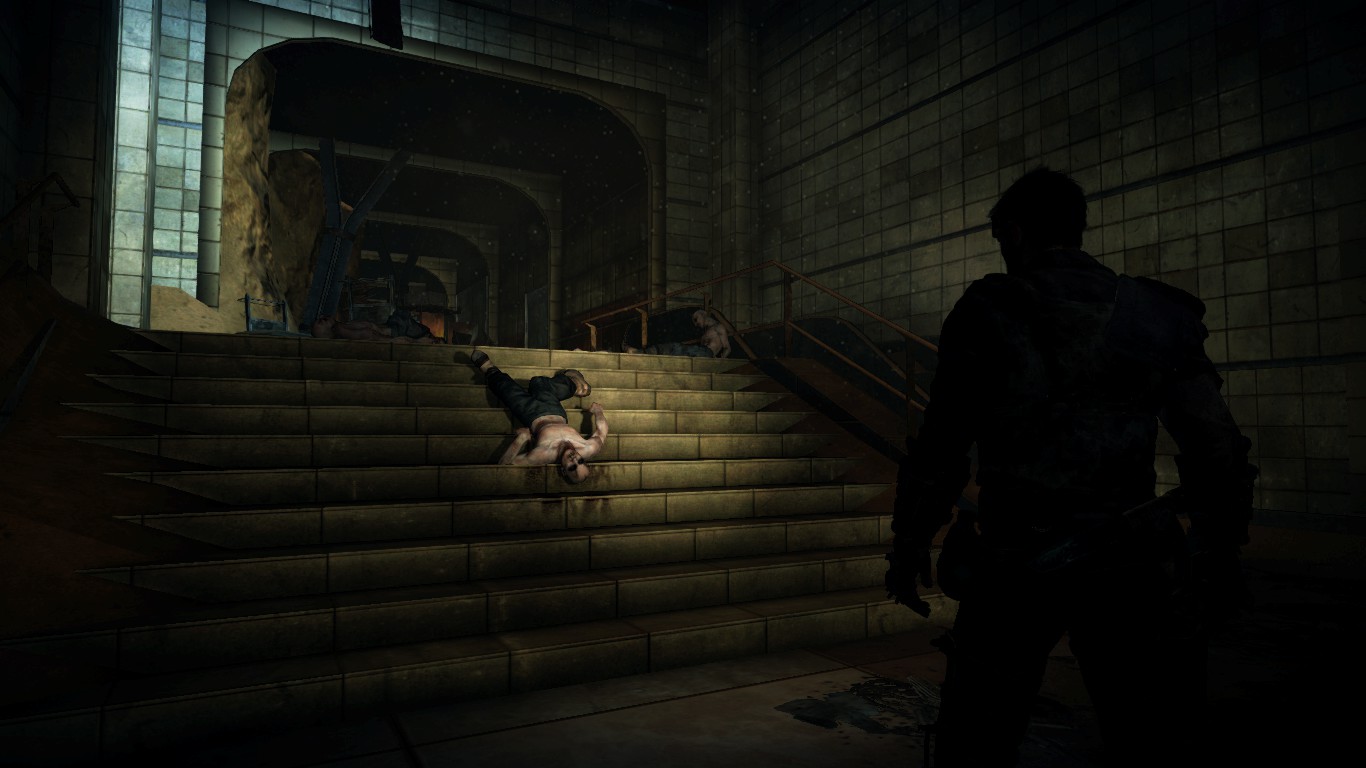
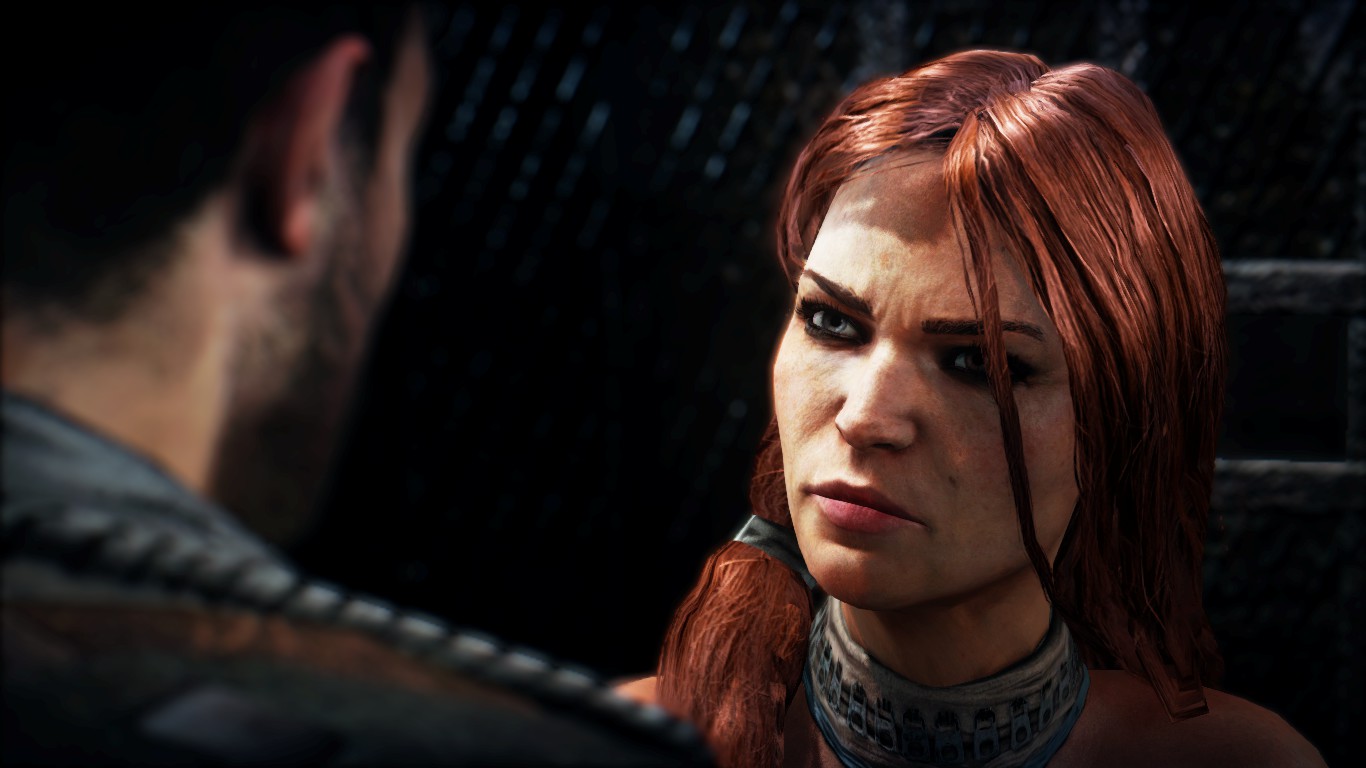
Meet B.J. Blazkowicz. You can make your own by mixing the DNA of Captain America and a large bear.

However, this has sort of been changed in The New Order. The alternate history-ometer has been ramped up to eleven as the prologue depicts the wardrobe-shaped hero Captain William “B.J.” Blazkowicz as part of a last-chance effort to defeat the Nazi menace in 1946. Backed by the final scraps of the allied forces, Blazkowicz assaults the robot-protected castle of mad scientist General Deathshead and fails about as hard as a person can without spontaneously combusting. His team is scattered to the winds and B.J. (stop snickering) has a piece of metal lodged in his head by a cheeky explosion that leaves him dead to the world.

So far, so miserable, but after that he spends fourteen years drooling in a Polish asylum as the Nazis trample all over the world, sticking a flag in every country that submits and punishing any of those that take too long to comply, including nuking the USA and attacking England with a skyscraper-sized robot, presumably because we kept apologising in an annoying way. But Blazkowicz finally powers back into action just in time to escape a German death squad and joins the underdog resistance with his beautiful nurse by his side, meeting up with quite a few of his old friends as he does so. Along the way he’ll journey from Nazi prisons to the depths of the oceans and even to the moon itself, all the while fighting the automatons of General Deathshead and duel-wielding machine guns like a boss.

This might sound all very silly, but that’s kind of the point. Wolfenstein knows how stupid the core concept is, but boldly wears it like a coat of arms rather than constantly hedge its bets with little justifications and weedy apologies for every little thing. And honestly, I like that. World War II has been a withered, paper-skinned husk to game writers for years, all of whom have struggled to draw any new ideas from it, but Machine Games took that husk and filled it with life again by running liquid nonsense through its veins.
2015-11-28_00050

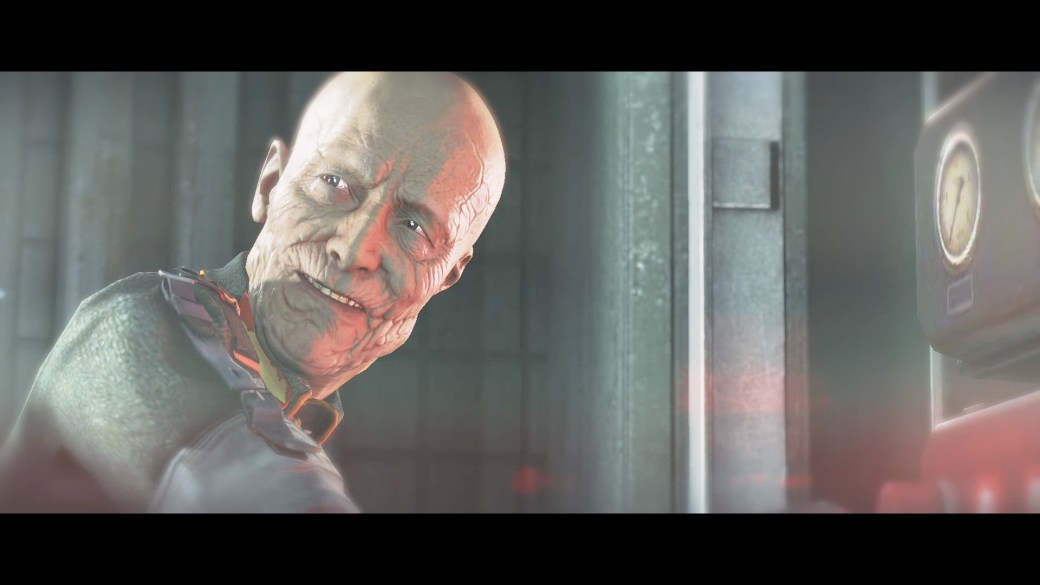
That face is all the reason we need to kill this guy.

Which isn’t to say it’s poorly written. As a matter of fact, The New Order has some of the strongest character writing I’ve seen from any game in a while, and proved that you can have a grizzled, warrior-soldier hero without sacrificing personality and depth, knowledge that would’ve helped when it came to creating entities like Solid Snake or Marcus Fenix. Blazkowicz comes across as tormented by what he’s seen, constantly having to remind himself of why he’s at war and not gruff as you’d expect, but quiet and saddened by his experiences. He seems more like a regular guy than anything else, and at one point confesses to running on a permanent level of repression, claiming that if he expressed his emotions properly, he’d never recover from the sheer enormity of them. Not to mention that when he commits certain acts of war in the game, he’s often visibly shocked or traumatised by what he sees – and that in itself is somewhat unusual. Upon causing some major act of violence, most FPS heroes would give it a stern glare before grumbling some one-liner and rappelling down to shoot anybody who had the poor judgement to try and defend themselves.

And the other characters are almost as complex as B.J. himself, making walking through the resistance HQ rewarding on its own terms, as you amass a little scrapbook of biographies. There’s the no-nonsense type that’s been inspired to fly aircraft after losing the use of her legs, the former German soldier who’s adopted a simple but kind-hearted giant, the elderly genius who believes that scientific enquiry is a form of worship and even an aspiring rock guitarist who might just seem a little familiar to those of you who notice the signs.

Mind you, he only appears if you make a certain choice, which is one of those things I’m not entirely on board with. During the prologue you have to pick which one of two allies get killed, and certain aspects of the story change depending on whether you’ve got the angry Scotsman or the nervous American backing you up. I understand why they implemented this, they want us to feel responsible and experience some of the weight of our actions, but I think this would have been more impactful if poor choices on the player’s behalf had led to them dying as a result, rather than stopping the story to make us drop Damocles’ Sword on one of the poor bastards. I’m all for player agency within games, but this isn’t an RPG. Wouldn’t it have been better to allow us to see all the content in one go? Whilst I’m sorry I missed it, I don’t feel the need to go back and immediately power through the campaign all over again, especially as I suspect not enough will have changed to make it worth the effort.

And that’s also a shame, because The New Order is surprisingly short, especially for a game that was being sold at standard retail price when it came out. What’s there is pretty damn good, but I had finished the main campaign in nine hours and there wasn’t anything left for me to do except replay the best missions and rewatch the sex scene a few dozen times. And though there’s a least three emotionally-charged moments that raise Wolfenstein from “good” to “excellent,” like all narrative based on surprise and shock, they can’t help but lose their impact over time and repeated viewing.
But what about the mechanics of it all? Wolfenstein is a game about visually spectacular set pieces, mixed around the core gunplay. One thing that delighted me from the get-go is that you can duel-wield any weapon, including lasers, shotguns and assault rifles, and there’s moments where the game mixes things up, such as scaling the side of a building on a grappling hook, shooting enemies with your free hand and swinging to avoid debris.

2015-11-27_00027

Would this be a bad time to mention my fear of heights?

It also helps that you’re not fighting dull shooting-gallery enemies. Nazis tend to eschew silly notions like cover and will often chase after you, making it all the easier to charge straight back and gun them down with exhilarating glee, and there’s robot dogs and armoured mechs that provide more of a challenge, strafing around them or looking for the fuel tank on their back to pop like a balloon.

But Wolfenstein is actually a surprisingly hard game, and something about me suspects it ended up harder than the developers intended. Health only regenerates a little bit, and medpacks and armour are often thinly spread or even just hard to distinguish among the environments. And whilst in cut scenes B.J. has the kind of physical endurance that would put a granite statue to shame, in gameplay it’s rather startling how fast you can get cut down by enemy fire. This is perhaps one of the reasons that The New Order lets you lean around cover to shoot people, rather than having to walk out fully and get your big chin blasted off.

Of course, the other reason you can peer around fences like a nozy neighbour is that there’s stealth, which is quite organically mixed in. Certain missions depend on it (such as sneaking through a prison camp with only a knife to defend yourself) but at time you’ll come across rooms full of enemies and you’re free to pick as many of them off as you like before you get spotted, using the holy trinity of stealth kills – the backstab, the silenced pistol and bizarrely powerful throwing knife from Call Of Duty, which as always can land in a man’s pinky finger and kill him instantly. Or maybe beneath the helmets they’re all Edwardian ladies who just faint at the sight of violence.

In hindsight I wonder if the stealth mechanics could have used a few more redrafts on the design document – it would have been nice to be able to distract enemies, for example – but it’s certainly not badly designed and what’s there works well enough that I’m happy to play stealthy when the option comes up.

2015-11-27_00067

Can you guess what happens next?

Finally, gameplay is shaken up every now and then with bizarre action vignettes, such as piloting a giant robot, fighting flying drones in a space suit on the surface of the moon and even shooting down zeppelins with AA guns, all of which last only a moment, but who cares? There’ll be another one that’s just as good in ten minutes. And though all of these spectacles are different, they’re all close enough to the core gameplay that it never feels schizophrenic or misplaced.

In short, Wolfenstein: The New Order has been a rather nice surprise. I was all ready to play yet another military shooter with delusions of grandeur and half-hearted character arcs, but The New Order is an inspiring blend of old-school shooters and modern FPS. Perhaps it realised that the way to have your cake and eat it too is to make it thick and flavourful enough to last – and you do that with layers. Layers of depth, layers of narrative, layers of gameplay, and a thick Nazi jam on top that any player is happy to go at with a big knife. I know I was.


8.5/10

Little nitpicks about length and a couple of rough-around-the-edges game mechanics aren’t enough to make me forget that The New Order has a great story, heartfelt characters and gameplay that’s all too willing to drop everything and have some genuine fun.

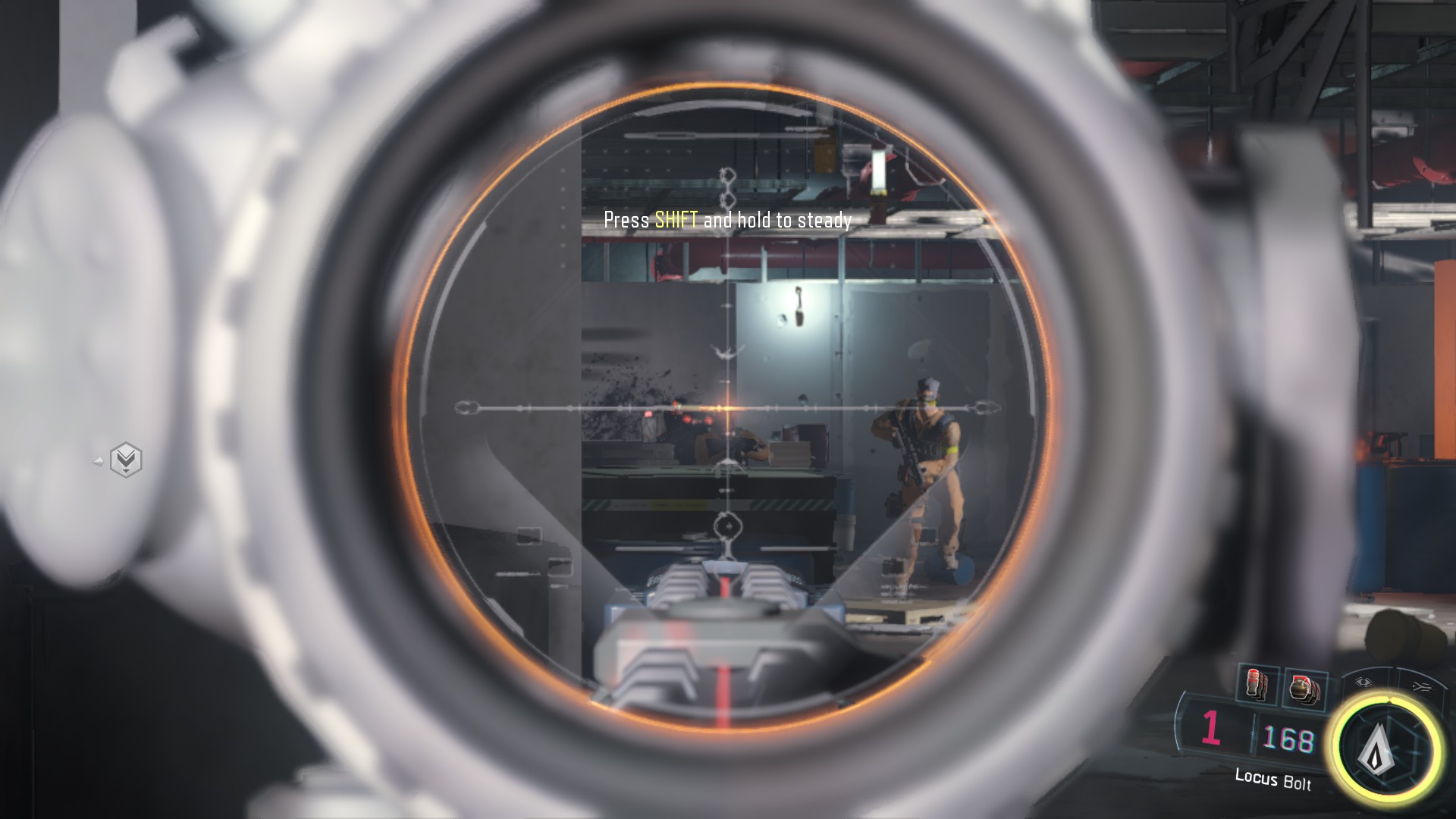
 

CALL OF DUTY: BLACK OPS III REVIEW – “I GUESS JETPACKS ARE BEST USED FOR SHARK-JUMPING”

So here we are. In the final week before THAT game comes out and my life is officially put on hold, I was looking for something interesting to play to tide me over to that point. Ooh, check this out – here’s a game about robot soldiers, rogue AI, cybernetic powers and the dangers of surveillance and augmentation. I guess this is that new Deus Ex game that – what? It’s Call Of Duty?!

And this is what it’s come to. The series has utterly given up on realistic warfare, and I say good riddance. For ages it did nothing but fumble about with dull shooting and half-baked plots, trying to recapture the magic of the original Modern Warfare, and I guess Activision have decided they’re done trying. Fair enough, but the problem is that they clearly aren’t sure what it’s being swapped out for.

2015-11-06_00029

Ugh. Modern commuting, amirite?

I wouldn’t bother recounting the single player plot in detail, because there isn’t much detail to it. Needless to say it’s embarrassingly cheesy and plays like a bad action film, but I find I’m not too bothered by this, at least not as bothered as I have been before. I wasn’t expecting much from the start, and at least it’s not coming down too hard on other countries or ideologies, edging away from the standard “Team America” nonsense in favour of a more personal story. This time the villains are a mythical terrorist group with a legitimate grievance, a rogue CIA hit squad and a loopy artificial intelligence that wants to destroy the world. Or save the world, I’m still not sure. All that really stuck with me is that it likes crows and has about as much relation to real science as a unicorn does to a stableyard.

But the gameplay’s been changed, and in ways that are suggestive of some improvement. The big new thing is jet-thrusters stuck all over the player’s body, which you can use to do cool tricks like wall-running, double-jumping and some sort of mega-powerslide that plays as if Jack Black had a firework up his bottom. It makes the combat more reactive, but the trouble is that the older mechanics are fighting this. I feel like BLOPS III can’t decide whether it still wants to be cover-based shooting or not, because whilst you can do all this Rocketeer insanity, all that usually happens is that you get shot out of the air when you try it. Maybe it’ll be refined with the next instalment, but for the moment it’s a step in the right direction, though the journey has barely started.

There’s also a bunch of technological abilities you can use on various enemies such as hacking robot drones, exploding the batteries in ground troops and controlling vehicles remotely. It reminds me a little of Watch_Dogs, but whilst Aiden Pierce would wave his smartphone like he had a genie on speed-dial to make the bullshit hacking nonsense work, the Black Ops player does a generic hand thrust that seems to cover all bases. It reminds me of somebody in Star Wars trying to use the force, and it has roughly the same level of realism.

Ah, well. It’s still more fun than just holding down a trigger and some of these new gimmicks are pretty satisfying. My favourite was a melee attack that allowed you to pull the battery out of a robot’s chest like the priest in Temple Of Doom, before throwing it at whoever was left whereupon it would detonate like a grenade. Yes, yes, yes. More of this, please.

2015-11-06_00036

It feels weird to do this without having recently thrown a jar of pee at someone.

You might have noticed that I didn’t give the hero’s name a little while back. Well, I would’ve if I could, but the playable protagonist in BLOPS III is nameless. I suspect the emphasis was on player self-projection, a suspicion that grew when I saw that you could customise the character, but Call Of Duty is clearly new to this idea because, without meaning to be cruel, it’s amazingly bad at it. Customising the player is limited to gender options and few preset faces that all look identical anyway, so it’s essentially a bone thrown to those who like to make their character look like a very specific kind of psychotic redneck.

But what about multiplayer, considering that’s what most people were thinking of when the game was announced? Well again, it’s moving in the right direction, but still needs a lot of refinement. The thing that always pissed me off about Call Of Duty was that the player was wearing half a dozen layers of battle armour and military detritus, yet none of it seemed to offer any protection whatsoever, meaning that you’re both ten square metres of grizzled lunkhead and also cursed with the durability of a bath bomb – a large and fragile target.

And sure, this applies to everybody, but it means that too often combat comes down not to skill, reflexes or even the savvy planning of your character loadout, but to the pathetic question of who saw who first. Even the most elite player can’t do much when a level 6 grunt pops up behind him with a full magazine of ammo in his gun, and that annoys me like you wouldn’t believe, because I’ve no idea what I’m supposed to do about it. Halo 3 (a game that I will forever hold up as one of the bastions of good multiplayer design) usually allowed you enough health and shields to give you time to react to an attacker (barring a few cheap power weapons). And that’s good, it allows for intense firefights and proper gunbattles, rather than reducing combat to a sequence of annoying ambushes that you could never be prepared for.

2015-11-06_00050

… I have absolutely no idea what I’m looking at.

But Black Ops III doesn’t seem to have realised that yet. The one major improvement is the increase in manoeuvrability, as all the jetpack abilities have carried over from the single player mode. So whilst you can do your best to evade gunfire, it’s only a small solution to a big problem and you’re still pretty easy to shoot as they haven’t done anything to make your character smaller.

I was also disappointed to see that the cyber-powers hadn’t made the transition from the campaign, but instead of those you can pick a sort of specialised ability thing that you pull out of your armoured trousers at certain points in the match, when the timer has clocked down far enough or you get enough kills to earn it.

These abilities vary hugely, but the problem is that they’re very poorly balanced. “Here’s a device that lets you see through walls for three seconds,” Black Ops III might gibber excitedly, “IS YOUR MIND BLOWN YET?”

“Sorry, did you say something?” We respond. “I was a little busy using this instant-kill area of effect attack that clears rooms like a sulphurous fart. Or using the flamethrower which destroys anybody in the nearest postcode.”

So it needs tweaking still, but I confess, I was having fun with it. Wall-running around like a scary Mirror’s Edge villain, kicking off into the air with my jetpack holding me aloft, then coming down guns blazing and bashing a guy’s head in with the butt of my rifle, that makes up for a lot of the shit that I had to endure to get there. In fact it more than makes up for it, including the poor server quality that kept spitting me out to the home screen like I was a fishbone in a bit of tuna.

And finally, what about Zombies? Frankly, it’s a mixed bag. There’s only one map so far, and it’s not very good, filled with extraneous, unexplained mechanics, annoying special enemies and an unintuitive level design that makes distinguishing the different areas annoyingly difficult. I also feel cross about the fact that it makes you leave all your kickass powers at the door. Yes, we know you’ve been enjoying this superb power fantasy, now let’s take away all your fun toys and give you a boring pistol to play with. Enjoy!

2015-11-06_00025

Is there something on my neck?

But I do like the aesthetic. From World War II Europe to modern Americana, the series has now picked up a strange mid-20th century Noir vibe, touched at the fringes by the influences of Lovecraft, in which you hunt around misty Gothamesque alleyways with strange occult symbols scrawled on the walls, as if Bugsy Malone had been invaded by Cthulhu. And the characters are nicely exaggerated and amusing, including a moustachioed magician played by none other than Jeff Goldblum, which was something of a surprise. So the whole place is dripping with atmosphere, but it still needs work mechanically.

And that’s kind of the point. My overall opinion of Black Ops III is that there are some good ideas here, but they feel rushed and like Treyarch weren’t trying to fulfil them as best they could. The single player is uninspired, the multiplayer mode is hampered by petty niggles and cheap deaths, and the zombie co-op needs some fine-tuning to bring it to its full potential.

And yet, I do want to go back to it, because there’s enough meat to hold all these things and carry them through to the positive side of the coin. And at the end of the day if a game makes me want to keep playing it even after the review is done, it’s got to be doing something right. Call it a resounding “just about good enough” and we’ll say no more about it. Deal?


7/10
Black Ops III is rough around the edges to an almost aggravating degree, but the exciting movement mechanics and suggestion of innovation to come does enough to make it worthwhile.

MODS FOR MONEY MAKES FOR MODDER MADNESS

Took a while, didn’t it? Well, I said it would. That’s poor management for you.

Last time (well, before that Sunless Sea bit) we took a look at Valve’s Steam Store and the less-than-exemplary way in which it’s run, at the end of which I hinted at the big faux-pas that was made recently. Have you worked out which one it was? It wouldn’t surprise me if you have, partly because the title gave it away.

Yes, it’s the paid mods débâcle. Earlier this year, with little-to-no warning, Valve suddenly threw this concept at the wall to see if it stuck. Starting with the absolute personification of modified content that is Skyrim, modders could use the Steam Workshop to distribute and charge for their creations. A cut went to Valve and to whatever game you were modding for, and that was basically it.

Which was sort of the problem, that it didn’t seem to have been thought through any more than that. Mods are a big part of the gaming ecosystem, they’ve existed almost as long as video games themselves. Even Tetris was a soviet invention made by a man just fiddling about with computers to see what they were capable of. And when mods exploded in the late 90s and early 2000s with the proliferation of the internet, a basic system was worked out through trail and error – one based around user love and charity.

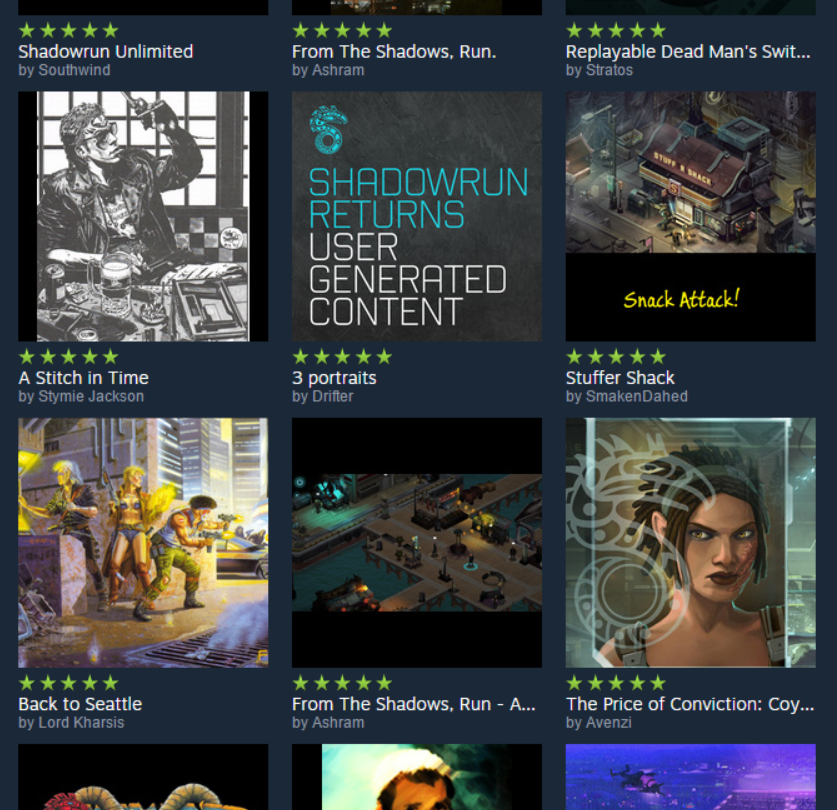
No, really. The mod community has always looked to me to be one of the healthiest and most admirable aspects of gaming culture. For years people worked on some of them and many were absolutely superb, whether it was fixing a broken game (like the PC port of Dark Souls), or tweaking something so well that it’s almost mandatory to use (like SkyUI), or even just adding hours of content like custom missions for Fallout or Shadowrun.

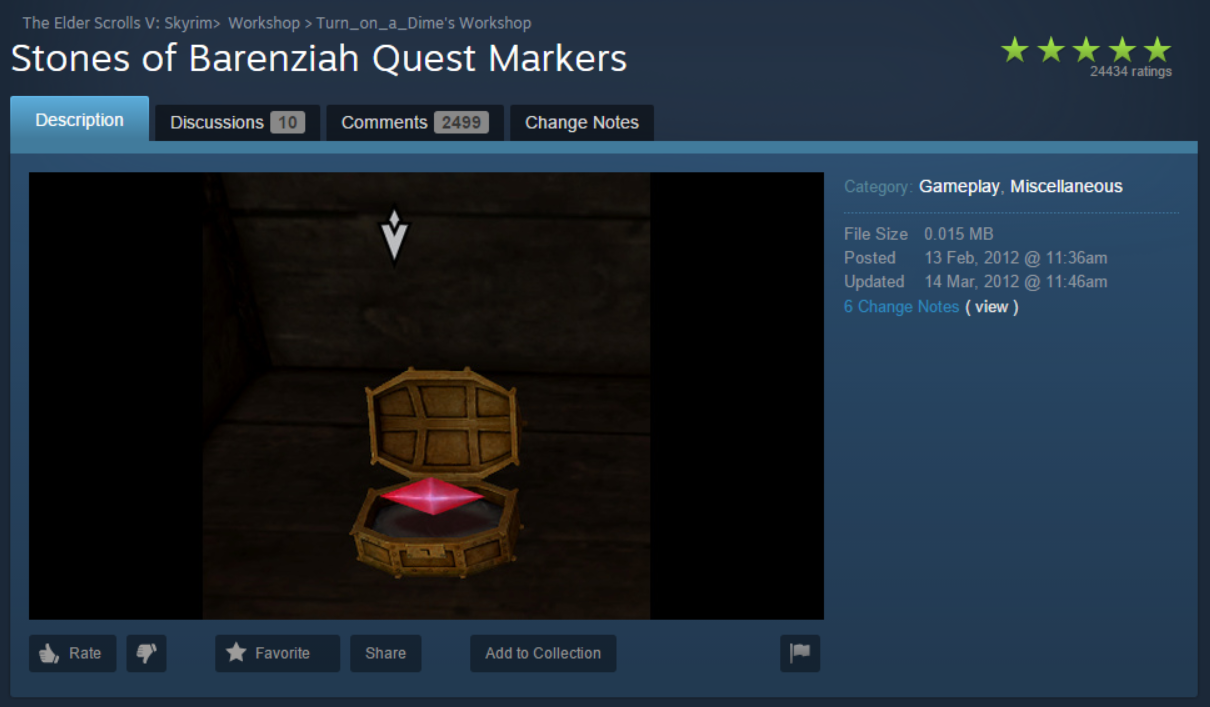
SOBQM Mod

No more walkthroughs for me! Now I actually have a chance of completing that sodding quest!

And throughout most of this, money didn’t really come into it. Occasionally people altered something to the point where they thought they should charge cash, like Arma II getting morphed into the far more successful DayZ, but generally the only profit made was through donations to the creators by contented users. It wasn’t perfect, but it worked pretty well.

But then Valve suddenly walked in and unintentionally sabotaged the whole thing. If mods are an ecosystem, then the Paid Mods Scheme was the hunter that walked in and started shooting lions in the hope of selling the fur.

Not that you couldn’t see the logic that was being implemented, or even a few of the good intentions. If a person creates something amazing then that person probably deserves some sort of reward, we can all see that. A lot of the examples I’ve mentioned were made by people who have certainly earned some sort of thanks for what they’ve done, regardless of what their motivations were.

Except that the problem is that people don’t always create their own mods, or at least not all of them. A lot of them borrow from other people’s mods and that’s where the trouble arises.

For example, if Tom is making a Minecraft “Improved Physics” mod, then he might see Harry’s “Super Realistic Water” add-on and think, “Ooh, I’ll ‘alf-inch that, put it in my one.” I don’t know why he’s cockney, just run with it before I put a pimple Aristotle in your Chevy, you Bushy.

But then you introduce the fact that this mod is worth money and things get complicated, as they inevitably do when you put a price tag on things. How much money does Tom owe Harry? Harry’s mod was being offered for free, but now they have value, what changes there? Does Harry have the right to take his work back and stop Tom from using it at this point? How have things changed legally, is there an argument to be made for theft of intellectual property, or is this a free-use affair? Will Harry have to send the boys to Tom’s house with a couple of baseball bats and make him a raspberry if he’s not willing to hand over enough bees and honey to settle this?

Bloody hell, what’s with me and Cockney rhyming slang today?

Shadowrun Mods

So much content, so little time…

Actually, it was whilst I was looking up these ridiculous phrases that I couldn’t help but notice that the slang for a mug, a fool, is “Steam Tug.” So if somebody’s being foolish, you’d call him a “Steam.” Funny how these things turn out, isn’t it?

Within days of its existence the experiment had shown its results. Modders were pricing their work too highly or scamming users for cash, confusion arose as various creators tried to work out what was owed to them, and the public had suddenly become cynical and suspicious over something that had once been a forum of collaborative efforts and enthusiasm. Awareness of the whole cock-up was raised with parody mods like “realistic horse testicles for $99.99” and so on. Just because you’re being socially aware doesn’t mean that you have to be mature about it.

Valve cancelled the whole thing and returned all the money, trying their best to fix the mess that had been made, but it’s hard to see how it could’ve gone any differently. With no obvious warning or major testing of the process beforehand, they’d basically gone out and thrown a baby bird off a cliff to see if it could fly – and it really, really couldn’t.

But as mentioned, I see why it would make sense in theory. Though that being said, I do think there was a little much of the “dollar signs for eyes” syndrome going around – the cuts taken by Valve and the publishers seemed to me to be a little much, especially when there are websites for this sort of thing that the modders could just go to instead.

There’s been rumours lately that Valve would like to reimplement the paid mods system, albeit structured very differently, but I really don’t think they should. They’re messing with something that already works, that doesn’t need alteration. Users will pay for things that they like, they’ll fund things that make them happy. It’s why Patreon and Kickstarter have been as successful as they have, because we understand that effort deserves reward. And the mod community is fine and will continue to do fine, at least until somebody throws a spanner in the works. The way the game industry works, that shouldn’t be too long from now.

SUNLESS SEA REVIEW – “WORTH A PUNT”

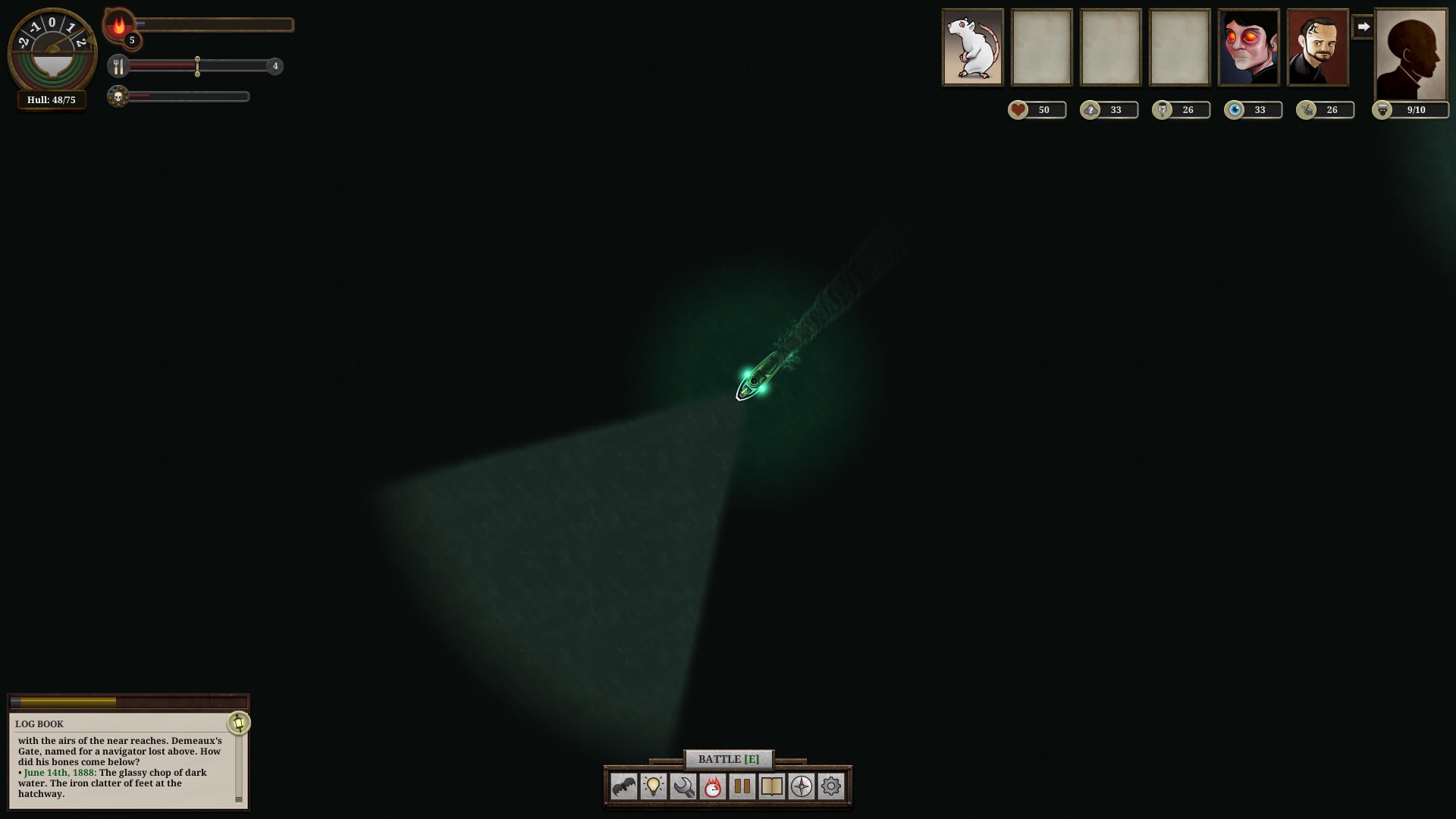
It’s been a while since I last saw the pirate ship, escaping it by vanishing into a thick cloud of fog which my trawler’s headlamp can’t even begin to penetrate. My engines exploded some time ago when I pushed them beyond breaking point in a moment of panic, and the resultant fire killed three members of the crew as it tore the hull to shreds. There’s talk of mutiny among the survivors, not helped by the decreasing rations and how far we are from land. Unless I can get them some shore leave or make a diplomatic home run, they’ll turn on me, and my body will be the first thing to go into the cook’s broth.

But I’m in uncharted water, and for all I know there’s no land for miles. Praying to whatever cold and ancient gods are listening, I take a trained zee-bat (a scrawny little rodent, but dangerous in hordes) and release it, hoping for some answer, hoping that it comes back with an olive branch, hoping it’ll find some sign of the civilisation we left long ago.

But what use is hope here?

Sunless Void

Is anybody out there? Are we even sure if we want that?

This is just one of the events that can plague you in Sunless Sea, perhaps the most original idea this year and set in the same universe as Failbetter Games’ previous title, Fallen London. Sunless Sea strikes me as what you’d get if you merged FTL: Faster Than Light and Darkest Dungeon, as it’s a rogue-like exploration game with an emphasis on psychological horror, resource management, unbelievable difficulty and a set of randomly generated oceans to explore.

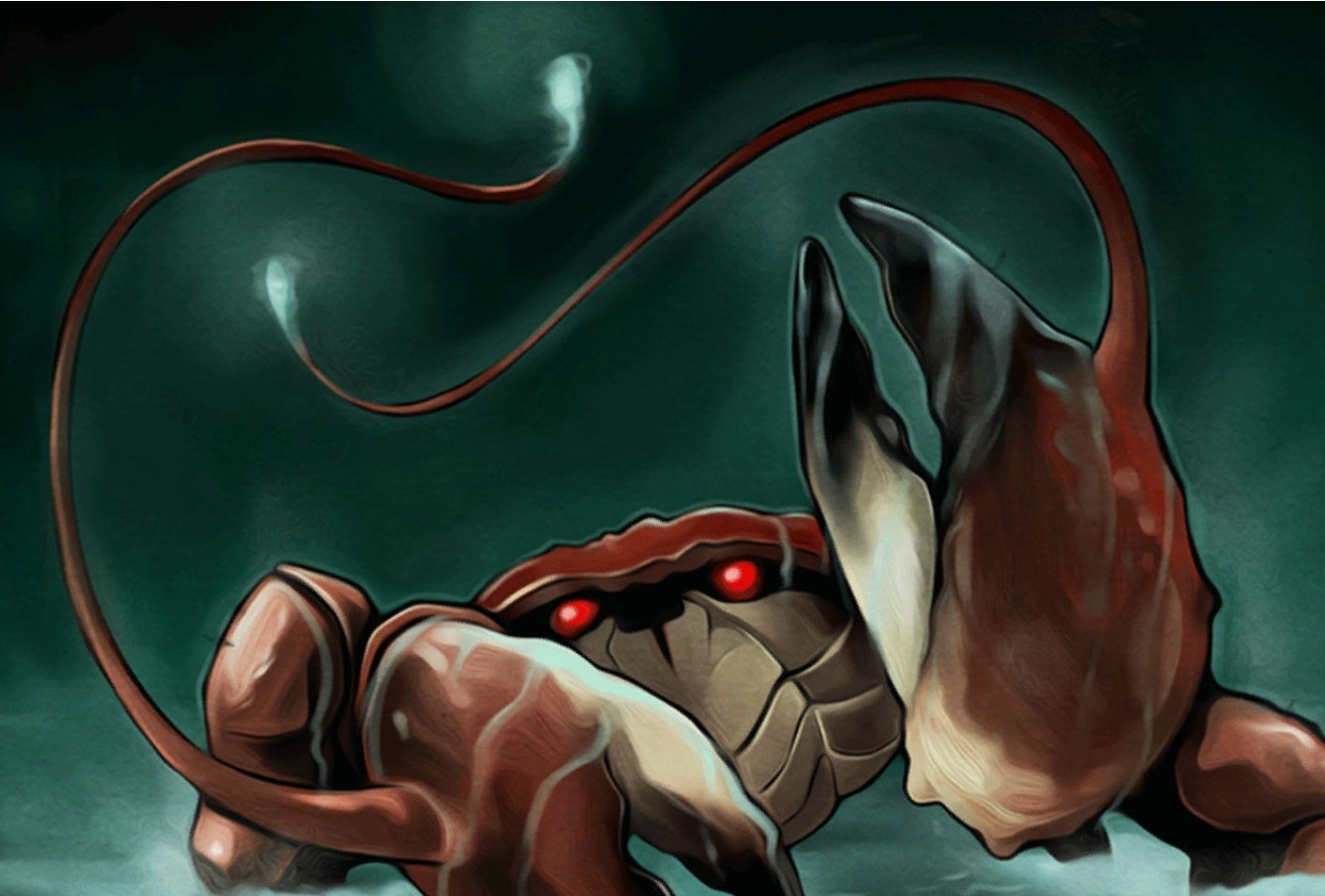
Well, randomly generated to an extent. The islands are always the same, but they’re shuffled around like a deck of cards each time you die, which came as something of a shock as the game doesn’t tell you that this is happening. When Captain Joel Franey III was sunk by a giant crab and eaten, his intrepid son Joel Franey IV decided he’d use his dead father’s knowledge of shipping routes to make some mad bank early on. Only instead of finding what should’ve been a bustling market harbour, he ended up bobbing on a featureless section of ocean, a section of ocean containing a gang of bad-tempered eels who had woken up on the wrong side of the coral and were just waiting to kick the shit out of some poor passer-by.

But death’s a big part of it and not to be ignored. Every character you make has different stats based on what their job was and what they want from life, and if your previous captain had money and sense to write a will, then your upgraded ship can carry over to the next guy, albeit with a sizeable deduction in cash to pay the sodding lawyer’s fees.

It’ll take a while to get to the point where you have anything worth leaving to your ancestor, though. Perhaps the most glaring flaw in Sunless Sea is the incrementally slow progress of… Well, everything. All the missions have about a billion stages to them, money comes slowly (if it comes at all) and even the basic act of movement is like watching a slug drag itself across a blue linoleum floor. To make matters worse, if half of your crew is killed then your ship starts moving at half the maximum speed, and considering you weren’t exactly going like lightning before, this just makes it torturous.

I assume that this mechanic was implemented to make you extra protective of your loyal sailors, but dangerous events can come out of nowhere and often take a bunch of able-handed men down into the briny blue. At one point I got jumped by cannibal pirates when I was exploring a tropical island, and my only real option was to fight back, which went less than superbly. Five of my men died then and there, leaving me alone with the ship’s cat, a navigator who would’ve made Iago look trustworthy and some useless bumblefuck who probably couldn’t pick his nose without poking his eyes. It took almost ten minutes of slug-sailing to get back to the one port where I could load up with Redshirts again, whereupon one of them immediately went bonkers and started beating the rest to death. Maybe she was disappointed by the rations, I don’t know, but it was hard not to feel irked by the whole thing.

Frozen sea

“And tell the lookout to stop singing “Let It Go!” I warned him three times and it’s starting to effect morale.”

But I suppose it adds to the incredible atmosphere, because it’s in that department that Sunless Sea shines, paradoxically enough. I didn’t make that early comparison to Darkest Dungeon and FTL lightly, as it’s not just sandwiched between the two when it comes to mechanics, it seems to occupy the chronological midpoint between future and fantasy – a highly fictionalised version of the industrial revolution.

Slap-bang in the middle of the Her Majesty’s British Empire, the mighty jewel of London is pulled beneath the earth, into a subterranean chasm that stretches on for hundreds of miles colloquially referred to as “The ‘Neath.” There are already weird creatures living here though, including dangerous gods, mercantile devils, mysterious families and colonies of bandaged undead. And far out, beneath and beyond the waters of the enormous ocean that occupies most of this cavern-covered land, worse things are lurking, hungrily waiting for the unsuspecting fools who explore the waves to release them from their aquatic prisons…

If all this sounds really fucking cool, that’s because it is, reading like somebody took Alan Moore’s “League Of Extraordinary Gentlemen” and had Cthulhu stamp it through to the earth’s core. A captivating blend of bleak gothic steampunk, swashbuckling old-time adventure and Lovecraftian horror watching from the fringes whilst breathing through its nose, but it all gels together excellently without seeming schizophrenic and becomes something really special for it.

Well, except for one embarrassingly out-of-place mission that has you brokering a peace between talking rats and guinea pigs. Yeah, it’s as silly and childish as it sounds. Considering that I’d just been trying to talk my men down from suicide and had been constantly avoiding unknowable horrors up to that point, coming up on a rejected screenplay for Stuart Little was about as tonally off-putting as arriving in the land of the Teletubbies. Not that it was poorly written, but it didn’t have a place in a game where you have an option that allows you to eat each other.

Another flaw that strikes Sunless Sea was also made fairly evident by that mission sequence – the incredibly frequent text dumps. As a student of Literature it’s probably wrong of me to say this, but there is such a thing as too much reading. In certain quests you can show up at a new location, all bent on danger and derring-do, only for a large book to be thrown bodily at your face and told you can’t have fun until you’ve done your homework. I’m sorry, I thought we were supposed to be having a chilling, thrilling adventure on the high seas, but you seem intent on making me read War And Peace. What happened to show-don’t-tell? I found myself skimming these enormous chunks of text before too long, what with so much of it being flowery prose. Again, it’s not badly written, there’s just too much of it in too densely-packed quantities. FTL remembered to keep its written stuff in short, punchy statements, and knew to let the visuals do a great deal of the talking.

Sunless gloom

Well, that’s cheery.

And there’s no reason why the same can’t happen here. The whole of The ‘Neath and its perilous “Unterzee,” they’re both realised in staggeringly gorgeous detail with beautifully rendered images. The people are pictorially charismatic, reminding me of Dishonored with their exaggerated features and a style that verges on cartoonish without ever becoming comic. The overhead images don’t lose any beauty for their being seen through a bird’s-eye-view, as you pass frosted fortresses, beautiful mansions, blood-splattered cathedrals, the forges of Hell and a hundred other captivating landscapes. They’re not just well-designed, they’re gorgeous in their portrayal and endlessly inventive. And whilst I don’t know enough about art to say whether a lot of these locations were hand painted or not, they certainly look good enough to give that impression and it comes down the same thing for the viewer. Add that to the haunting musical score, and you almost feel ready to start humming some mournful sea-shanty along with your despairing sailors. Well, what’s left of them.

But I realise now that I haven’t really talked about Sunless Sea’s mechanics in detail, and that’s because there isn’t really a huge amount to discuss, as it’s pretty minimal. Gameplay takes two forms, either pootling around in the water firing projectiles at bad guys (which you’d be wise to do as a last resort, as you’re generally pretty weedy) or sorting through text boxes looking for the best way to manage your money, resources and ever decreasing morale.

Yum yum

Get the lemon and mayonnaise, boys! If we survive, we eat well tonight!

And as you meander through the wordy stuff on land, you’ll frequently come across options that are closed to you, at which point you piss off to find whatever metaphorical key opens that metaphorical lock, in classic adventure-game style. So if Johnny Bignose wants a new set of handkerchiefs to replace his old ones, you’ve got to go out and find a set before he’ll give you the Sacred Cross Of Saint Kleenex, or whatever it is you need from him. And whilst this can be a little problematic with the labyrinthine map, they do tend to give you a general direction to go in. And even if they don’t, you could always go and do another mission instead and see if you come across those precious sneeze-rags along the way. After all, the world is your oyster. Well, maybe not an oyster. Perhaps one of those giant clams that grabs your leg and holds you underwater until you drown.

Sunless Sea could still use a bit of work, especially mechanically, but it’s genuinely gorgeous when it comes to the trademark sense of wonder and dread. You’ll always want to see what lies a little bit beyond the horizon, and a little bit further and further still, and then the world will suck you in before you know what’s happened. It should also get your attention if you like games that are happy to punish you for every little mistake; the calling card of the rogue-likes as well as don’t-take-no-nonsense titles like Dark Souls, Hotline Miami and Amnesia: The Dark Descent.

If you want something to do this weekend, lose yourself in Sunless Sea. Lose your money, your way, your crew, your mind and your life. Lose everything you have to the vast evil of the ‘Neath. It’ll all be worth it.


8/10
Though it suffers from an agonising lack of haste and a general lack of imagination in the mechanics, there’s very few video game worlds that are so deep, so creative, so atmospheric and dripping with personality.

WHEN STEAM TURNS TOXIC

Today I’m going to suck air through my teeth, make little whimpering noises at the back of my throat, and do something that goes against every urge in my body: I’m going to criticise Valve. That company that manages to be both successful and profound in their work, that balances originality and classic elements within their games, that has redefined major genres like the first-person shooter, the puzzle game and the online MOBA. I’m going to look them straight in the eye, summon my strength and say “come on, buck up.”

Brrrr. I feel slightly dirty writing that.

But I’m not criticising their games today, I’m talking about something very different: their infamous Steam store. As the most popular method of downloading games that there is, Steam is something of a must-have for anybody who owns a PC and uses it for anything more entertaining than Minesweeper.

And there’s a lot to like about Steam, I won’t deny that. It wouldn’t be as big as it is without being good at what it does, and it’s not hard to see why people flock to it. It’s got a good user interface, a huge library of games, regularly holds sales that allow you to buy them at low prices and incorporates interesting extras like mod workshops and a community market. It’s got more pros than a Vegas brothel, but like a brothel you’d be wise not to approach those in a management position. You’re also terrifyingly prone to viruses, being financially scammed, witnessing offers from those who are worryingly inexperienced, and just being disappointed with your purchases in general. But anyway, what did YOU do last weekend?

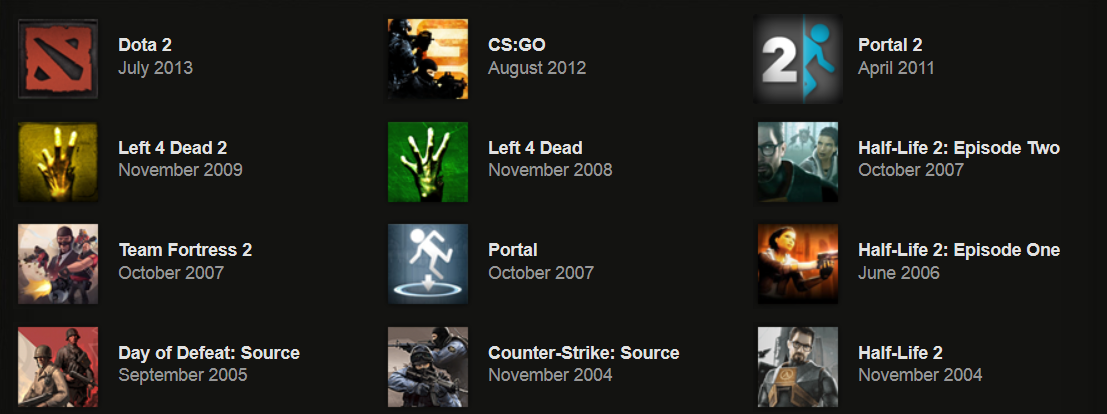
The thing is, Valve seems to enjoy the “hands-off” approach, tweaking the Steam formula occasionally before sinking back into the shadows to see what happens, and this is a problem when you’re running a system where a hell of a lot of money changes hands. You can’t set up a system this complex, nuanced, popular and open to manipulation, and then just ignore the whole thing.

Valve history

I’m sorry… I’m so sorry…

Because this can lead to some serious issues. There’s been many cases of misrepresented games on Steam, releases that lied about their content in order to get people spending. And whilst that’s neither Steam’s fault, nor a problem that plagues it exclusively, in most other cases the host platform gets involved and takes it off the marketplace. After all, these incidents effect Steam’s reputation too, especially when they’re on there for a while.

And boy, the incidents are really starting to pile up. Valve appears to have no interest in quality control, allowing anything onto Steam and only removing it when enough of a fuss is kicked up. There have been games which publishers lied about in their marketing (Aliens: Colonial Marines), games that were basically unplayable at launch (Batman: Arkham Knight) and games that were using asset packs and other people’s content without permission (take your bloody pick on that one).

And in all these cases, Valve didn’t do a thing. They sat back and went “not my problem.”

Isn’t it? For god’s sake, at one point somebody was distributing malware and computer viruses through your system, claiming it was a demo and sitting back to watch people’s hard drives melt. Not only that, but it was using someone else’s game as a trojan horse to hide it, so it’s both cyber-vandalism and a copyright scam.

And Valve stepped in, eventually, but it took a while and the damn thing never should have been up there in the first place. There needs to be a vetting process where they can see what’s valid and what isn’t, before the consumer has to find out the hard way. If you’re asking us to put our faith in your store, you need to have faith in it yourself and make it safer to use, or at least start cutting out those games that don’t deserve to be up there.

Steam Error

There’s also the occasional technical glitch. Or that Starbucks router was touched by the finger of god, either one.

And what about Early Access? For those of you who don’t know, the Steam Early Access program is another of those ideas that sounded fine, at least before people abused the shit out of it and reduced it to the embarrassing mess it is now. Developers can upload basic alpha models of their games in order to raise support for them, and those who buy these prototypes will have them updated for free when they’re finally finished, funding the developers in the meantime.

The problem is that the costs of this method can often outweigh the benefits. Whilst there have been success stories like Darkest Dungeon and Speedrunners, both interesting and innovative concepts that broke their respective molds to a certain degree, there’s also quite a lot of… Well, flotsam and jetsam.

Early Access games sell themselves on promises, sometimes charging the player the price of a full game (or more) and claiming that it will all be justified in about a year when it’s finally evolved to what it should be. The idea is that the creator can use those initial funds to finish crafting it, but that’s often not the case. Some games remain in a sub-standard limbo, never escaping the cocoon of mediocrity or even mending the broken butterfly wings of non-functionality. Other games might take a surprising direction and turn into final products that the players might not like, but were deceived about with the early claims.

The danger is that people use Early Access as an excuse to get away with games that are essentially unfinished. And whilst in some cases (like the aforementioned Darkest Dungeon) you’ve essentially been given the full game but with some minor balance tweaks and additional content waiting in the wings, other times these things are nigh-unplayable and likely to stay that way for a very long time, maybe indefinitely. We’re not talking weeks, we’re talking months or even years before you might get the final version of Nippletweak Simulator 2015 or whatever, and that’s without knowing if it’ll have the features you were hoping for, like climate control and a full range of clamp and tassle customisations.

The only real upswing that Steam has had recently was the introduction of refunds, and that’s not really a thing they should be too highly praised for. All that happened was that a highly profitable retail agency allowed a basic right to their customers, a right that’s existed everywhere else for decades. For my two cents, I’m still not hugely satisfied with the rules it currently uses for reclaiming your money, but it’s a step in the right direction and better than nothing, which is what we had before.

Though even the new refund system isn’t being managed properly – I happen to know that people started downloading tons of games as an experiment, playing them for as long as possible then requesting their money back before they reached the limit. Once again, Valve didn’t seem to notice anything was wrong and allowed this to happen. Wah, wah.

Oh for fuck's sake

OK, this isn’t funny anymore.

I suspect it’s just easier in the long run to stay out of the public eye and not do anything to raise attention. It’s cheaper, simpler and harder to pinpoint. After all, a person who does nothing can’t be condemned for their actions, because they haven’t made any.

Except that’s not really true. Inaction is a choice on its own, and it’s starting to look like Valve don’t care about what Steam is becoming – the dumping ground, the video game landfill. Where you can’t find one good indie game without having to drag yourself through a hundred shit ones, where you can’t trust the sarcastic review scores, the associated descriptions, even the games themselves, for fear that you’re being deceived in some way. Rules aren’t any good if nobody’s enforcing them.

There is a second half to this piece of writing, one concerning the most interesting controversy that Steam had this year, but I’m sorry to tell you that this article is actually in Early Access, so you’ll have to wait until next time. If you’re lucky. Or maybe I’ll be reviewing something instead, you just don’t know. Welcome to the joys of Early Access and poor management. I can’t even be bothered to pay the internet bill, so it’s fairly likely that this will – CONNECTION LOST.

PAY A LITTLE, LOSE A LOT

Microtransactions are never acceptable outside of a free game. No no no, don’t fight it. You don’t have a leg to stand on. Not now, not any more. That ship has sailed, and come back filled with spiders, used needles, avocados, exercise bikes, all sorts of nasty things. And now we need to sink that ship before it turns on us and those that fed it, and also before this meandering, mixed metaphor makes itself any more messy and muddled. Capiche? No, me neither, so we’ll take it from the top.

Like so many things in the games industry, this is one of those concepts that should be fine, at least in theory. There’s nothing inherently wrong with the idea of a free game having little elements for which a person can pay. Not only can it work, it has worked in the past. Games like Loadout, Fallout: Shelter or Team Fortress 2, they all offer full game experiences that can be enhanced by putting in a little cash for the developer’s benefit. That’s OK, that’s fine. A small donation to the creator that benefits both him and you, I can boogie down with that, that’s groovy, cool beans, super fresh and so on.

That said, there are limits. Angry Birds 2, Dungeon Keeper Mobile, Final Fantasy: All The Bravest, The Simpsons: Tapped Out, they’re some examples of games that took it too far. Not only did they desecrate the legacy of their franchises in order to try and make a quick buck, the model they used was insulting. Essentially, they handed out free software which did bugger all, and in order to “progress” you had to start renting gameplay with real money.

You didn’t get a whole game, because then it would be a demo, and considerably more reasonable as a concept. No, when you shelled out your earnings you basically got to play for about five minutes more, before the whole thing yawned and went back to sleep. Sorry, you can either come back tomorrow or wave a bunch of fives under my nose to wake me up, like I’m a hooker with a gut full of sleeping pills.

Simpsons tapped out town

Come for the gameplay, stay for the outrageous attempts to rob you!

Come on, people. It’s not hard to find that line between reasonably-priced extras and obnoxious paywalls, and I can’t help but think that the more player-friendly option is the best one, even on a financial level.

Why? Because nobody played Dungeon Keeper Mobile and All The Bravest for long. They were so aggressive in their need for cash that people got bored with them fast. Whereas all the games I mentioned positively are doing fine, in some cases they’ve flourished! Fallout: Shelter has, in the few months since E3, made enough money to actually fund a Bethesda-sponsored nuclear apocalypse.

But all the purchases in that game are still for minor things, they’re just little lotteries that give you a random selection of loot and resources. These lotteries aren’t even limited to paying customers, you can get them by completing in-game challenges and you don’t have to pay a bean. But people did buy them, because the game was fun and they felt invested. What do you know? People who like a product will pay for it even if they don’t have to, that’s the power of customer respect.

But here’s the big question – do microtransactions have a place in priced games? Dead Space 3, Mortal Kombat X, GTA V, they all have them, but the key is determining the difference between regular DLC and a microtransaction. That said, there is a very obvious clincher for me – permanence.

When I download, say, “Tiny Tina’s Assault On Dragon Keep” for Borderlands 2, I’m definitely getting DLC. That content will always be available from that point, it will never run out or deplete, there’s no ticking time bomb programmed into it that will force me to buy it again.

But microtransactions aren’t like that, because they usually have a built-in limit. They’re most often something that can be burnt up or used only once, like the jewels in Pokemon Shuffle or the easy fatalities in Mortal Kombat X. Once you’ve bought them and used them, there’s no way to get them back, you can only buy more, and this annoys me like the dickens. In most cases they’re simply ways to reduce challenge, which cheapens the experience and basically puts the player in a position where you can pay the fucking game to play itself!

Mortal Kombat cold balls

In Raiden’s fatality, he just snaps his fingers and has a butler beat you to death with a wad of money.

The issue with usable resources in any game is the regularity with which they appear, and you know that in a game where you can pay to get more of them they’re going to come up slowly. The developers want you to get impatient enough to fetch your credit card, and tease you with incrementally slow progress to hammer home the necessity.

Not that this happens only in the paid games, it happens in the free ones too, but there’s a kind of understanding there. We know that there’s a psychological struggle to balance out the fact that the game is free, that we’re going to get pestered for money every now and then to cover the costs of production. If it’s too craven and desperate it can be a turn off, but in small amounts we’re willing to put up with it.

But it’s more than a little aggravating in a fully-priced game, not least because the games are so often structured to force you towards them. I found GTA Online to be a fairly nasty example of this, as it reduced the rate at which you earned in-game currency to an absolute crawl, all the time taunting you with amazing items that only the most committed, dead-eyed maniac would be able to earn the cash for.

Or, you could skip all that and hand over forty bucks, at which point Rockstar will plop a sack of digital dough in your lap and say “well done for playing the game your way!” Meanwhile, all the others who are desperately capping people for pennies in the next street over don’t have a chance, when Richie Rich can just drive up in a golden tank, or call in his personal chauffeur to drop off a harrier jet to obliterate them with.

Loadout suggestive pose

I’m not going to make any jokes here. It would be too easy.

That’s what bugs me most, the unavoidable nature of these things. It’s not good saying you can ignore these microtransactions, like some reporters have claimed, because so often now the games are created around them. “Oh, it gives you options, it allows you to progress at your rate.” No, it doesn’t! The creators push them as hard as they can, they penalise those who deny them and keep trying to inconvenience players who want to do without. That inconvenience wouldn’t exist if they hadn’t put it there, they’ve driven a spike into your horse’s leg and told you that you can hire them to remove it – for ten minutes at a time.

So microtransactions cheapen the art they’re built into, anger savvy players whilst scamming the less experienced, and twist their host games so that they always lead back to that paywall. DLC is fine (in theory at least, you can still get badly made or poorly priced DLC), and microtransactions are a justifiable evil in a free game if they’re kept in the background, but there isn’t an excuse any more for putting them in expensive, AAA games. Or indie games. Or any games. Or anything ever. Basically, fuck off.

METAL GEAR SOLID V: THE PHANTOM PAIN REVIEW – “NOPE, STILL CAN’T TAKE IT SERIOUSLY”

Whilst I’m always annoyed when I come in on the tail end of a trend, I do think it’s given me a healthy amount of emotional distance in this case. The only other Metal Gear game I played before this one was Metal Gear Rising: Revengeance, which actually managed the Sisyphean task of having a plot that was stupider than the title.

But this is apparently one of the things people like about Hideo Kojima and the Metal Gear franchise: the inherent weirdness of it all. I can definitely say that this aspect has carried over into the newest installment of the franchise (and most likely last installment, now that Konami is trying to see how many shotguns it can fit in its mouth), The Phantom Pain.

It suddenly struck me just how absurd the plot was when I tried to recount the prologue chapter to a friend, only to look back on what I’d been saying and realise that it wouldn’t have looked out of place scrawled in crayon on a padded cell wall. The whole game plays like a bad 80’s action film being adapted for anime, and the tone wobbles to an alarming degree. I’ll say it now, a story that features an intro sequence with militarised death squads gunning down unarmed civilians and has a scene where a man is tortured by having his leg bent the wrong way? That is not the same story that should contain hidden fart jokes, shameless attempts at eroticism and cute puppy sidekicks in quirky costumes. It comes across as vaguely psychotic, quite frankly, and it’s all played way too straight to be anything other than intended to be taken at face value.

Let’s not deceive ourselves, this game doesn’t have hidden layers that we can’t see. It’s not a devastatingly ironic take on the absurdity of AAA video game writing. No, Kojima is just bonkers and it shows when he picks up a pen.

MGSV Lion king

I think Snake’s been watching the Lion King once too often.

These last few paragraphs have probably put me on the kill lists of the thousands of Kojima fans who would rather burn their Japanese love pillows than hear one word against his ridiculous dialogue, but remember, what seems normal to the locals always seems baffling to outsiders. Yes, Hideo Kojima deserves some respect for basically being one of the first people to try to get really complex storytelling into video games, but whilst the idea was a superb one, his execution has always left a lot to be desired. It’s like the works of Suda 51, only not satirical and self-aware in the least.

So let’s study the story. In Metal Gear Solid: The Phantom Of The Opera, you play as a legendary mercenary named David with a series of codenames, affiliates and missions that he stole from unsuccessful male porn stars, including Solid Snake, Liquid Snake, Naked Snake, Big Boss, Snake Eater, and possibly Susan if I can just get the paparazzi shots to prove it. This week he’s clearly discovered S&M, because now he’s going under the moniker of “Punished Snake,” and all that kinky foreplay has taken its mark, because his mug is covered in scars and cuts that would put somebody with their head in a blender to shame.

At the end of the previous game, Ground Zeroes, Snake was blown up by an evil villain named Skull Face, who is named this because his face is a skull. Guess Kojima was worried that his legendary subtlety might be too cryptic for the audience, so just to confirm that this twat is the bad guy, he gave him a cartoon bank robber’s mask, put him in a funereal black suit and stuck him in charge of an evil organisation named Cipher. It’s a bit like if a rejected James Bond script was being adapted for kid’s TV, but with the kids employed as the writers.

MGSV Batman

“Ooh, Let’s do that bit from the Dark Knight movie! Come on, it’ll be hilarious!”

So Skull Face (presumably the father of the Majora’s Mask antagonist) has an army of soldiers, robots, superzombies and giant mech-suits, which he uses to generally bother people and be a nuisance. He also monologues at Snake from time to time, who always politely sits and watches, instead of doing the smart thing which would be putting so much ammunition inside him that the bullets could be melted down to make a life-size statue of the bastard.

Meanwhile, Snake has been in a coma for nine years, until his surgery comes under attack from a clown kid in a gas mask and a man made of stitches and fire. They hassle him for a while, until he’s saved by the incredible Bandaged Man and his all-too visible backside. Then these new BFFs crawl around for a bit, until your new mummy chum runs over the human torch with an ambulance and Snake escapes, before being saved by a cowboy from a sudden attack by a falling blue whale and a fiery flying unicorn. The cowboy then brings him to an oil rig before they stick a robot arm on him and polish the horn in his head. No, I’m really being serious, and that’s just the first level.

Snake must now use what little is left to rebuild his life in the form of a mercenary organisation known as the Diamond Dogs, which incidentally sounds like a particularly camp pet salon. They set up their base of operations on the aforementioned oil rig and use their resources to make the best private army possible, and that’s where the gameplay, which until now has been snoozing in the back seat of the car, suddenly jolts awake and is allowed to drive.

And it’s good gameplay, very good gameplay, which does more than enough to balance out the embarrassingly awful story, much like Revengeance before it. But unlike Revengeance, which was all about hacking enemies into pieces with your sword, The Phantom Pain is a free-roam game with an emphasis on stealth, reconnaissance and nicely organic methods, kind of what you’d get if you merged Red Dead Redemption, XCOM and Far Cry 3. You horse around the desert before coming up on a stronghold and use whatever methods you like to take out the Soviets inside. Then you use the rewards (including the terrified soldiers and wildlife you fired into orbit) to revamp your base and equipment to be more prepared for the next mission.

Yes, this is where the story about giant robots, superzombies and clown kids gets weird, because Kojima has discovered the Fulton Recovery System, or at least some magical version described to him by a six year old. If you come across a lose object or living creature, you can strap a balloon to their chest which rockets them into the sky, where they are apparently picked up by your mates and brought home, at least if they haven’t been taken out by a commercial jet along the way.

MGSV Human Torch

“Sniff… I can kill a man by looking at him and survive a missile to the chest… And yet, I cannot love…”

Despite the silliness of it all this is actually a very good mechanic, because it gives you an incentive not to use lethal methods. If you get a reading that the commanding officer in a stronghold can break a man’s neck with his nipples, and you decide you’d like him and his nipples to join the Diamond Dogs, you can knock him out and have him recovered from thirty thousand feet, hanging beneath a hot air balloon and trying not to wet himself. Then he’s brought back to the lonesome, inescapable oil rig, whereupon your allies presumably hit him with sticks until all that pesky patriotism and loyalty to his country has worn off to the point where he’s willing to sell his killing skills to the highest bidder. What heroes we are!

All joking aside, this is a very good concept and I’m glad it’s in there, but there are mechanics that I don’t feel so overjoyed about. There are always a hundred ways to deal with a problem, but I only really felt like using a couple of them, because they’re what I’m used to and usually much more effective than the others. MGSV keeps insisting I could snipe enemies from a distance or run in guns blazing, use my attack dog or the robot legs that you get after a while, but why do those things when they’re all noisy, lethal and you can’t get items or recover loot and enemies? I found that just throwing distractions and choking people out when they looked around worked fine, and I always had the tranquilliser gun for when things got crazy and I needed to drop somebody. It’s all a bit flabby and could have used a bit of streamlining.

The base management is good though, albeit with a terrible GUI that makes navigation a chore, but the two systems support each other well enough that neither one feels unimportant and it all escalates at a good rate, meaning that you don’t usually feel overpowered.

In fact, it’s hard not to feel invested after a while. Whilst the beat-by-beat plot points are batshit, the overall theme of building a private army by attaining resources, earning a name for yourself, kidnapping experts, making shrewd business choices and working out strategies isn’t a bad premise and the game handles it well. I was feeling pretty proud of everything I’d make for myself, from the barracks stuffed full of cheery soldiers, to the world-class R&D lab who had something new every time I came back from a mission, to the overflowing coffers and the mighty matrix of facilities I’d built with my own ingenuity.

Which is why it felt utterly, gut-wrenchingly awful that after twenty hours of solid work, the game crashed and corrupted my save, forcing me to start from square one and endure the rubbish prologue level once again. After making a noise not dissimilar to a jaguar being fed through a combine harvester, as well as eating one of my pillows in abject frustration, I managed to calm myself to the point where the police felt they could leave me alone without issue. Konami strikes again with their relentless commitment to perfection, it seems, and I’ve seen enough posts online to know I’m not the only one it’s happened to.

It also wasn’t the first glitch I’d experienced in the game, though it was definitely the worst. At one point my horse managed to somehow run me over whilst I was riding it, a prisoner I was trying to rescue decided to fall through the map in order to escape for good, and one enemy walked so close that his gun clipped through Snake’s head and yet somehow failed to notice the eyepatched man crouched nearby.

MGSV Character

Once again, I try to make my face in a character creation program, and once again I end up with something that is depressingly more attractive than I am.

Now that I mention it, the AI is pretty shit in general. Enemies will respond normally to sounds and sights, but once you’re spotted all they do is move in on the place you were. After you’ve slipped away they bumble around angrily like they’re bees in a hive that’s been nudged too hard, and then go right back to guard duty, regardless of how many of their men have either been launched into the stratosphere or lie bleeding nearby.

But there’s positives to the game, technically speaking. It’s nicely optimised, though I always think that’s kind of a hollow point to make. It’s basically saying that it functions as advertised, but for what it’s worth, it ran very well on my laptop on the highest settings, something that few games manage.

And that’s good, because a great deal of the game is pictorial atmosphere. Whether it’s the Afghanistan scrubland or the jungles of Africa, the environments have good scope and I found myself stopping often to admire the scenery, at least once I’d cleared it of Russians and had all the sheep airlifted out of it. The one exception is the water effects, which are about five years behind by my estimate, but that’s a small quibble and a sign that there’s not much else to say.

Except there is something else to say. I wasn’t sure if I was going to mention this, because the Metal Gear franchise has famously always featured ridiculously oversexualised women to the point where it’s like saying that hot chocolate tastes good, or stab wounds are problematic. It’s such a given that you might as well not bother. But what irked me about this one was something that Kojima said in the lead-up to The Phantom Pain, showing what a bit of context can add to a discussion.

See, there’s this girl in the game called Quiet. She’s a mute sniper who works for Skull Face until you fight her, beat her, and bring her back to the base to get her on your side, like you do with all the other grunts you fight. The problem is that Quiet is not wearing what you might think of as regular sniper gear – aka, a ghillie suit and enough face paint to keep a children’s fairground supplied for weeks.

No, she wears a skimpy bikini, ripped translucent tights, and always manages to be in just the right position for the camera to leer at her like a dirty old man, to the point where it got genuinely uncomfortable to observe, as if I was expecting somebody to burst in and take a photo of me watching what looked like foreplay. I know Kojima doesn’t know how to keep a consistent tone, but I was wondering for a few moments if he was venturing into softcore porn. It doesn’t help that when you bring her back she’s put into the brig, where she kills time by lying face down with her top off.

But the thing that annoyed me was a tweet by Kojima about Quiet herself, in response to fairly widespread criticism of her design.

“I created her character as an antithesis to the women characters appeared in the past fighting game who are excessively exposed. “Quiet” who doesn’t have a word will be teased in the story as well. But once you recognize the secret reason for her exposure, you will feel ashamed of your words & deeds.”

MGSV Quiet

And deprived of her shirt. And her trousers. And her dignity. And her inhaler. Man, I could do these all day.

Intriguing, I thought. A subversion of traditional female representation in games? A major franchise responding to characters like Soulcalibre’s Ivy and Felicia from Darkstalkers? Kojima will probably get it wrong, but it’s a good start and a noble intention. Well done, that man!

Then I played it, saw it, and realised what the statement above was – a trojan horse. There is an explanation in the game for why she dresses like a page three girl with daddy issues, so look away now if you don’t want spoilers – Quiet has been infected by a parasite that gives her superpowers, but her rejiggled biology means that she has to breath through her skin. Therefore, if she gets wrapped up in a sensible jumper and jeans she’d asphyxiate. How inconvenient for her, but how fortunate for the people who really wanted to see a pair of double-d’s flopping around as they prepare to slaughter a camp of Moscow-born soldiers.

For a while I wondered if I’d missed something. How’s that a subversion? How’s that an antithesis? That’s just a plot reason for why she has to dress like that, isn’t it? The Human Centipede has narrative reasons for showing torture footage, but it’s not a satire on body-horror. It’s just the story bending over backwards to fit in the shots that the director wanted to see.

It would be a satire or a clever take if Quiet was secretly a pre-op transexual, or weighed three hundred pounds, because it would be playing on the expectations of the audience. But this is just exhibitionism with the reason made up after the facts. Kojima wanted a sexy character, he’s said as much in interviews. And if he really wants one, then just go ahead and do it, but don’t lie and claim it’s more than it is, i.e., masturbation fodder for those who don’t have a steady internet connection. You can’t have your birthday cake stripper AND eat her too.

Wait, let me rephrase that.

MGSV Soldiers

Who shall we pick? Brutal Slug, Hissing Whale, or the legendary Frigid Moth?

On the whole, the game suffers from one problem – flabbiness. There’s a bit too much of everything, like the editor was late to the offices and didn’t have time to cut it down properly. Too many mechanics, too much dialogue, too long an intro, too much fast-travel. Whilst a sandbox is only as good as its contents, a lot of that stuff just isn’t needed or looks a bit dull.

And yet I’m still looking forward to restarting and getting back to where I was, because there’s a lot of fun to be had here.

That’s the key – to look at the game as a whole reveals the flaws, so it’s more about the moment-to-moment encounters. Dropping into the midst of four thugs and taking them all out with a series of kung-fu kicks and punches, lying face down in the grass as a whole platoon moves past, missing you by inches, or charging out of a base on a bipedal robot chassis, firing your minigun like a madman as a support chopper comes in to help, all the while blaring “The Final Countdown” – those are the moments you take with you, the wheat pulled triumphantly from the chaff, and they’re enough to cancel out any other flaws the game might have.

The Phantom Pain is not perfect, not by a long way, but I could never stay mad at it for long because it’s just too satisfying to play. Now I need to make a new save and rebuild everything I lost before. I can’t say it’s not appropriate.


An over-abundance of bells and whistles can’t quite make me forget that there’s a genuinely excellent rhythm at the centre of it all. A solid stealth system that’s strong enough to drag a brain-damaged plot and a few technical imperfections behind it without slowing it down.
7.5/10

THE NINTENDO CONUNDRUM

Three of the big stories in the last couple of weeks were linked to Nintendo. The first was the announcement of Pokemon: Go, the first proper game in the venerable “Pocket Monsters” franchise to be put on mobiles since the depleted chicken bone that was Pokemon Shuffle – a “match three” game with the little critters’ pictures pasted over the top, the easy option when somebody needs to hammer out a tie-in mobile game and the idea bucket is running so low that it could venture into a combination Fun Run/Limbo contest. Expect Pokemon: Go early next year, if you’re into that sort of thing, or watch the unbelievably cheesy trailer if you want a primer on it.

The second bit of news was the reveal of the new President of Nintendo – Tatsumi Kimishima. He’s replaced the late Iwata as the head of the company, but only for a year and says that he’s basically going to be following the plans set down by his predeccessor. More about this later, but for now just know that something tells me might be a token gesture.

The third story was the release of Super Mario Maker, a game that allows you to make your own Mario levels for yourself and others to enjoy, celebrating the little red plumber’s thirtieth anniversary. I don’t have it, but if I remember the fads in Halo 3 custom maps correctly, I’m pretty sure that about ninety percent of the initial uploads will be enormous shapes of anime girls made of thwomps and strategically placed pipes, as well as about two billion attempts to recreate World 1-1 from Super Mario Bros. If you’re not sure which one that is, then I can tell you this: yes, it’s the one you’re thinking of.

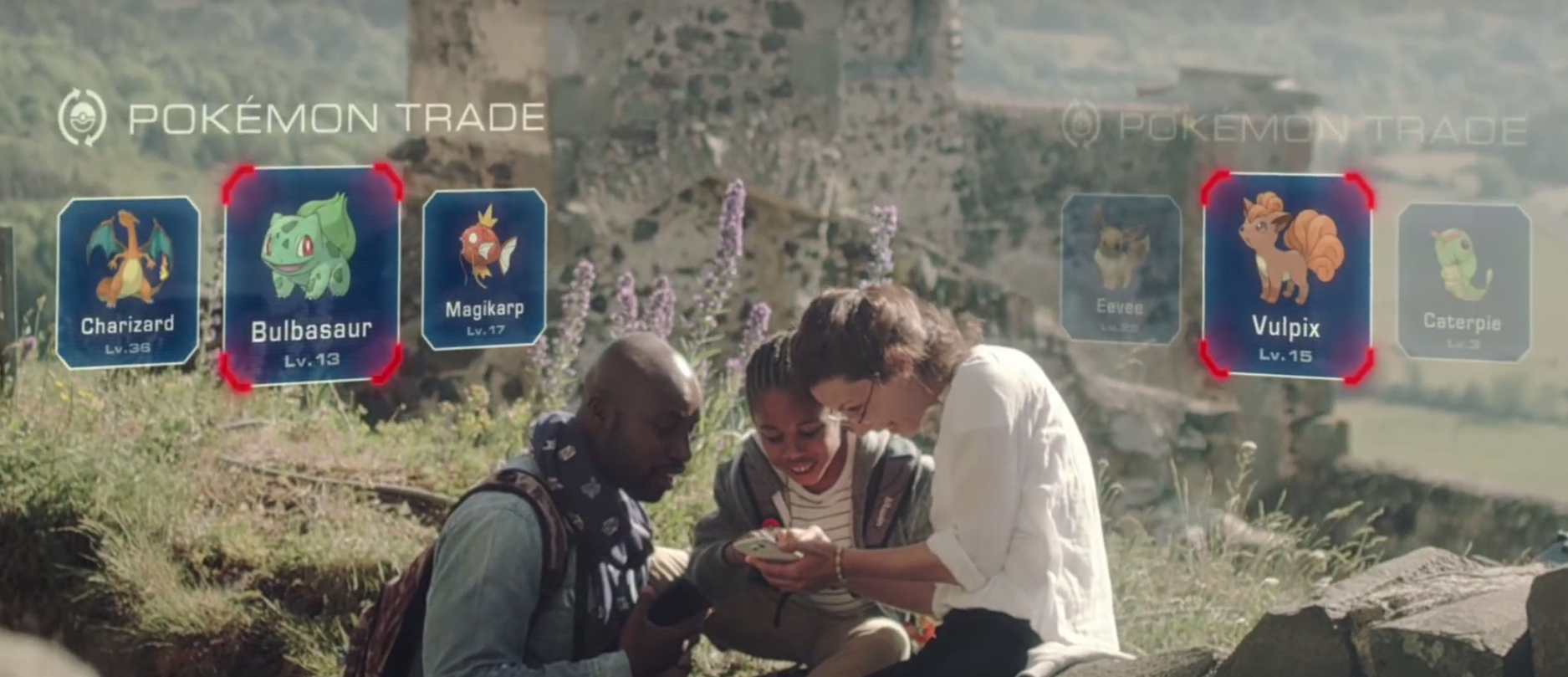
PK Trade

You let your daughter trade a bulbasaur for a vulpix?! WHAT WERE YOU THINKING?!

Super Mario Maker seems odd to me, and more than a little short-sighted. If you stick every mechanic, environment and sprite from the series in there, it stands to reason that just about every map possible is going to get made, in the old “infinite chimps at infinite typewriters” theory that the internet has spent the last two decades confirming.

So here’s the problem – why would anybody buy the inevitable upcoming generic Mario platformers when this game is producing community levels constantly? Yes, there’s going to be a bunch of awful maps made by brain-damaged toddlers that are basically straight lines with goombas marching down them, but if there’s leaderboards involved then sooner or later the good ones are going to rise to the top, like… Actually, a bunch of analogies come to mind for that, but none of them are particularly wholesome, so we’ll let it go.

And remember, people will almost certainly remake levels from other games, including any future ones. I think this is one of those things that’s bad for Nintendo, but good for us, as they’ll be forced to think of new and substantial mechanics that SMM doesn’t have, in order to have the edge on a game that they themselves designed.

Oops, bet that’ll come as a shock! Of course, they could always start pulling the recreations off the internet and banning those that just ape the old classics, but that won’t endear them to anyone and they’ll lose a large portion of the audience by doing that.

Fortunately, this strange decision – and all the others – can be explained handily by three simple words. Repeat after me, children, because they’re going to keep coming up: Nintendo is weird.

And it’s not like they only just started acting weird recently. I always thought that if any major corporation was run by space aliens, it’s Nintendo, with their psychedelic IP and banana-studying upper echelons.

Not that this has always been a bad thing, and it often used to work to their advantage. Creative out-of-the-box thinking was what allowed them to carve a substantial niche in the early days of the NES in the 1980s, they basically healed the wounds from the 1983 games crash on their own and brought console gaming back to the public eye in the West, so top marks there.

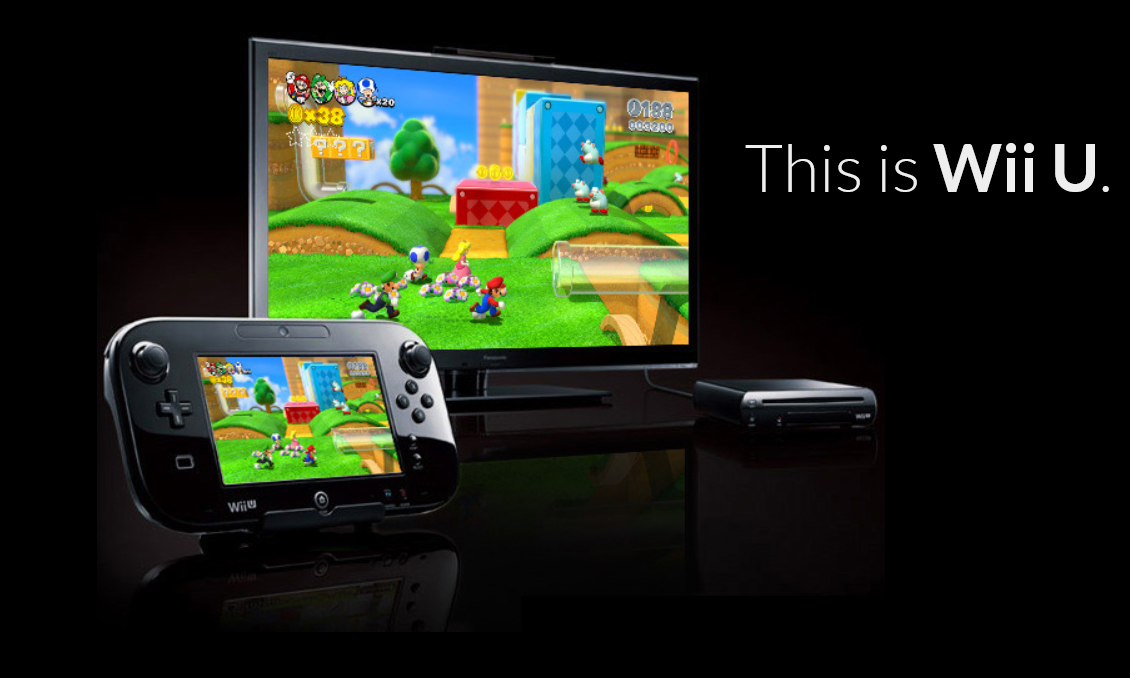
But there’s also always been a sense of detachment from reality, combined with terrifying quantities of “refusing-to-accept-the-obvious” in recent years. Sure, they’re not performing the legitimate actions of self-harm that Konami is so gleefully inacting, but lately they keep getting things wrong when it comes to major decisions. The obvious example is the Wii U, that dead weight which they’ve basically jettisoned to keep themselves afloat in favour of the mysterious NX. Nobody wants to make games for it, the Wii Pad is an absolute joke, and it’s been behind the Xbox One and PS4 for as long as people can remember.

Wii U ad

Indeed it is. It seems Nintendo were worried that having a website and a massive ad campaign dedicated to it might not be clear enough.

That said, you can still see the semi-logic that went into making this stupid thing. A series of half-formed ideas that don’t quite get what would make it good, and that’s what makes it so infuriating. People like tablet devices and quirky controllers? Make the controller a quirky tablet! The original Wii was popular? Take the user interface from that! People enjoyed the DS, a device with two screens above each other? Give the Wii U two screens! How could people hate the result? I’m sure we won’t be edging away from this thing like it’s a ticking bomb in just three years.

Speaking of the DS, Nintendo still takes the lead when it comes to the handheld market, but basically by virtue of being the only people still in it, aside from Sony’s half-hearted attempts. And even then, things are going poorly. Admittedly, the 3DS had a spirited release when it turned out the new feature was melting the eyeballs of children who played it, but even then the prospect of making games for it was daunting when Nintendo were demanding that developers use every function going, including the horrible ones. How many times do we need to go over this, Nintendo? Don’t make a game use the touchscreen or the microphone if it won’t make it better, damn it! And while we’re on this topic, please make the 3DS a shape that doesn’t cause havoc on my finger bones! Until I get a girlfriend or a fresh watermelon, I need them.

But again, we see the attempts at human thought, coming close but not getting close enough. 3D is popular in the cinema? Here we go! Folks like multiple features and functions? Bam! Is the Wii interface still hanging around? In it goes! Don’t worry, any soup tastes good if you put enough in it! Mmm, tastes like falling profits!

And why? Because Nintendo is weird, remember? And not only is it weird, it’s pretty childish about the way it does things. When a kid hears a joke or draws a picture that makes people praise him, you’ll see what he does – the same thing. Over and over and over. The same joke, the same drawing, and Nintendo operates in the exact same way. Mario, Zelda, Pokemon, Metroid. Mario, Zelda, Pokemon, Metroid. All work and no play makes Jack a – sorry, that got away from me.

The point is that they put on the broken record when they don’t have any other tunes to play, and recently they’ve been doing that a lot. New Super Mario Bros. 2 was basically the standard Mario template, unchanged, and when it comes to Zelda, a series that rarely took any massive leaps forward anyway, they’ve actually given up all together and started re-releasing the older games.

But in the last year or so they’ve begun to realise that running in circles might not be enough any more, but the problem is that when you’ve had your gaze turned inwards for two decades, it becomes very hard to rotate your eyeballs outwards again. The best attempt they’ve done to modernise is Splatoon, a third-person shooter with an emphasis on online multiplayer, which is so out of character for them that it would be like Batman being in a good mood, or Mel Gibson showing some iota of religious and ethnic tolerance.

Splatoon teams

God, look at those prats. It’s like a Mad Max tribe forged in the remains of an anime convention.

And you know what? By all accounts Splatoon is pretty good, so kudos there. But now that their obligation is done, they’re going straight back to the broken record again. Look at E3, where they announced no new IP or ideas whatsoever. Zelda, Metroid, Mario, Star Fox, Animal Crossing. All old, tired concepts, and everybody thought so, if the general response from the internet is anything to go by. It looked underwhelming, it looked boring, it looked low effort.

The really revealing tell is the new Smash Bros line-up, in which you could see them desperately scraping the bottom of the barrel for new characters to put in, considering they haven’t made many in the six years since the last Smash Bros. Out of forty-nine playable mooks, only sixteen of them are newcomers to the series, and many are just older characters invented decades ago. Some obscure Pokemon, Bowser Jr, Pac-Man, the second-string characters from games like Kid Icarus and Punch-Out, and to top it off, the Wii Fit Trainer and a trio of Mii designs! Wow, I hope I’m wearing reinforced shoes, because I think this is going to blow my socks off!

But what about the general strategy? The tragic death of their President Saturo Iwata earlier this year may have huge consequences for the company, though his legacy was not without its issues. That said, whilst we can accuse Nintendo of cynicism from time to time, Iwata seemed startlingly genuine and though he sometimes made what some consider mistakes, it never seemed to be from malice or greed, only a desire for the best games available. I can honestly say that the industry is a slightly lesser one without him in it.

But now that Kimishima has his job, things could be changing quite rapidly in the near future. I don’t think it’s a coincidence that Pokemon: Go has just been announced in the months following Iwata’s death, as he was famously against the mobile market until just last year. And even then he seemed wary and cautious about compromising Nintendo’s image by putting stuff on the Apple Store, despite the fact that the vast majority of critics, fans and even figures within the company were concerned about Nintendo being left behind.

Bananiwata

RIP, Mr. Iwata. You’re watching bananas in heaven now.

But now that he’s gone, I bet all restraints are off. Oh, they’ll start slow, because they don’t want to look disrespectful to their former leader, but within five years they’ll be uploading Super Mario Bros 3 to the App Store and selling replica SNES controllers to plug into your iPhone. And you know what? That’s probably a smart move, because otherwise it’s going to be a losing battle. After all, anybody with an Android phone or a PC just needs to download an emulator and they have what is basically the entire Nintendo library.

But Nintendo have backed themselves into a corner by taking so long to acknowledge the mobile market, because by not putting games on phones they’re losing money. However, they also can’t commit to mobiles right now because it will kill the 3DS, at least if they do it properly like everybody wants them to. After all, why buy a whole new chunky bit of hardware to play Majora’s Mask, when you can download it onto something sleeker that you’re bringing with you anyway? And then, if the 3DS is gone, it will pretty much end the dedicated handheld gaming market, because the only other competitor is the Vita and not even Sony cares about that.

I made a joke about Nintendo being run by space aliens earlier, but that’s not their biggest issue. Being out-there and otherworldly, that’s what gets you noticed, that’s what makes you look like a pioneer, and even if you fail it’s for the best reasons.

But most major publishers have what I like to think of as an attitude. When viewed from a little further back, the sum of the whole seems to emit a certain ambience and a distinct feeling to those dealing with them. For example, EA broadcasts a cold lack of respect for customers and other businesses. Valve comes across as quiet and introverted. Bethesda gives the impression of being like an excitable geek, furiously writing for years at a time before shouting to the rooftops about what they’ve made.

But Nintendo? It seems to me that recently they’ve been defined by one characteristic – denial. They fight every sensible suggestion, they refuse to significantly update their older IP or come up with many new ones, they won’t accept that they’re going to have to change if they want to stay relevant. Yes, they’re a charming embodiment of an older time in gaming, but there’s only so much goodwill that buys you and Nintendo has been struggling for a while now as more progressive companies move past it. Without adaptation, without evolution, the company is going to start looking even more dated than it already does. It’s spent the last few years in a comparative nosedive after the flash in the pan that was the Wii, and it doesn’t seem to want to take any of the steps that would be necessary in order to save it.

And yet, I don’t dislike them for that. There’s a strange sense of stubborn nobility to that behaviour, holding firmly onto values from a previous era and refusing to let them go, but they need to recognise that it can only hurt them now. It’s antiquated, it’s pointless, it makes them look… Well, you know the answer to that one.

A KICKSTARTER CAROL

You know what? I don’t trust Kickstarter. Not one jot. I’d feel more positive about a shark in a paddling pool filled with children. Perhaps it’s how cautious I am with my money, but there’s something suspect about a system that says “cough up cash now and maybe we’ll get round to creating a product vaguely similar to the one we mentioned later.” Call me cynical – and I’m sure you do, if you’ve read this site before- but that seems a little shifty.

However, it’s clearly taken some people, because Shenmue 3 recently made enough money to drown a small city, and it’s not like Sony, a major international corporation that’s leading the global console race and has hands in just about every technological aspect of society, would be able to afford a few million to fund a game that’s basically guaranteed to be a success. No, we had to cough up for that one, I’m afraid.

The problem was that I used to be in favour of crowd-funding, and to a certain extent I still am. I like the theory, I guess would be the best way of explaining it. Conceptually it makes sense, but in reality it keeps letting us down, and not in any small ways. You can tell how broken this system is by looking at a trio of games I’ve come to think of as The Ghosts Of Kickstarter Past, Present, and Future.

The Ghost of Kickstarter Past is the least offensive of the three, Tim Schafer’s and Double Fine’s adventure game Broken Age (released in two halves about a year apart), the project that proved that having an interlude might work for theatre but it don’t hold well with PC gaming.

Broken Age was one of the first real gaming successes on Kickstarter, and like Shenmue 3, it came out of the initial funding process with a startling amount of cash. After asking for four hundred grand, Schafer stumbled away with three and a half million clogging his piggy bank, and even at the time I could suspect what was going to happen. Because let’s be honest about one thing here – it will never cost that much to make a point-and-click adventure game, not unless you’re hiring the cast of the Avengers for the voices and building functional starships for the motion capture.

BA Tree

There’s a “got wood” joke here, but I’m not going to acknowledge it until someone else does.

Something tells me that before it got so much funding, Double Fine was planning on a single release, but after getting loaded like this they must have felt obliged to do more, and that was the problem. The initial vision was being hampered by public demand, and they were duty-bound to listen. Tim Schafer might have been planning a short and powerful game, but short games don’t cost over three million, so suddenly they’re having to change it, stretch it, and god, it shows. So much of the second half seems dull or made-up at the last moment, like they weren’t planning on making it at all.

But what was the alternative? If they made a short game, people would’ve been annoyed and wanted to know where all that money had gone, and there’s no system in place to give a certain percentage of it back, at least not that I know of. The ideal situation would have been a limit to how much could have been donated, but the day that a company turns down three million is the day that Rob Liefeld looks at a character design and thinks “that’s probably enough belt pouches.”

Next we have the Ghost of Kickstarter Present. It’s the worst of the three, and also the one most deserving of being described as an ethereal being with no basis in reality. I’m referring to the infamous case of Godus, the hypothetical game suggested by Peter Molyneux and 22 Cans.

This one is so messy that it’s probably deserving of an article on its own, but I’ll try to condense it down and be brief. Peter Molyneux was a game director working for Lionhead, and was the guy responsible for the Fable games. After Fable: The Journey, he went on to help form a developer company called 22 Cans, and immediately opened with a new Kickstarter campaign for Godus, a PC god-game in which you torment small people from above and occasionally help them out if you’re bored, that sort of thing.

Godus inspire

Well, this is awkward.

Godus got the money it needed and then some. That’s not to say it exploded like Broken Age did, but it held out a begging cup for four hundred and fifty thousand pounds, and not only succeeded but got an extra seventy-five grand on top of that, so I think we can call it a win.

Or at least, it should’ve been a win. Funding for Godus ended in December 2012, and for a while everything was quiet while the backers waited for it to show up. In May the next year, a horribly glitchy Alpha version of the game was put out for testing, and everybody promptly shat on it from a very great height. Not that an Alpha build should be perfect, the whole point is that it’s a work in progress, but huge sections of the game were missing and it was so technically incomplete as to be basically unplayable. It wasn’t a skeleton of a game waiting to be fleshed out, it was missing both femurs and couldn’t stand up without suffering multiple fractures.

Then came an even longer wait with only minimal updates from 22 Cans, until in August of 2014 when they put out a mobile version of the game, something that nobody had wanted but was coming out anyway on our dime, so suck it up. It bore shockingly little resemblance to the original concept, people got angry, key designers started quitting 22 Cans, and the result was that a boat that was already unstable began to rock very violently indeed. The reputation of the developers was irreversibly damaged and Molyneux was ordered not to speak to the public anymore.

Today, Godus does still exist on Steam Early Access, but it’s buggy, unfinished and ignored, like a sick puppy left in an alleyway. Whole features like multiplayer are missing, and the end result is that thousands of backers have been asking for their money back, which seems to me to be very reasonable.

I find it hard to believe that there’s any complexity to this issue. If you’re taking money from people in order to make a product, it’s your duty to make that product, isn’t it? Nobody tricked Mr. Molyneux, nobody forced him to make claims about the game that he couldn’t live up to, and he’s the one who chose how much money was necessary.

Now, if he’d tried to make it, failed, and returned the cash, then that would be different. A designer who is famous for over-promising does an Icarus-style flop in front of everybody and has to hand back what’s left of his wings. That would be disappointing, but not actively outrageous. But what we have now is a mobile game that nobody asked for and a non-functional design on Steam, neither of which have the larger features that were part of the reason that people were funding it.

Godus water

“Don’t be a fool Bobby, you’ll never make it! We’ll just have to live on this island for the rest of our lives.”

Maybe the PC version will be fixed and even upgraded to the full package, but that doesn’t excuse the fact that this has taken three years, when 22 Cans initially promised it to be finished in seven months. It doesn’t excuse the fact that certain factors about the business plan have been changed, such as taking on a publisher when it was initially claimed that no such thing would happen. It doesn’t excuse the fact that Bryan Henderson, a young man who won the “God Of Gods” award they had going and was therefore entitled to a certain cut of the profits, has been basically ignored from the start and wasn’t given a bean. Guess his reward isn’t one of those things that’s going to make it into the final product, so better luck next time.

The strange thing is that nothing happened about all this. The word “fraud” is spoken in hushed tones around this incident, and I don’t know enough about the legality of Kickstarter to say whether that’s a valid accusation or not, but I think we can agree that morally there’s something very off about all this. No real effort was made to undo the errors or even just to give a genuine show of apology. There’s been talk about the fact that they might just abandon Godus altogether and start on a new game, and Peter Molyneux has admitted in an interview there’s still some Kickstarter money left, so to that I respond thus – GIVE IT BACK. You weren’t given that cash to make some unrelated game, it was donated so you could make Godus, and if you’re not going to make it then you should give it back. That’s just the way it works. Or at least, that should be the way it works, but nothing’s been done to reimburse the public and it doesn’t seem likely at this point. Most of the donations are gone, and it seems 22 Cans has arbitrarily decided it’s done enough to validate the claims.

I should probably move onto the next example before I get too angry, because I can feel my blood pressure rising and lord knows with the amount of red meat I eat, I don’t need that as well, though I doubt the next example is going to do much to calm me down. The reason is that the final spectre is the Ghost (or perhaps Ghosts) of Kickstarter Future, and the title is richly deserved, because this is a story all about looking ahead rather than doing what it needed to be done at that moment.

Our story begins in 2013, where Keiji Inafune (one of the main figures behind the legendary game series Mega Man), suddenly popped out of nowhere. He’d left Capcom to start his own company called Comcept, and like 22 Cans, he started by putting a new idea on Kickstarter named Mighty No. 9, a spiritual successor to the older classic for which he was rightly famous. Announced at PAX with the goal of making $900,000, by the end of the month it had made over four million and had become one of the most successful crowd-funding campaigns in history.

Everybody was very excited, and sat down to wait for it. And wait. And wait again. Whilst progress was evident, it was taking quite a long time, and then, just to rub our noses in it, two additional crowd-funding campaigns were started up in 2014, one for a DLC pack and another for a bunch of additional extras, including an English voiceover. Hmm, that seems a little suspect. You’re asking for more money before the game is out? Why wasn’t this part of the original campaign, and why can’t you afford it, considering you made over four times what you needed? Alright, fine. We’ll let it go for now, as long as you don’t ask for more.

MN9 Enemy design

It seems that one of the enemies you fight in Mighty No. 9 is an aggressive wall clock. Who knew?

Except that they did. In July 2015 Comcept started a new campaign for a game called Red Ash: The Indelible Legend. Even from the start it was problematic, as the game had been poorly explained. Is this linked to Mighty No. 9? Which consoles is it coming out on? And why on earth is there a second crowd-funding effort on a different page for a “Red Ash” anime show?

Then the confusion turned to anger. Hold on, people said, why are you making this at all? Why aren’t you finishing the original game and using the profits from that to fund this new one? Why are you asking for another $800,000 before you’ve proven the first investment was justified? Unsurprisingly, this new campaign failed to meet its goals, making just over half a million before it ran out of time and became just another hypothetical idea.

What didn’t help was that Comcept were treating the public with a very obvious lack of respect, talking about how it was so important that they met the stretch goals… Whereupon Comcept would get around to deciding what those stretch goals were. No, really. They wouldn’t talk about what you’d get for putting in more money, only assured you that you’d regret doing otherwise. The exact words were thus:

“The Kickstarter campaign is going 100% towards more content! Consider your pledge a contribution to stretch goals from here on out.

Exactly what are those stretch goals? We’re sorry to say that will have to wait a little while longer! Like we said, we’re very busy with many behind-the-scenes things over here, and we apologize if you feel left in the dark. As you can see, the things we have brewing that are keeping us occupied are BIG, and all for the purpose of getting you RED ASH in its biggest, bestest form.”

There were two implications here, the first one being “all we need to do is snap our fingers at this point and you’ll pay up. We don’t even need to say what we’re making, we know you’ll fund it for us anyway.” The second one was more insidious, more subtle. Look at the last sentence and what they mention – “Red Ash in its biggest, bestest form.”

The suggestion is unavoidable. Anything other than the maximum is sub-standard, it’s not what it could be. And surely you don’t want to miss out on the best version of the game you can get, otherwise it would be… Well, worse.

This tactic has been used for a long time and is dangerously effective, it’s the same reason that we feel the urge to pre-order for the content bonuses. Nobody likes to think that they’re missing out, that they’re getting a product that is anything less than perfect, but we know that we are. It takes a great deal of self-control to say “no, I’ll stick with the inferior version, thanks,” and a lot of people would rather pay the penalty and get the best version of the game that’s going.

The end result is that Red Ash has been torpedoed, and unless the company uses the profits from Mighty No. 9 to make it, it won’t exist. And why? Because they got greedy. One of the company members has claimed that large sections of the team were done and they needed a new project, but they must have known how it would look. Their desperation for cash was so obvious, they didn’t even wait to think up stretch goal incentives, assuming that the public would be gullible enough just to smilingly hand over their hard-earned money.

The fact of the matter is that these examples prove that the system needs to change. Some might say that it’s the people, not Kickstarter itself, but that’s kind of the point – Kickstarter is a system used by people, and it’s revealed itself to be full of holes. You need a method of crowd-funding that can’t be exploited, because otherwise people will exploit it, they’ll get carried away and make stupid, short-term decisions that benefit them and nobody else. It’s not good enough to say that not the site’s fault, because people are a key part of it. You might as well say “Seaworld would be completely ethical if Shamu would stop moping around and enjoy herself for once.”

The key issue here seems to be oversight and regulation. In their defence, Kickstarter has recognised this and is making an effort to be more hands-on, but it’s going to need a lot more of this sort of thing before people feel safe, because for the last few years the site has basically operated on the Honour System, and when this kind of money is going around, that just isn’t good enough.

There needs to be more awareness of how excess money can change demands, there needs to be a legally binding contract to ensure that those asking for funding have to live up to their side of the bargain, and there needs to be the understanding that you are beholden to those who have invested in you, just like in any other business. You can’t just cut and run, or produce a semi-functional product and call it a day.

Chivalry arm

See what we can achieve when we try? …Um, It’s more about the principle than the actual image.

And again, I like the idea of crowd-funding in theory. If a new developer or even just an independent designer working in his bedroom has an idea, and neither have the income for it, then Kickstarter can be what makes the difference, but the system by which it operates needs to be changed. At its best, Kickstarter provides awesome projects like the Shadowrun games, FTL: Faster Than Light, Chivalry, and of course, Elite: Dangerous. Examples like these are enough to prove that we should keep trying to make this work.

Of course, you could always donate generously to a different cause, like the Joel Franey Fund, which will keep me angrily shouting at the screen for years to come. And remember, we have stretch goals! If you donate enough, then I’ll be able to afford a pizza so large that I will literally stretch the jeans I’m wearing. How could you turn that down?

MAD MAX: THE VIDEO GAME REVIEW – “SANDBOX? MORE LIKE BLANDBOX”

It’s an accepted lesson in life that you don’t gain much by hanging out with somebody who is generally better than you. If you’re going to sell yourself on looks, don’t eat dinner with Brad Pitt. If you’re going to brag about how good an athlete you are, avoid going to the theatre with Usain Bolt. And if you’re going to make a video game inextricably tied to a movie – a movie that was one of the best things to be made this year – you’d better be sure that you know what you’re doing.

Mad Max is one of those franchises that has had a huge hand in inspiring other video games, such as Fallout, Rage and especially Borderlands, but never really had a direct presence until now, using the recent success of Mad Max: Fury Road as a jumping point to push this game into the public eye.

By the way, get used to hearing about Fury Road in this review, because it set a benchmark in quality that I’m going to point at every time I can. Some might say I shouldn’t judge a game based on how it related to a different creation, in a different medium, but those people are more deluded than a man with a fistful of lottery tickets. This game wouldn’t exist if not for that film, it constantly brings it up in an attempt to validate itself through association and it’s selling itself on the goodwill that George Miller’s recent blockbuster created. The game is basically hanging off the side of the movie like a remora.

Max with binoculars

Yep, that’s sand.

Obviously, the problem is that Mad Max: The Video Game is nowhere near as good as Fury Road. It hasn’t really done itself a solid by drawing attention to the comparison, because it’s not a favourable one. For god’s sake, it’s so unwilling to think for itself that it was advertised as “Mad Max: The Video Game.” When was the last time you heard of a game with that subtitle this side of 1990? The most recent one I can think of is the infamous Rambo: The Video Game, and that was like being punched in the gut by Sylvester Stallone for several hours.

Which isn’t to say that Mad Max is bad. In fact, it falls just on the positive side of average for what it’s worth, but that’s not worth much. I don’t regret buying it, but I don’t feel the need to go out of my way for it either, that sort of thing.

What we’re looking at here is a sort of driving, punching, resource-collecting free-roam game in a literal sandbox, kind of a cross between Sleeping Dogs and Just Cause 2. You play as Max Rockatansky (no, really), a lone survivor in a dusty, post-apocalyptic Australia. At least, I think it’s meant to be Australia. The actor playing Max is a genuine Aussie, apparently, but he sounded to me more like an American trying to gargle a mouthful of koala pee and shredded Fosters cans.

The game starts off with Max having his car stolen by the local warlord as he drives across the wasteland, whereupon he’s beaten and thrown into the dunes with absolutely nothing and must claw back his meagre needs from an uncaring and hostile world in which – no, wait, it’s alright. He’s immediately found by a deformed mechanic prodigy named Chumbucket, who has a safe base of operations, a set of highly useful practical skills, knows the area like the back of his hand, and is also brain-damaged enough to believe that Max is some sort of deity for whom he needs to build the best car ever.

And good thing that all this was here, I was almost expecting there to be some effort put in from the player. Mind you, I do have to congratulate the game for being the first one I’ve ever seen to have a button solely for “make my twisted, brainwashed, hunchbacked slave fix my car whenever I feel like it.” You know what button that is? E! It was so intrinsic to the gameplay to be able to order the disabled guy around, they actually gave that function to one of the vowel keys, and not one of the crap ones like O, or I.

So it’s not a struggle to get from nothing to something. The difficulty comes into driving the sodding cars, because the physics are lurchy as hell and vehicles feel about two tons heavier than they should. They don’t drift, they break easily no matter how much armour I put on them, and all the fun extras you can add to them, like flamethrowers, grenade launchers and the annoyingly necessary harpoon upgrade, they’re all locked off until you do a bunch of side missions, or just spend your time knocking over student art projects.

Max grappled

“Alright, but no tongue!”

See, the wasteland is divide into sections, each one owned by a settlement, and they’re all under the heel of the nutjob who committed grand theft auto on you at the start. Therefore you can earn goodwill by roaming their respective areas, pulling down the scarecrows he’s made, killing snipers he’s sprinkled over the place strategically (pretty smart for a guy who wears a fake rhino horn as a codpiece) and blowing up the conveys that go around doing… Well, we’re not sure yet, but they need exploding, right?

The other way in which you can lower his influence is by clearing out bases of thugs and destroying his oil supply, and that’s probably where the game is at its strongest. By the way, don’t be fooled into thinking this is a shooter, for while there is a shotgun you can use, there’s almost no ammo and it’s more of an instant finishing move for when you desperately need it. For most of the time you’ll be relying upon your fists and the occasional bat with nails in to make it through your foes.

How’s it function? Well, I didn’t make that early Sleeping Dogs comment lightly, because Mad Max uses the kind of melee combat we’ve seen in the Arkham games, Shadow Of Mordor and yes, United Front Games’ recent odyssey of Wei Shen. And this sort of combat needs a name, so I’m calling it a “reaction brawler,” fighting that’s more about keeping an eye on your opponents and cancelling out their attempts to hit you than it is about just tearing through them like an American tourist mistakenly walking through a Japanese paper door.

Luckily for Mad Max, I really like reaction brawlers, but that doesn’t mean I won’t ask for a new take on those mechanics. All the other games I’ve mentioned had their own spin that separated them from the herd. The Arkham series, ostensibly the original creator of the reaction brawler system, was about free-flowing movement and the right tools for job, engaging in a complex game of rock/paper/scissors as each enemy had a specific weakness you had to exploit to defeat them. In Shadow Of Mordor it was based around crowd control – picking off specific targets with the bow, brainwashing others who might be useful, blasting back troublesome enemies to deal with later and terrifying the rest with psychotic finishing moves. Finally, Sleeping Dogs utilised a more combo-based methodology, bringing in heavy and light attacks as well as a variety of different counters and grapples.

But Mad Max doesn’t have any of this. It’s got the basic mechanics, but there’s nothing else there. It’s like the starting template from which the other games all grew, but there’s not a lot added to it in this case, bar a vague emphasis on picking up breakable melee weapons if you see them. It’s still fun, but once you’ve played it a few times you’ve basically seen everything you have to see.

Mind you, the combat can be pretty brutal. Enemies move fast, it’s frequently hard to counter them in time and there’s a fair few attacks that you can’t block and have to roll out of the way. This makes for a pretty jarring barrier to entry, as players will need to have quite a lot of caffeine in them to adjust, but I actually like this. The whole point of this world is that it’s unforgiving, that it’s a struggle to survive. If you could just knock over a settlement with your B.O. it wouldn’t mean much, and it gives it all the more cathartic potential when you increase your stats over the game and can return to entry level missions to break people in half with your massive metal knuckledusters.

However, psychotic skinny people wearing body paint are not your only threat. Perhaps you remember the moment from Fury Road, in which a lightning-tornado-sandstorm obliterates most of a fleet of super-cars without batting an eyelid, like an angry two-year old set loose on his dad’s model train set? For those of you who didn’t know, it looks like this.

Mad Max storm

Holy shit, that puts Hurricane Katrina to shame! And of course, the video game adopted these destructive typhoons as well. Storms occur randomly in the wasteland as you explore, and you’re given a shockingly brief amount of time to get to a settlement and wait it out. Of course, you could always venture back outside to face them, because the rewards are not insubstantial, though you do run the risk of getting fried by a thunderbolt or hit in the face by a piece of corrugated iron that was was being blown past. The profits to be had are large crates of scrap metal, the game’s primary resource, which are blown through the air and can be secured with your car’s harpoon if you get close enough. Cracking these open will get you far more scrap than any other source in the game, which you’re going to need to upgrade yourself, your car, and basically get around in style. It’s money in all important respects, except that it doesn’t have the Queen’s face imprinted in it.

There are other resources, but there’s not much to them, so don’t get your hopes up for yet another survival simulator. Water just functions as a health-regen item you can carry around, and food has the same purpose, it’s just eaten on the spot rather than stowed away for later. The only other thing you can search for is petrol to fuel your car, but it’s so common that I never ran out. A full tank lasts as long in the game as it would in real life, and every base is overflowing with the stuff, not to mention that you can store an entire spare can of fuel in the back for emergencies. I never needed these spares, though, and found them more useful as makeshift explosives, as you can always stick a burning rag in the top and use it to ruin a warboy’s day.

But this is all fringe stuff. The real nail in the coffin, the real reason why it shouldn’t have sidled up to Fury Road and kept smelling its hair, is the story. Fury Road had an epic plot, combining massive action set-pieces and fascinating absurdity with powerful character arcs, heartfelt emotion and a surprisingly nuanced approach to several philosophical questions about faith, patriarchal values and gender attitudes in society.

Max vs stairs

Max bears witness to a shopping mall the day after Black Friday…

So which of these did the Mad Max game bring with it? Um… None of them, or at most makes a few vague shrugs towards them. Even the easiest and most iconic part, the Mad Max weirdness, all feels fairly token. Yeah, the cars have spikes on them and the villain is called Scabrous Scrotus, whatever. It’s surreal, but it feels forced, feels unnatural. It’s entry-level oddness, insanity for beginners. I never felt really startled by any of it, which is pretty much a deathblow.

On top of which, what the hell happened to the empowering presentation of females from the film?! The movie included a badass woman warrior who personally lead a dynamic escape to return to a superior matriarchal society, only to decide that what really needed to be done was to go back and conquer the testosterone-driven civilisation they left behind. And, if that wasn’t enough, she had a robot arm and was called Imperator Furiosa! Seriously, how awesome could she be?

Unfortunately, the game doesn’t have her or anything comparably close. The only major female character is an imprisoned prostitute who has to get Max to rescue her daughter, because there’s absolutely no way that somebody without a Y-chromosome could do it herself. Any others? Well, there’s a woman with no legs who needs Max to build her a boat, and a drug-addled lunatic who you then have to murder once she’s done what you needed her to do. Yeah, something feels a bit off about this story.

The weakest flaw is Max himself. The character portrayed in Fury Road was a great deal more sympathetic, as numerous horrible experiences had basically reduced him to a terrified fight-or-flight instinct, albeit one coiled around a sense of stubborn altruism. But the Max in this game is just an arsehole. He’s bad-tempered and aggressive, even going so far as threaten those who are already helping him, which is hardly likely to make him relatable unless they’re marketing this game to loan sharks.

I also don’t get much sense of Max’s motivation. He’s determined to get to somewhere called the Plains Of Silence, but he’s obsessed with the idea that he needs a good car to do that, and for that reason about 85% of the story is Max trying to get hold of a V8 engine, because apparently the V6 he has already just isn’t good enough. And whilst the Plains Of Silence might have held intrigue, his bio in the glossary flat-out tells you from the start that they’re made up in his head, so there’s not much to be had there either. The most development Max gets comes from one poorly-written scene in which you can practically hear the writers straining to make him more human.

Hope

“What do you mean, I’m as good as female representation as this game gets? I’m shit as a character and we all know it!”

But he’s not human. He’s just a vague concept, that of “angry white man with dead loved ones.” That’s a tango we’ve definitely danced before, but like the melee combat earlier, there’s no twist on this or even on him. No charm, no complexity, no reason to follow him except that the camera demands it. And all the bone-crunching finishing moves aren’t going to make me like him any more than the next guy, because a fridge falling off a cliff could accomplish the same thing.

Finally, frustratingly, the ending is a flop. After a disappointing boss fight in which you basically blow up a few vehicles as you’ve been doing before, Max does something truly horrible for no reason, at which point he has to throw spears at a car, and then the game is over. That’s it. Not with a bang, but a whimper, I think is the phrase.

There’s enough good stuff in Mad Max to make it just above average, but most of the game is wasted potential. Story is pathetic, combat isn’t as developed as it should be, driving is clumsy, survival elements are lacking. There’s other stuff, like the fact that climbing is too contextual and the difficulty curve is wonky, but generally Mad Max comes across as lazy. Buy it if you see it for fifteen pounds or less, but don’t feel the need to rush out for it now.


6/10
Good mechanics go undeveloped and the plot is a trial to get through, but there’s enough at the core to make Mad Max basically workable and occasionally enjoyable, though it’s largely unadventurous and won’t stay with you for more than a week.