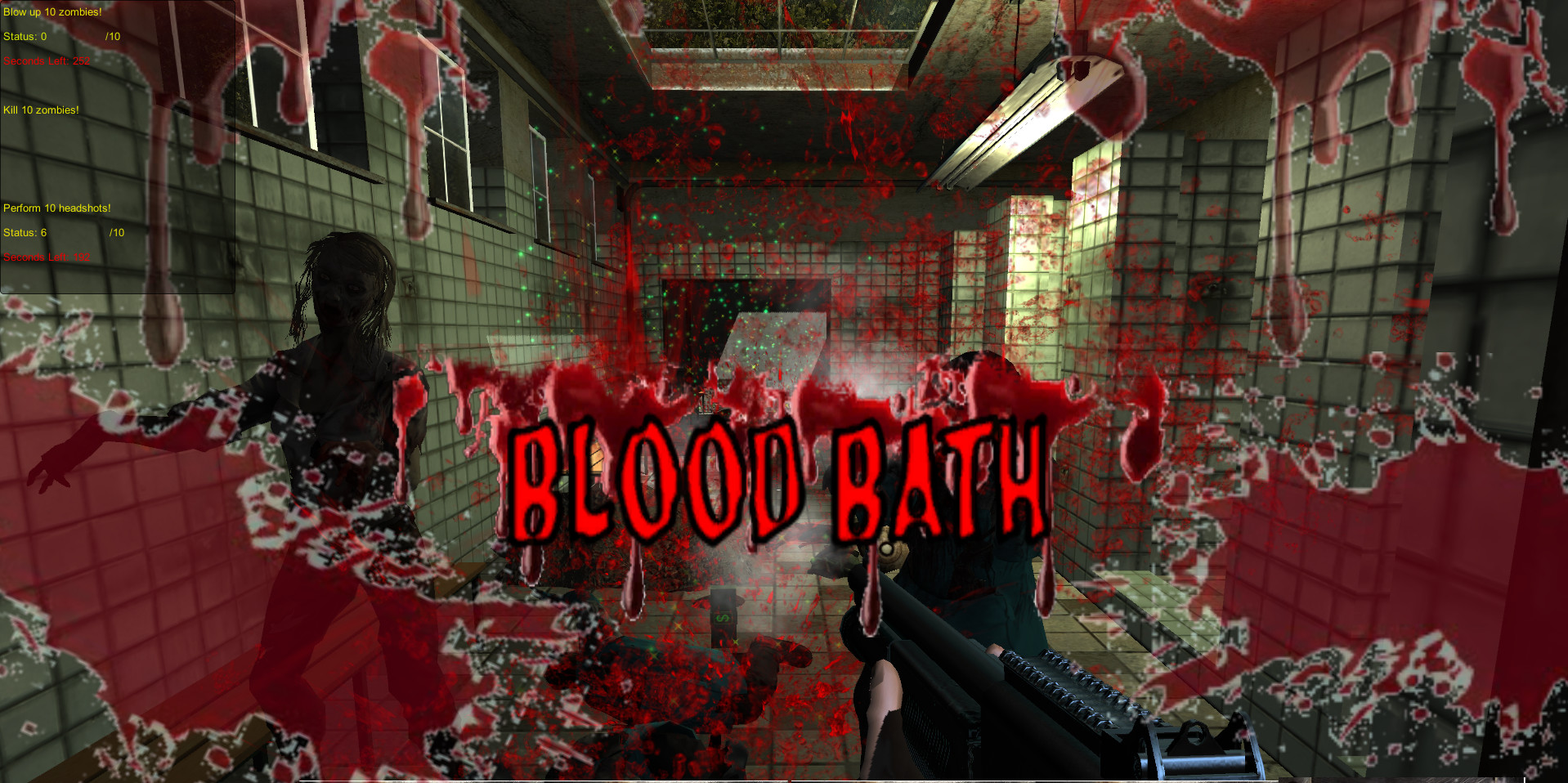
SEX! AND ALSO VIDEO GAMES, I GUESS

In a move that should surprise no-one who is even remotely familiar with me, I’ve been thinking about sex. That’s an internet hat-trick right there: Explicit sex, video games, and middle-class white people who think their opinions matter, the famous trilogy of the world wide web. All I need to do now is start filming housecats in compromising situations and I’ll have the full set. Might as well start now – those “cheezburgers,” amirite?

Anyway, back to sex, a phrase I don’t get to say often enough. A few articles ago I accused filmmaker-in-denial David Cage of having made one of the most awkward sex scenes it’s possible to make, in the creative endeavour that was Heavy Rain. In it, one of the protagonists is attempting to rescue his son from an insane killer by completing multiple deadly trials over the course of a week. Having evaded death numerous times, suffered hideous burns across his torso, mutilated his own body, been on the constant run from the police and forever struggling with the constant knowledge that little protagonist junior is one bad choice away from being sent to Hell with all the other video game children, the hero somehow finds the willpower to get it up and bump uglies with another player character. I guess the convenience of the child in danger is that if he thinks about it midway through the act, it’ll stop him from finishing too early.

Hardly a bed sprinkled with rose petals, is it? Maybe he wants to have a replacement kid ready in case he screws up royally, but it’s still absurd. And of course she has to go on top, because if somebody in his physical condition leans forward too much, their innards will fall out and smother the person they’re straddling. How could they not be turned on?

Even if the context wasn’t surreal at best (and psychologically revealing of the writing staff at worst), it still made me cringe to watch the whole thing. It’s not as if the graphics were bad – they were pretty good, not phenomenal, but sufficient enough to maintain immersion in all other scenes. But suddenly it was very obvious that I was watching a couple of polygonal models clonk against each other. It would have been less surreal and embarrassing to mash a couple of stick figure drawings against each other and make kissy-kissy noises in front of a camera.

Kiss

You can’t hit the X button fast enough.

I wonder if it was ruined by the knowledge that the scene was made collectively by dozens of people. Sex is something that most people still think of as private, or at least very personal, a shared experience between two persons. But the understanding that there’s nothing personal about this, that it’s a false construct made to explain part of a story, that might detract from the whole thing… But I doubt it. We wouldn’t feel that way about any other form of love-based scene, such as a first kiss or a romantic dinner. No, it’s not problematic that it’s personal, it’s something else. And besides, you can still ignore that feeling in a movie, something that’s made by just as many people, if not more.

Is it the failed attempts at eroticism? Nah. Don’t get me wrong, that Heavy Rain scene and the infamous ones in Bioware games are about as sexy as a middle-aged accountant committing infanticide by the glow of a TV showing Ann Widdecombe, but again, you can see sex scenes in films that are focused around love instead of allure, and they don’t make me want to cringe straight through the wall in an attempt to escape. I just process them in the context for which they are intended and move on, but it’s harder to do in gaming. I don’t know why, it just is.

I think that the contrasting motivations between the gamer and the characters don’t help. Ethan Mars, Madison Paige, Ezio, Commander Shepherd… They all have their canonical reasons for wanting to do the nasty with other people in the game, but their reasons are usually different to ours, based around love or seduction. Whereas the player’s reasons are usually less intimate, more based around bored, dispassionate amusement. Curiosity, the completionist urge, that’s what drives us to find out, and the schism between their heartfelt drives and our observational ones become all too obvious when we’re watching them bonk each other in scripted, choreographed thrusts and moans.

Taking a step back, I think that might be the real mood-killer – the fact that these people are doing it on our orders. Anybody can sense the weirdness in coldly instructing two people to either fall in love or feel horny on cue. It’s the extension of the old “press F to pay respects” madness that Saints Row 4 was wise to made fun of. Short of using a Wii remote to simulate jerking off a partner, there couldn’t be a way to make it more humiliating.

ME Blue chick

Captain Kirk would be proud, though less so if he could see the hideous mess that she’s hiding at the crotch of her jumpsuit. It’s like the Predator’s mouth after a bad trip to the dentist.

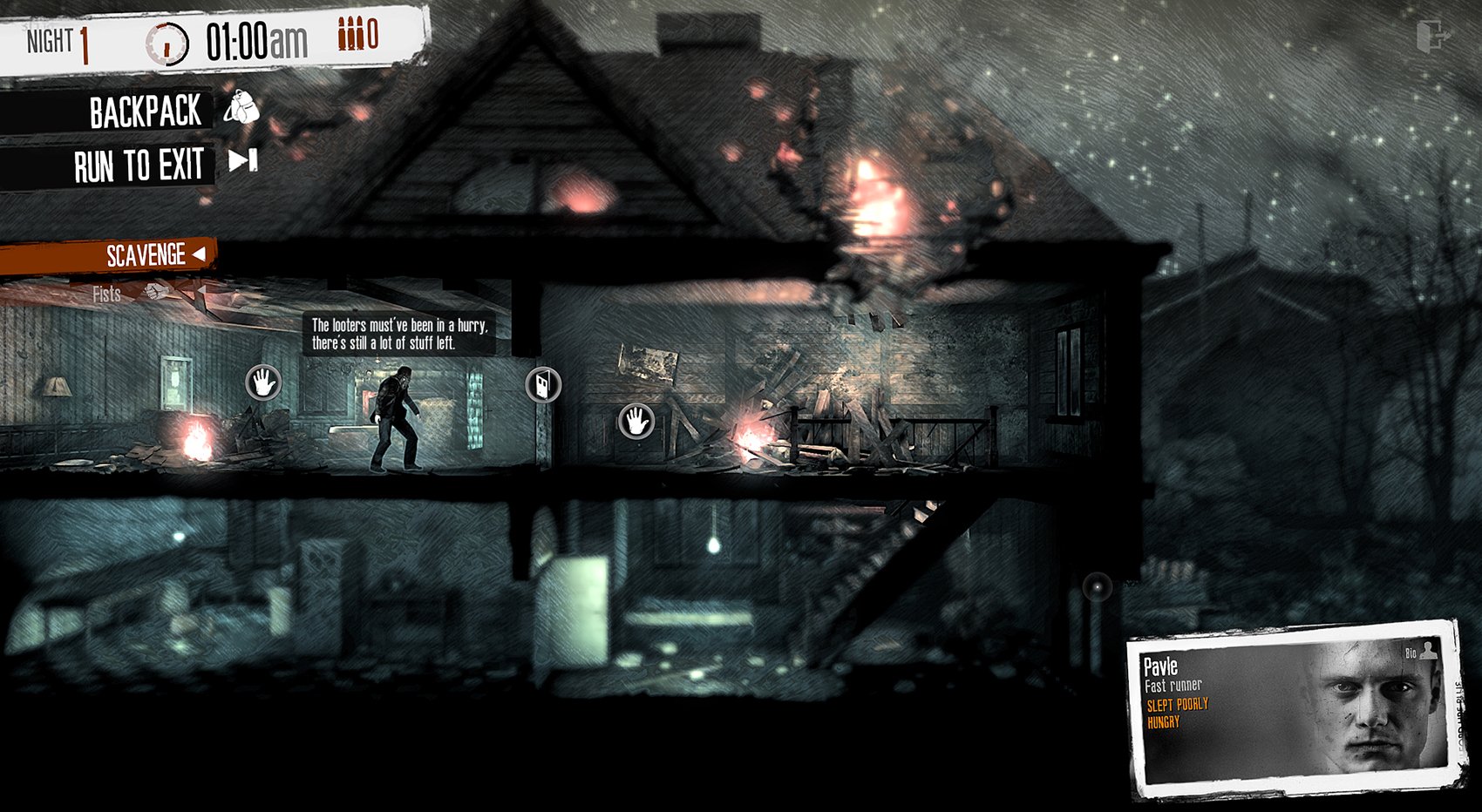
I’m not going to get involved in the “is there a need to even have sex scenes in games” debate, because I wouldn’t ever make a statement on what content is or isn’t necessary in art. The Binding of Isaac is a game about child abuse and the damage that can be done by a religious upbringing. Hotline Miami is all about the mistreatment and deception of those with learning difficulties. This War Of Mine is all about the loss of morality of favour of survival, and all three manage to be superb games whilst dealing with dangerous or controversial issues.

There’s no inherent reason why a game with sexuality as a core theme should necessarily be bad or come across as cheap, in fact it should speak to a lot of people. But it speaks to the comparative immaturity of gaming that they just can’t get it quite right, that they can’t make it seem genuine and it usually comes across about as organically and naturally as a terrorist attack, and just as erotic and loving.

Actually, I think the graphics quibble I threw away earlier might be more relevant than I thought. When the focus of the scene is on the physical contact between two folks, we need it to look real enough to fool us. If smooching lips suddenly clip through each other, or limbs seem disjointed and angular, it snaps us out of the delusion, because now the bodies of the heroes are the point of interest. For that reason they need to look as real as anything, because otherwise we’ll consciously know that something that should be as natural as possible is being structured in the most artificial way. You might as well just bung a couple of blow-up dolls in a centrifuge and you’d get the same result from your audience.

Gaming will have to grow up a bit before we get it right. It’ll have to work out the most tasteful way to display two people making love, it’ll have to stop the vending machine mechanics of “hand over gifts and niceness to go to bed with somebody” and it’ll have to get past the over-simplistic presentation of the most complicated aspect of human interaction.

Oh, and stop forcing bad voice actors to make cheap moaning noises. Just let the music swell or something, because it always sounds like two seals slowly dying in unison. Trust me, I’m English – if there’s one thing we know how to do, it’s disapprove of sex.

CONTENT DOES NOT MEAN CONTENTMENT

There’s a rather insidious word floating around the games industry, namely “content.” It seems to be a highly praiseworthy thing to have a massive amounts of content crammed into your game, to have it so jam-packed with stuff that it’s practically bursting out of the screen like it’s auditioning for Poltergeist.

I’m not so convinced, because content isn’t so inherently great, though you’d hear arguments to the contrary. “Watch_Dogs, Titanfall and Destiny failed critically for not having enough content.” “GTA V and Arkham Knight were great because they had tons of content.” To this I say a strong and resounding… Meh. It’s not awful to have this stuff, but it’s not great either, a bit like a clingy lover. I assume.

No Surprises Here

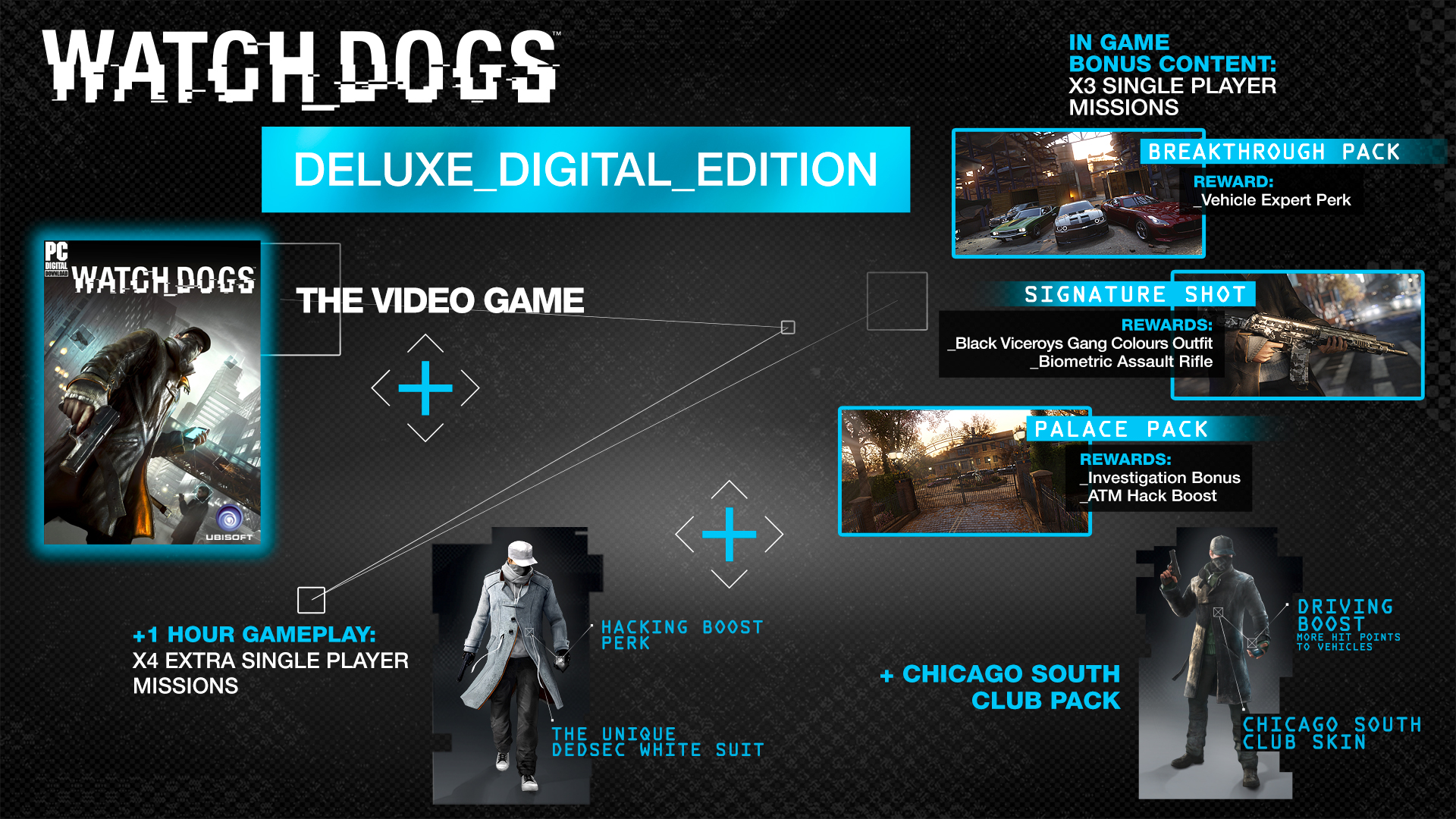
Oh, look. Watch_Dog’s first screenshot on Steam involves Ubisoft trying to cram day-one DLC and special editions down our throat. What an utterly unexpected surprise.

Let’s take a look at the examples above. Watch_Dogs seemed anaemic because it held a vast sandbox map with very few activities to fill it. But if it had been a sequence of linear missions, we wouldn’t be complaining nearly as much, because there wouldn’t be that sense of emptiness. Titanfall and Destiny struggled with content because of their multiplayer focus, and without a structured story they both just petered out and became boring when you started doing the same things over and over. And whilst Grand Theft Auto and Batman both had lots of side quests, they were often dull or just not worth the effort, such as the golfing in the former or the Riddler trophies in the latter.

That said, there are some games that thrive on vast quantities of content. Skyrim boasted a vast fantasy world with adventure in every direction, and came up clean on that score. Dark Souls is a long, teeth-gritting slog in which you have to push for every victory, but it works and fits the tone perfectly.

I think that’s the issue – that to make a game full of content is not a victory in itself, you have to make all that content fun or it might as well not exist. It’s just packaging and extraneous matter, and it’s a problem that’s endemic to sandbox games in particular, which hope that if they throw enough variety at the players then maybe something will stick.

Look at Sleeping Dogs, so desperate for additional features that it added a bizarre cock-fighting minigame (I’m resisting the urge to make an immature joke) and a horrible karaoke feature, a feature which has the gall to come up twice in the main story, and that’s not even mentioning the embarrassingly easy drug busts you do over CCTV. None of it was fun, none of it was rewarding, but goddamn it, we made this sandbox and we’ve got to stick something in there, even it makes the player want to start cutting bits out of themselves.

The real danger is loss of focus, padding out the game to fit some arbitrary timespan without the consideration of pacing, a tightly-designed narrative and whether the gameplay is fun or not. GTA V has the attitude of child’s toybox, so filled with little functions and playthings because it hopes you’ll enjoy some of them, rather than building on the core features and making something more elegant and razor-sharp. I still can’t forgive that game for that bloody yoga sequence, forcing me to play that before getting to do heists and gunplay. You know, the fun stuff that we buy the game for.

I do get the urge, there’s an appeal to a longer game, and whilst I do like a well-paced story that’s slim and tighter than others, there’s nothing wrong with a title that has a wider reach and allows for options. But as we all know, an excellent story doesn’t come just from a good writer – it comes from a good writer AND a good editor, who can cut down the unneeded fluff and make something really focused.

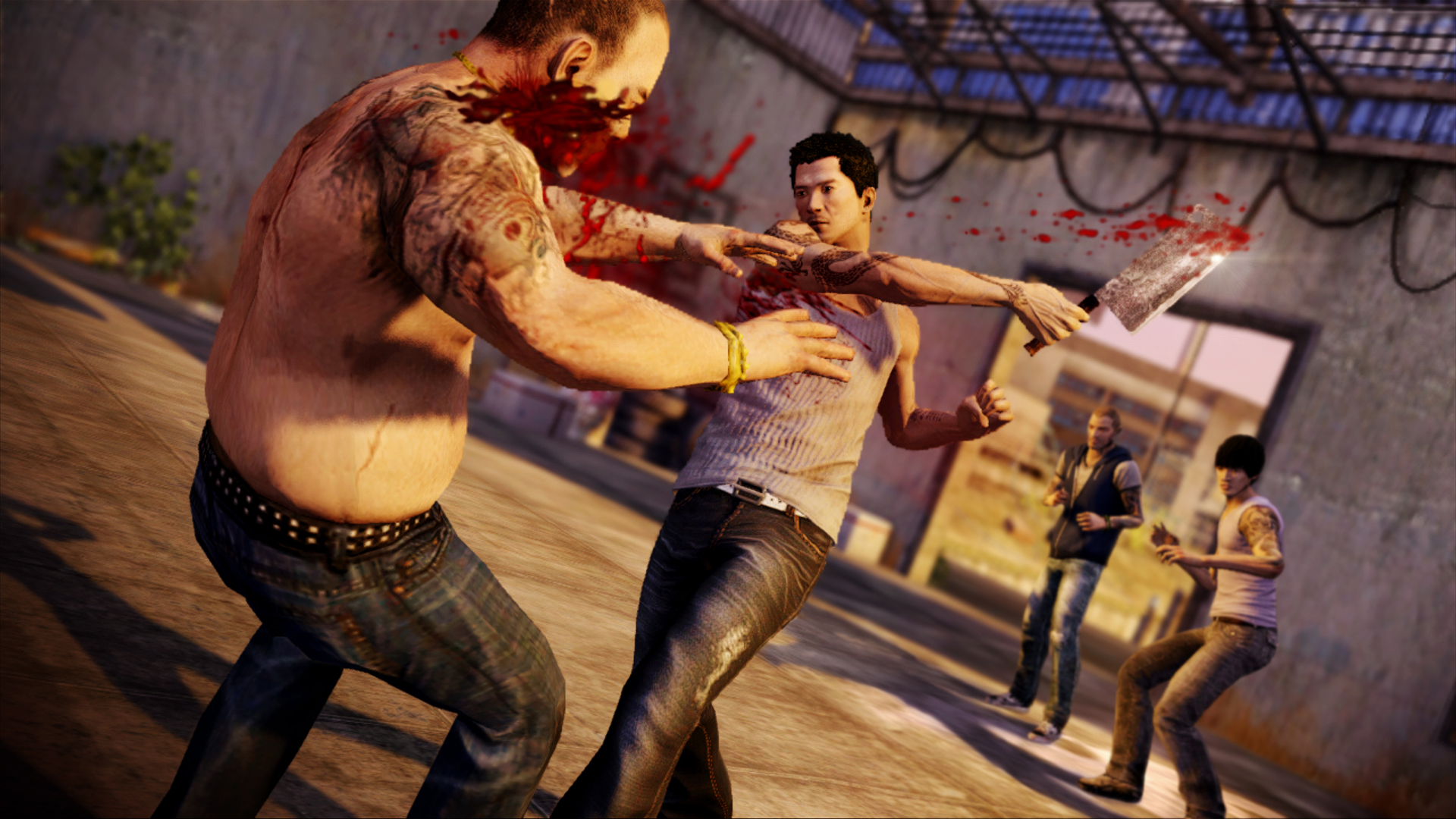
Wei Cleaves A Bitch

This isn’t a mission fight. This is just the result of me being angry that the story made me do a rhythm game to sing “I Fought The Law.” That’s worth a cleaving on any day.

Games need more of this cut-throat attitude, though sadly I doubt it will happen. Making any of these features requires so much work, that it would be horrible to think that it’s got to be thrown away right at the end if it doesn’t make the grade. With the resources and capital that gets pushed into everything in a big-budget game, they can’t afford to lose any of it. There’s no room for experimentation.

The annoying thing is that many games only work so well because all the extra flab has been cut away, leaving a pure and hugely rewarding experience that’s unfettered by anything else. Even the big games like Skyrim all revolve around a provably good set of core mechanics. There aren’t any minigames about dragon taming, skooma cooking, or being racist towards elves, thank Talos.

Though we should take into account a game’s length when we’re pricing it. The Order: 1886 can be completed in five hours, but is being sold at the same price as any other game. That’s preposterous, it’s a scam, no matter how pretty the graphics are. You don’t sell a bungalow at the same cost as a mansion, even if it does have great décor. And yes, I’ve said before that story length isn’t the best measure of a game, but you have to be sensible when you’re sticking a price tag to the result. People want the best value for money, and how much we get out of a game does matter in that regard, it’s ridiculous to think otherwise.

No, a game being full of great content is fine, but if you don’t have much to work with, just make a shorter game with a lower price to match. It might sound horrific, the idea that you might not make as much profit, but it’s far better than hammering various ideas together in the hope that you’ll be long enough to fit some self-imposed limitation.

Essentially, it comes down to identity. Be Wario Ware or be Portal, but don’t try to be both. Then you just get Chell with a big mustache, and that pleases nobody.

MARIO IS DEAD, LONG LIVE LUIGI

Let’s start off with a test for all you Nintendo-loving johnnies out there. Mario has existed since 1981 and has been in dozens of games, which should allow ample time for minimal character development. So let’s all count down the five most interesting aspects of Mario’s personality together! This should be fun.

First of all, he’s heroic and brave. We can agree on that… Though we have no idea of the motivation behind it. Secondly, uh, he’s nice? I guess? Thirdly, it’s easy to see that he’s, um…

Well, this is awkward. Shouldn’t there be more to him than this?

It suddenly struck me how little we know about this massive multimedia icon, when I was recently playing the Mario and Luigi games, namely Partners In Time and Bowser’s Inside Story. I really like it as a series so far, they eschew the traditional platforming for a highly involving take on turn-based combat that works well and develops nicely as it progresses.

But I also like the fact that there’s an emphasis on plot. The last entry I played before these was New Super Mario Bros 2, a game that took to originality like Nazi Germany took to ethnic diversity – pretty damn unfavourably. But the Mario and Luigi series has always leaned towards a focus on linear story telling and characterisation, which is pretty cool for a franchise that has always resented any plot more complex than “squash the goomba.”

ML BIS

Look at that. Four characters on the cover, and the only one showing no emotion is Mario. Creepy, moustachioed little bastard.

But the weird thing is that there’s only one person in these games who doesn’t get a personality – Mario himself. Everybody else is filled with charm and charisma, particularly Luigi and Bowser. In fact, it becomes kind of weird to see Mario just standing there like a brick, whilst his brother in particular acts very dynamically and constantly shows aspects of himself in cutscenes, all through visuals alone. Luigi is lazy, nervous, clumsy, a little vain, but good-natured with a fondness for children. He cares about what people think of him and enjoys food perhaps more than he should, and always reacts with genuine delight at every victory in the game, doing little dances or bragging proudly.

And Mario? It’s difficult to say anything about him, there’s not much to work with. Oh, he likes Peach? At least, I assume he does. He certainly puts in the effort to rescue her, but when he finally gets her back he just stares at her like she’s a “Where’s Wally?” book. I can’t even tell if they’re meant to be going out. I think that used to be the case, but at some point it was quietly forgotten about and now they’re just good friends. Yep, they’re innovating the canonical relationships by making them increasingly boring.

I’d be happy to see Mario get put on the backburner from now on, because he’s just a place-filler for anybody more interesting. I even enjoyed playing as Bowser more, for Mario just comes across as weird, especially in games that are selling themselves on personable heroes and characters. It would be like watching a Punch and Judy show, with the addition of one character who was just a mute piece of wood standing right in the middle of everybody. It’s unnerving, it’s awkward. You keep wishing he’d have the sense to politely leave.

That said, it’s not hard to see why Nintendo have resorted to this methodology. If there’s nothing tangible to Mario, there’s nothing that’s going to be inoffensive or polarising. It’s nice and safe, but then again so’s a glass of water, and there’s not much flavour there either.

But for all my quibbling, I can’t actually think of what I’d like Mario to be like. He’s been so bland and so generic for so long, that it’s hard to imagine him showing any genuine complexity. It would seem unreal and forced. Maybe if he grew into a personality over multiple games, it would be interesting to observe, but it does seem unlikely. They’ll just keep making 2D platformers and putting a Mario template over the top, ignoring any chance of evolution. Is a charismatic hero really so dangerous? Everybody loves Luigi, and he’s the one that’s taken all the risks. Doesn’t Nintendo see the value in trying that out again?

Mario has always announced himself with the rather self-congratulatory cry, “Its’a me!” A phrase to which everybody should now reply: “so what?”

PIP-BOYS, PUBLISHING PROBLEMS AND PRE-ORDERING

So I might have to confess something here. After the Fallout 4 E3 article I did a few weeks ago, in which I made some arrogant snorts about Bethesda’s rather strange presentation, I sat back feeling very pleased with myself, knowing that I’d said something cruel about some people who weren’t there to defend themselves. Monday as normal, life goes on.

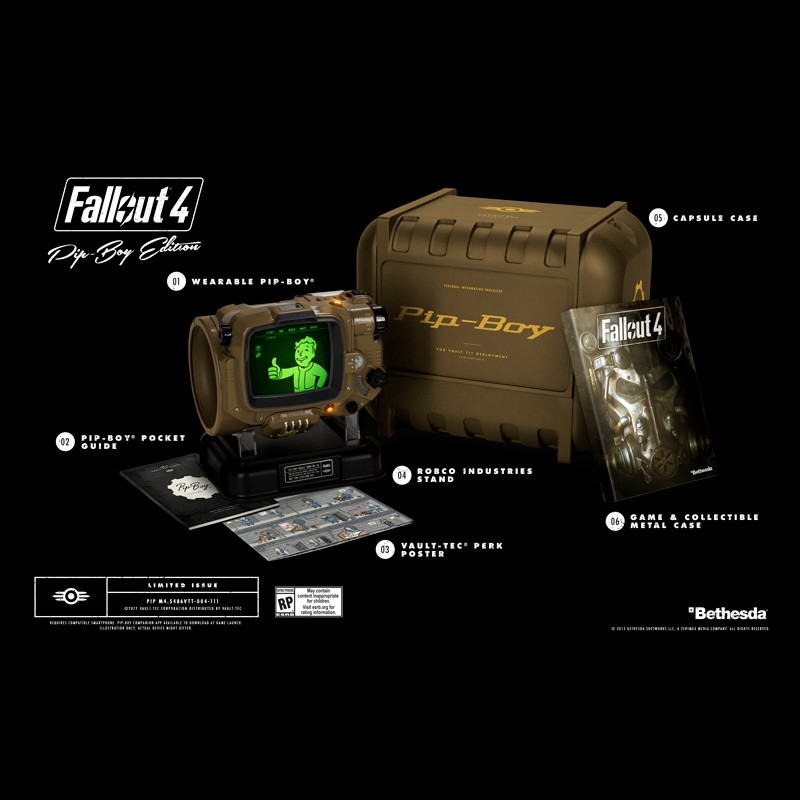
In fact, one of the things I was most cynical about was Bethesda trying to sell us the Pip-Boy edition of the game, which comes in a special case with a bunch of extras, including a life-size recreation of a pip-boy which you can slot your smartphone in, to use as a replacement screen. I have the exact charges here, M’ lud, taken verbatim from the original article.

“But I’m worried the game is spreading itself too thin, because we really didn’t see much, even though it was trying to show us everything. One fight, a sped-up crafting demonstration, and all the less interesting bits of the plot, and to top it off, the presentation still had to be padded with the dull-looking app and the Collector’s stuff. Look, Bethesda, why don’t you show me what this game is actually like before you try to convince me to buy the version that costs over a hundred bucks?”

I do think my argument still stands, by the way. I didn’t really know what Fallout 4 was at that point, so I wasn’t going to spend money on a better version. I still needed to see the standard one.

But that smug feeling faded slightly over the next two days to be replaced by an uneasy feeling of awkward realisation, understanding that I might have just been very stupid. Why? Because, well… I really wanted a Pip-Boy. Like, a lot.

Part of it’s a weakness I’ve had for trinkets since I was a kid, something that plagues a lot of geeks like myself. Like a bespectacled magpie, I have to grab anything of value, just because it’s so pricey and holds some very minor status. I’m pretty bad with comics, for example, grabbing the more respectable issues on sight, issues that I didn’t want until I saw them, or snagging little toys related to games I have a fondness for. At the end of the day a lot of the problem is hubris and being weak-willed. That’s a rare and expensive item? Well… I’m a rare and expensive person. Yoink!

But part of it is that the Pip-Boy looks genuinely cool, and I like the idea of having it on my shelf like a gaudy trophy, or wearing it to taunt those who didn’t get one. Aside from Vault Boy, it’s the most iconic thing in the Fallout series.

I started to realise that I might have been very stupid, and the uneasy feeling became worse and worse. By the time I realised how badly I wanted one, they’d all been pinched by heartless scalpers and die-hard fans, much to my frustration and embarrassment. But luckily, Bethesda decided to make a few more, and a very good friend of mine who works in a Game store procured me one. Shout-out to you, anonymous figure. The only way I would’ve been more happy would’ve been if you sent round the less inhibited members of a burlesque show.

PB

My precious… Gives it to me, the preciouses…

So I’m getting a Pip-Boy come November, and it can’t come fast enough. And that makes me stupidly proud, but I’m also worried I look like a bit of a hypocrite. I’ve mentioned several times on this site that pre-ordering is a dumb idea, and now I’m directly benefiting from it… Should I be eating my words?

Nope. Don’t you people realise yet that I’m forever right and infallible, like Jesus with better hair? I haven’t broken my rule, because in truth I’m not against pre-ordering as a concept. In fact, times like this prove that you should  pre-order in some cases. That first batch of Pip-Boys were gone in two days, those that got them were smart to be as fast as they were.

That’s when you pre-order, that’s when it makes sense. When you’re scared that the amount of copies may run out, you reserve one to get on the day it’s released. There won’t be any more Pip-Boy editions of Fallout 4, sadly. And when the next game is released with an edition containing your own pet centaur, it’ll make sense to pre-order that too.

But that’s hardly ever the case these days. It makes no sense to do it with digital copies, and when was the last time you went into a store on the day to pick the normal stuff up, only to come out disappointed? In all my years of gaming, it’s only ever happened to me once. They just don’t run out of regular copies any more.

The truth is that the bigger the release, the less likely it is to vanish from the shelves. The shops buy according to the public demand, and they always buy more than they think they need, because they know they can sell them later in the year. It’s not like the games are going to go off, they’re not a box of peaches, so they just stock up on enough copies to build a fort with and divvy them out over time.

Now, let’s talk about the actual advantages of pre-ordering. There are two main reasons that publishers love this practice, and one of these is harmless and doesn’t matter to the buyer either way. However, the other reason is a very nasty, insidious one that is directly to our disadvantage.

First, the harmless reason. Pre-ordering helps publishers because they can start making educated guesses on how many more copies they’ll have to make, how many sales they’re going to get, how lucrative advertising might be, all that mush. It doesn’t benefit us, but it can help publishers get all sorts of useful information that can help them maximise profits or reduce unnecessary spending. Again, it doesn’t hurt us, but it’s also not our problem.

But the other idea behind pre-ordering is quite manipulative and cruel. See, pre-ordering means that you’ve bought the product before it’s been reviewed, before it’s been criticised. You’ve paid money for a game that might be rubbish, and by the time you’ve found out it’s all too late. You’re committed to the buy. Before Steam introduced refunds, this was even more of a problem.

But surely that can’t be all that common, right? I mean, if a game was surprisingly bad or even broken, we’d know way in advance. It’s only happens in rare events like Assassin’s Creed: Unity, Duke Nukem Forever, Aliens: Colonial Marines, Arkham Knight for the PC, Arkham Origins for the PC, Sim City, Watch_Dogs, Destiny, Thief, Halo: The Master Chief Collection, Driveclub, Sims 4, Titanfall, Sonic Boom…

Hmm. Maybe this is more common than we think.

And of course, it leads to getting burned by that sense of disappointment, self-loathing and feeling cheated that pre-ordering a shitty game always brings.

Duke Pukem

The tale that never stops being relevant. Maybe some games should just stay dead?

There’s more problems. For the reasons mentioned above, publishers are getting more and more desperate to rake in the pre-orders, ravenous to separate us from our money at the earliest opportunity. They really like it when we pre-order, it’s just safer for them on every level.

And thus we have the pre-order bonus. New missions, new character skins, new weapons, new gear, new content packs. Order now and get it free, all for you to enjoy.

Except none of it is new. This stuff should be part of the release as is, because a lot of the time it originally was. But before it’s sent out and distributed, publishers look at a full game with the clinical eye of a mad scientist. What can we amputate from this game without killing it in the process? How much can it afford to lose? Snip, snip, snip.

Don’t kid yourselves. They’re not selling you extra content, they’re holding the original content to ransom. They’re keeping it back from you to offer out again when they feel like they need it, making you jump through hoops for parts of the original design. If I kidnapped a large family (again), and returned them all back later except for elderly aunt Gladys, I wouldn’t try to sell her back to them under the label of a beneficial add-on. “Pay the ransom before August in order to get the Crabby Old Woman DLC.”

But if we stop pre-ordering and come down hard on publishers for this nonsense, they’ll stop hacking bits of content off the game. We’ll get the whole thing, all for ourselves. I wouldn’t have bought the better version of Fallout 4 if there’d been actual gameplay bricked off, but Bethesda have been gallant enough to leave their beloved creation alone and unmolested. Good for them.

ACU Gunshot

We never saw him coming, sir! He clipped straight through the wall at us, and when one of us attacked his face it vanished completely, leaving only eyes and a mouth floating in mid-air!

And seriously, do you HAVE to get that game in the first few minutes of release? The fact that one of the arguments for pre-ordering on Steam is the ability to “pre-load” has always irked me, mainly because it shows how utterly terrible people are at waiting for their games. Can’t you show the tiniest bit of self-restraint? It’s for your benefit, you know. I wouldn’t throw myself at a meal if I knew there was a chance for it to be poisoned, I’d wait for somebody else to try it first and find out for me.

For those who don’t know, pre-loading means that you can download the game in advance, but the file has a little lock on it. When you reach the release date, the lock comes off and you can start playing instantly. Here’s a thought – why don’t you wait twelve hours to buy it, a period of time you could literally sleep through, then check the reviews (which will be out by then), and reconsider accordingly? A lot of disappointing purchases could have been avoided if people just took the time to check what they were spending money for.

That’s all it comes down to – making sure. Are you hoping for a limited product that looks to vanish fast? Then go for it, that makes sense. But are you enthusiastically encouraging companies to hack their games to pieces in an attempt to trick you into a bad purchase? That’s not as smart. In fact, that’s very, very stupid. And now we have this bizarre situation where it makes sense to pre-order the more expensive version of a game, but not to pre-order the cheaper one.

Anyway, time for me to sit around drawing pictures of Pip-Boys. Whoever said material things don’t bring happiness was quite clearly a moron.

PRESS F TO GIVE UP ON CINEMA

You know that new game that’s “cinematic?” Well, bollocks to that.

It’s not a nuanced start to an article, I know, but it’s really starting to annoy me whenever I see that word come up when referring to a game. It crops up a lot on IGN reviews, enough that I’m wondering if they get paid to use it. They coo about how cinematic it is, but is that a good thing? In short, no. Not in the slightest.

We know what that phrase actually means, of course. It’s used for games like Uncharted and Call Of Duty. Titles that are defined by their set-pieces, by pretty graphics and impressive (but often meaningless) visual effects. Buildings exploding in slow-motion, detailed shots of vehicle crashes, scripted action sequences that you mustn’t deviate from in any way. Seriously, if you do anything but the exact actions they have in mind, they’re going to stamp on you, hard, and make you start all over again. That’ll teach you to have free will, you troublemaker.

The reboot Tomb Raider had a lot of this nonsense going on. You know the sort of thing I mean – sliding down a hill and rolling out of the way of debris, or parachuting in an uncontrollable direction and having to swing out of the way of trees. It’s a big thing for major games these days, to have these visually memorable stunts, but it’s pretty dull and unengaging. The whole thing feels weirdly artificial and seems to want to wrestle control from the player. They’re like overbearing mothers, slapping our hands whenever we try to do our own thing.

SOTL

What could go wrong? No, don’t answer that.

I think there’s some weird belief permeating the whole industry that games should aspire to be like films, but I don’t get why. If a film became a slideshow so that it could be more “photographic,” or books started trying to clamp on your hands to be more like a video game, we’d think the creators had lost their marbles. Why can’t you commit to the medium you’re part of? Surely games are at their best when they embrace their nature and work with it, as opposed to against it?

Spec Ops: The Line is a phenomenal example of this. The writers understood that there was a unique opportunity here, one that was exclusive to this medium. See, their stroke of genius was to make the player commit awful atrocities in order to survive. What was the effect of that? Well, we felt responsible. In a story all about the damaging nature of guilt and the things that humans will do to survive, Yager used the interactive dynamic of the game to make us feel guilty. And god, did it work. You couldn’t do that with a movie, we’re only observing that as an outsider. But not here. Here, you’re the one who pulls the trigger and ends up with severe PTSD. If you’re lucky.

There are other examples of this. The Far Cry games are nicely organic, and why? Because they work with choices, not with a script. For example, you want to take out a stronghold of bad guys? Sounds cool, what do you feel would be a fun way to do that? You could go all sneaky and start backstabbing people like Ezio on a bad day. You could charge in with an LMG and turn everything into red mist. You could sit on the next hill along and start sniping bad guys as though they were heavily armed ducks. Or you could just set a tiger loose and have him take care of everybody for you. What floats your boat? We cater for all tastes here, my friend.

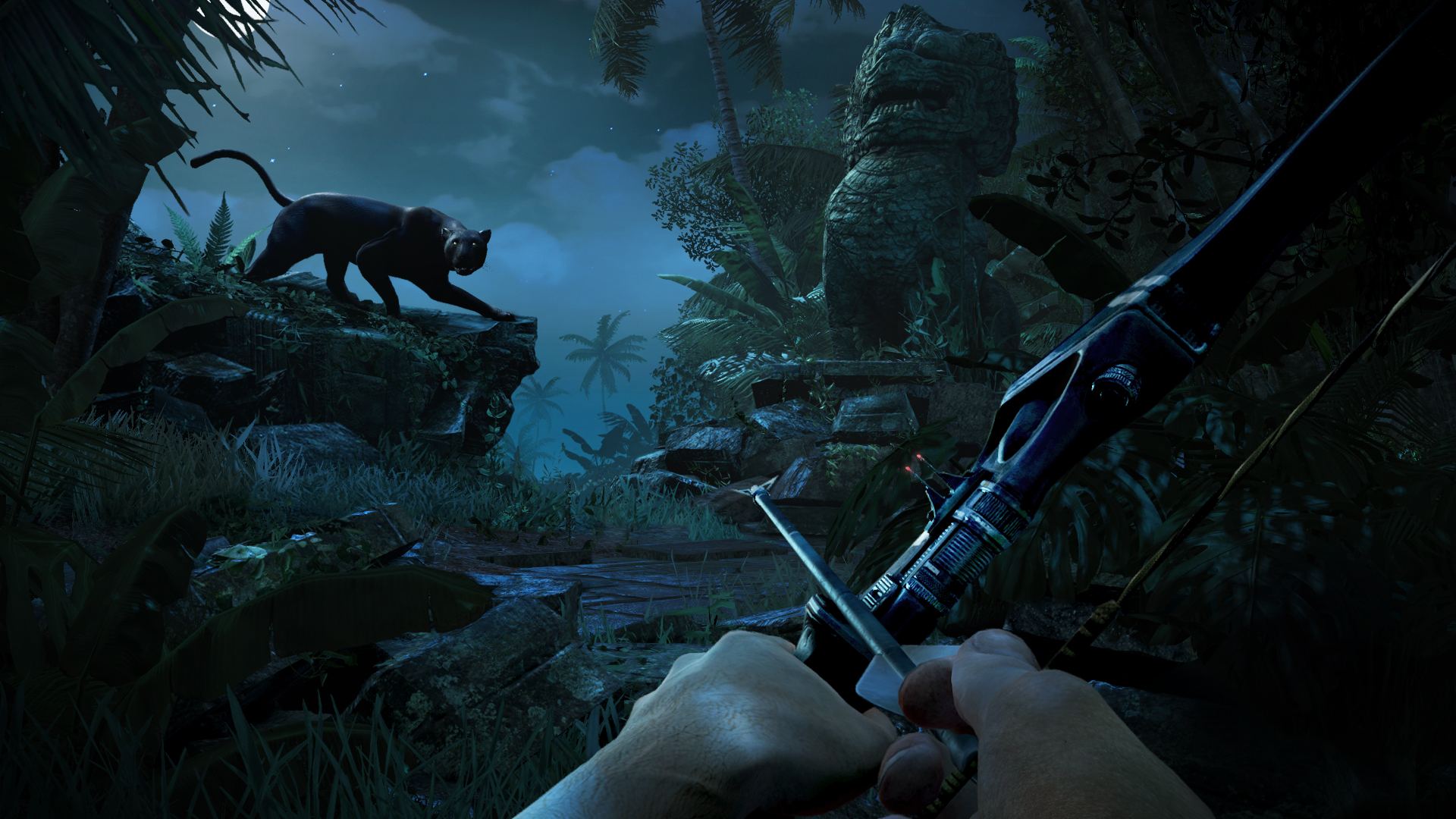
Pussy Cat

Don’t worry, folks. That panther went to a really nice farm with other big cats. Then I shot it with an arrow. That’ll teach it to try and hide.

These games work because they aren’t constantly fighting to be something else, and the worrying thing is that we’ve seen when games are trying to be more like movies. It’s not pretty.

Let’s be straight here – I did not like Heavy Rain. The story was absurd, the characters were boring, the tone was surreal and the gameplay was minimal. The sex scenes made me cringe and the irrelevant ninja fight dream sequence made me want to bang my head on the wall in frustration. The only good bit was watching one of the characters lop his own finger off. Call me cruel, but that was the only part of the story that seemed even somewhat grounded in reality.

I don’t really get why David Cage makes these games in the first place. They can be done well – Telltale’s recent trend of games, the one that started with The Walking Dead, proved that they live on strength of story and that you need to have your QTEs integrated well with the action to prevent it from being distracting.

But Heavy Rain’s story was abysmal, and the complex combinations of button pushes needed to perform the action scenes was like trying to bring somebody to orgasm with one hand whilst trying to make a caeser salad with the other. And Mr Cage, if we fail one of these, please don’t count it as a choice for god’s sake. If I choose to let somebody fall off a cliff, you can roll with that. It’s what I wanted. But don’t do it if I just missed the button prompt, because that leads to a story I’m not interested in, one I didn’t want.

I honestly don’t know who David Cage was making Heavy Rain for. Film lovers? Nope. The story’s too long and doesn’t have the tight structure that would be expected, not to mention that large portions of the game are filled by wandering aimlessly around, looking for the thing that wakes the plot up again.

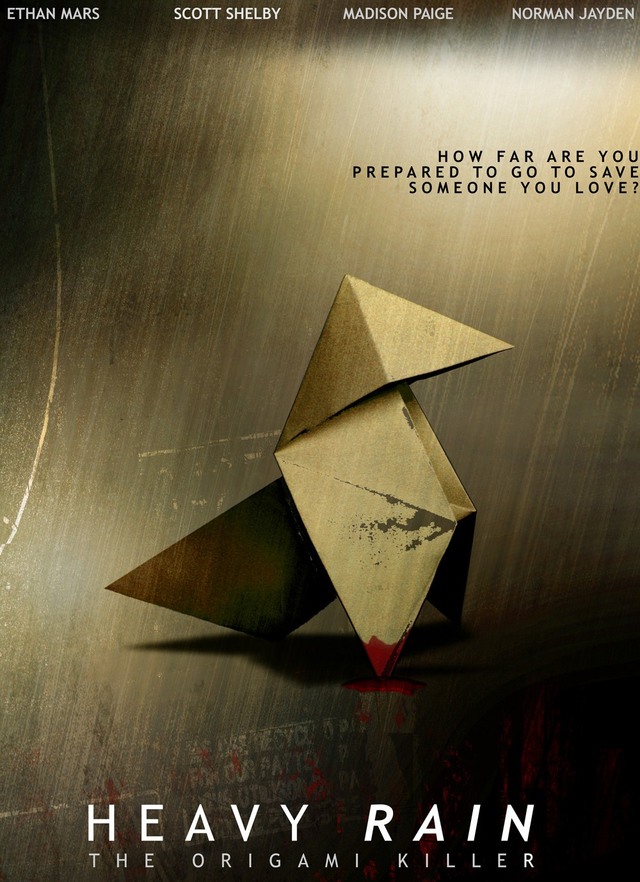
HR poster

Does anybody else wonder if Mr. Cage is upset that he directs games and not films? Maybe we should start a Kickstarter to get him a job with Michael Bay. That’d make him happy, and also stop him making stuff like this. Win-win.

Is it for gamers? God, no. The gameplay is anaemic and reluctant to show up at all, like a cantankerous Baptist uncle at a gay wedding. Not to mention that any ending that isn’t the totally happy one feels like a failure on the player’s behalf. So who exactly is this mess of mechanics and motivations aimed at?

Well, it’s aimed at the gamer that hates video games. The snobby hipster, the aloof critic, the unimpressed academic, who plays Rayman Origins or Team Fortress 2 and sniffs at how there’s no depth to the writing. The one that loves anything pretentious, and doesn’t see the value in fun.

David Cage seems to view himself as an hauteur (though I don’t see it myself), and Heavy Rain is aimed at those who think like him, who would rather see fake depth than genuine joy and who are just happy about the fact that the game is different, rather than thinking about whether it’s engaging or even if it makes sense. It’s innovative, but that doesn’t mean much. Putting bleach in your eyes is innovative, but I’d be reluctant to call it an improvement.

It’s just weird to watch at this point. Is he embarrassed about the fact that he’s making a video game? Indigo Prophecy had an unforgivably awkward joke where a character makes fun of fetch quests whilst doing one of his own, almost like it wanted to weakly urge how unlike that trope it was. It also didn’t have a “Start Game” button in the menu. Nope, Indigo Prophecy opted for the “New Movie” button instead. I guess if you’re laying your cards on the table, you might as well do it with enough force to break that table in half.

But I can’t deny it – David Cage’s games are indeed cinematic, but it’s also why they suck. They’re basically going through a crisis of identity, and boy, does it show. Let’s not forget the key factor about cinema – it’s unwavering, it’s inflexible. Films don’t change depending on how we hit the play button, they’re not going to obey our instructions. They are inherently non-interactive, but a game is defined by interactivity. They need it like a swan needs a bad temper.

That’s the real issue to be noted – the more cinematic a game becomes, the more it strives to take control from us. Cameras pull away from our control to show events, characters perform moves we aren’t even aware they’re capable of doing in the middle of QTEs, freedom is compromised so that the game can tell its story, and not ours. This is fine in tiny quantities, but it gets annoying when it becomes overbearing. And I have one more way to prove it.

“Press F to pay respects.” That’s the future of cinematic gaming right there. It shouldn’t hope for much respect itself.

WE NEED TO BE CRUEL TO BE KIND

Acting nasty is really, really fun. No, don’t lie, don’t disagree. You’re a nasty, dysfunctional human being like the rest of us. You get a kick out of tormenting your fellow man, just as much as we do. When you sprinkle toast crumbs in a friend’s bedsheets, it’s done for that tired, haggard look of misery they have the next day. When you spend five hours lowering a person’s doorway with newly-learned carpentry, it’s all for that satisfying clonk as they discover what you’ve done via the medium of the forehead. When you lure a person into a room with a pack of hungry wolves, it’s so that you can witness the outrage on their face as they hear the the click of the lock behind them and realise the significance of that raw steak you gave them.

… Alright, maybe there’s a limit.

The reason I bring this up is because I’ve heard some grumblings from the other side of the industry recently, from developers and mainly the indie ones at that. There’s the idea floating round that criticism of smaller, independent games needs to be more careful, to be tactful, to be considerate of context and not to be as harsh or clinical as the criticism of major releases.

The most recent time I heard this was in the interview with the critic, journalist and online personality Jim Sterling, formerly of The Escapist and Destructoid. Mr. Sterling had already been accused of being overly brutal and living off the work of small developers when he came down hard on Skate Man Intense Rescue, a memorable product made by Digpex games that he tore to shreds online.

In a responding letter, Digpex accused him of “using poor weak developers for money,” and this came up in his interview as well, with the frustrated creators of The Slaughtering Grounds (another game he reviewed unfavourably) claiming that he was a “leech,” dependant on the work of small, struggling developers whilst harming them in the process.

TSG

This is The Slaughtering Grounds. You… Should try it before you judge. Or not. Could always let a critic judge for you.

I’ve seen the same ideas levelled at personalities like TotalBiscuit and AngryJoe on forums too, and both have been the subject of attempted censorship on YouTube, when upset developers try to take unfavourable videos down under the guise of copyright. It’s embarrassing, clumsy, and it never works, but they try anyway.

I do get why indie developers can get so upset. Indie projects are small scale and thus very personal. A developer might be desperate for the income that such games generate. There can be emotional attachment to even the most horrible, lazily constructed game.

But I’m going to have to tell you developers that I think you’re wrong to make these claims, because the gaming industry needs no more of this “the player is the last one that matters” mentality. I said before that this is a akin to a war between those that make the games and those that buy them, and whilst this isn’t a major blow, it is an attack on consumer awareness and worth responding to.

Let’s make this clear – if you are selling a game, for money, in the public sphere, you are up for criticism. All of it, on every level, uncensored. You don’t get a pass depending on your circumstances. You also don’t get to cancel out unkind criticism, even though it never works.

The Slaughtering Grounds is currently on sale for fifteen pence, but it wasn’t when it was put up, when it was getting the initial attention. It was going for almost ten pounds. And as somebody who’s played it, I don’t believe the quality of the product justifies that price. That was too much to ask for the product as it was being sold.

That might sound mean, and it probably is, but I don’t think it matters in comparison. When somebody criticises something and ends up giving the final verdict, it’s often done with the price taken into context. For example, watching a crap film would still be unpleasant, but it’s not so much of a loss if the ticket only costs fifty pence. It might even be worth it, if there’s a good sex scene halfway through and you can just sleep through the rest in a comfortable cinema chair. But if it’s fifteen pounds? Well, the situation’s different. It’s not good value for money.

That’s the point – criticism defends the consumer against the deceitful monsters that are PR, Marketing and spin. And when criticism is dropped, some very big problems can get past the radar. Critics were waiting to leap past the review embargo when Aliens: Colonial Marines came out, desperate to warn the public against a horrible game that was riddled with technical issues and disturbingly different to the trailers. And those that pre-ordered the game were wishing that they’d listened to them first.

ACM

Horror is contextual. The game wasn’t scary, but the attitude it represented terrified everybody.

It’s the same principle here. Money is important to people (not to mention the time invested) and they want to know they’re getting the best use out of both of these things. Thus, if you’re selling something for money, the critic is morally obliged to urge potential customers against it if he thinks they could be getting far better use from other products and other uses of their hard-earned cash. It’s not just the developer who has to be watchful of income, you know.

Besides, things get better when they’re criticised and the developers take it into account. There’s a reason why we put “constructive” at the beginning of that word so often. A good critic doesn’t just wave his or her hand at a product and say “Yeah, that? That’s kinda shit, don’t waste your time.” Even with the most toxic product, the critic points to specific issues and says exactly where they’ve gone wrong, or even suggests potential solutions for the next game.

And if they’re being mean? Well… That’s the way it goes sometimes. I’m afraid you’re going to have to grow up and deal with it, and I’m not being harsh here, that’s just the risk you take when you enter the public sphere. We all know this, none of us are exempt from it.

That said, critics probably shouldn’t be unjustly cruel, or at least should have good reason for blistering reviews or analysis. You have to know what you’re talking about, have to feel right in saying these things. You’re not a priest, you do have to put SOME effort in to proving your claims.

That’s the final point I’d make. Brutal criticism might be hard to hear, but it’s not done out of spite, it’s done out of necessity, for both the customer and the creator. So you’re going to have to learn to deal with it. Remember how at school, there was always that one kid who cried at every little thing? Don’t emulate that kid. That’s not going to get you anywhere, except dehydration and wet trousers. That one’s for you, Wikiquote.

THE WORLD LOVES TO HATE HATRED

Talk about being behind the rest of the world, next thing you know I’ll be discovering that people landed on the Moon when my back was turned. See, I finally got round to playing Hatred, the recent isometric shooter to hit Steam in the same way that a brick with a rude note tied to it hits a window.

Hatred was announced a while ago, and garnered a lot of press attention because of the fact that the objective of the game is to run around an American town with more weapons than the average platoon, gunning down everything you see for basic recreational purposes. Can’t we just stick with Crazy Golf?

Let me start by saying I do quite like the visual design in Hatred. It’s almost completely black and white in the Sin City/Madworld/Schindler’s List style, with important factors like fire or police lights done in full colour and the whole thing comes across as quite engaging to watch, if nothing else. I’m getting this complement out of the way early because it’s the only thing I’m going to praise. The rest of the game is a load of rubbish.

Right then, let’s get down to the meat of it – you play as an unnamed character in a douchebag leather trench coat, who is inexplicably angry at everything in the universe. Oh god, I thought, as he growled his threats at the camera. This is going to be a long evening.

Oh, and to the developers I say this: the “unnamed character” aspect is bloody asking for it in my opinion. People will instinctively fill the gap with the first name to float through their thoughts, and it my case it was Mabel. Somehow I don’t think that’s what you had in mind, but that’s as seriously as I’m going to take this greasy wanker.

Mabel and Shotgun

Excuse me, good sir. I believe my shotgun barrel is blocked. Could you possibly check for me?

Anyway, Mabel has decided that he’s bored of the fetid worms in this dying corpse of society (no, he really does talk like that), and from behind the black curtains of his award winning “world’s worst haircut” he makes the momentous decision to run out and start blowing heads open like they’re a bunch of coconuts in a shy.

Then he gets shot and killed ten minutes later because the controls are rubbish. There’s little niggles, like the inability to control the camera, but then there’s some big ones, like the fact that you have to sprint at cover to vault over it. But this requires both a run-up and that you come at it from a direct angle, and several times I found myself glancing off fences like a sparrow flying into a window pane.

Also, I’m fine with destructive scenery, Hatred, but not the way you do it. Red Faction proved it was fun to drive through the wall of a bunker and watch it collapse. XCOM proved it was useful to blow holes in buildings to get the best angle of attack. And in Hatred, the ability to knock down a wall with a well-placed grenade would be fine, but not if it’s just useless. At one point I got swamped by the scurrying insects of this corrupt and tiresome world (that’s the local constabulary to you and me) and tried to flee through a gap in the wall I’d made earlier.

Except that Mabel ran smack into nothing and just started jogging on the spot like he thought this was a good time for his morning cardio. Oh, I see. Destruction physics with a low attention span. Do we want to give this programming lark another go?

The AI is just as useless. Civilians will run when they see you open fire, but only for about five seconds before they lose interest and start milling around again like farmyard turkeys. Some enemies will see you before you’ve even entered the same building – presumably they use X-ray specs – and they all seem to gravitate towards fire like suicidal moths.

On top of which, the only way to regenerate health is to perform executions on weakened enemies, which all involve some boring fatality in which Mabel shoots them or cuts them up whilst looking like he’s trying not to ejaculate all over his coat.

But this means that there’s almost no point in using the better weapons, which all kill in one hit and don’t allow you the chance to get your HP bar back up. And considering there’s no penalty or danger in executing people (all the enemies stop shooting whilst you do so, presumably they’re keeping score), you might as well use only the starting pistol so you can stab your way to full health when you need to.

Mabel Dances

You gotta practice your dance moves, even when you’re in the middle of a killing spree. You – are – GOLD!

The weird thing about Hatred is that it gets boring VERY fast. Killing people has shock value, but it’s not long before you realise that it’s all this game has to offer, and it’s not even very good at that. Nobody shows any humanity or intelligence whatsoever, so it’s hard to feel sympathetic for these automated screaming machines, and Mabel himself is about as complex as a Bond villain. We never know why he wants to kill, or what drove him to this state. Maybe if he had demonstrated internal conflict we would’ve felt something more towards him, but he just clomps outside in combat boots and starts smirkingly gunning down people at the bus stop.

I also noticed that the game is tagged with the word “Mature” on Steam, which gave me a good chuckle. It’s anything but mature, this is the sort of game a thirteen year old with too many Image comics finds cool. Everybody who’s grown up at all knows that this is just ridiculous, it’s a child’s view of what adult material should be.

In fact, Hatred seems kind of cynical in my mind and not in the obvious way. It’s the bare minimum needed for controversy, you know what I mean? People might have been worried about the message, but there is no message here. It’s been made purely to exploit the profit that comes with a controversial release, and there’s nothing else to it. No statement, good or bad. Just a product out to make money.

I couldn’t help but wonder if the developers were having fun with it by the end. There are times where I come close to thinking that the game is a parody of itself, a knowing jibe at the silliness of the basic concept. Mabel is a rejected slasher movie monster as opposed to an actual character, and I just started laughing at his stupid lines about “toxic vermin” and “blessed damnation.” They’re not being serious with this, right? I’m imagining the voice actor trying to get through his lines without giggling, whilst the guys doing the recording pull faces at him through the glass and wear black wigs that come down to their shoulders.

But it doesn’t matter. The media took it in a straight-faced manner, and I’m sure they’ll take the relative success of the game seriously too, when there’s really no need. The reason that it sold so well was that most people wanted to know what all the fuss was about. They’re only interested because pundits spent several months telling them that they shouldn’t see it. It’s basic human curiosity, it’s Pandora’s box. Tell us we can’t have something and we’ll want to have it more, just to understand why we can’t.

And the reaction from those who played it was actually pretty encouraging. The critics just rolled their eyes and went back to The Witcher 3, and the Steam page is littered with joke reviews taking the piss out of the game. Isn’t that strange? The only people who were looking for an evil message were those that didn’t want the game to be released at all.

But I can anticipate the response to this of argument. Some might say that we have been desensitised to violence and gore by these kinds of games. Desensitised by Hatred, by Postal, by Grand Theft Auto, by Manhunt. Even my precious Dark Souls got a lot of attention when it was found in the room of the Craigslist Killer, Miranda Barbour. Thanks, Fox News! Another reason for me to hate everything you stand for.

But I really don’t think violent games do effect us much. There’s a little switch, an understanding that registers in people’s minds. We know when we’re observing a fiction or a harmless fantasy, and when we’re observing real life. We can make that distinction without difficulty.

In an age where you find footage of anything online, we’ve all probably witnessed video recordings of people dying, be it publicised tapes from terrorist groups or live news of police combat. The one that haunts me most is the suicide of the politician Budd Dwyer, who took his life at a press conference in 1987 when he put a revolver in his mouth and pulled the trigger, all the while advising people to stay back lest they be hurt accidentally, and ignoring the pleas of those around him.

It’s horrible to watch, the sort of thing I shall not forget within my lifetime. I think it’s the speed with which it happens, the rapidity in which he goes from a complex human being to an unthinking object on the floor. After pulling the trigger, he drops with startling speed, blood leaking out the top of his head and pouring in streams out of his nose, as witnesses scream and rush forward.

I never knew the blood came out of somebody’s nose when they did that. It never occurred to me that it would.

Budd Dwyer

R.I.P, Mr Dwyer. I’m sorry that it had to end the way it did.

But that’s the point. That’s real life, and no rational person looks at that event after playing Manhunt and shrugs their shoulders. The experiment’s been done, we see people react in visible horror to this kind of footage, whether they’re gamers or not. They still have that basic empathy that they had before they started playing. The reason we don’t respond to gaming violence is because we understand it’s not real, we can see the difference.

I think that might be the reason for violent figures often having violent games to hand. I don’t consider those games to be the cause of aggression, instead I think they’re the outlet for aggression, at least for a time.

If a person feels angry and wants to hurt somebody, maybe it helps him to let it out of his system in a harmless, pixelated world. But of course, they too can see the separation. They understand, like us, the difference between a false world and this one. And for that reason the game has limited capacity as an outlet for that anger, and that’s when things get very bad.

Do you really think that a game could do otherwise? Drive a normal, sane person into the realms of psychotic insanity? Turn a pacifist into an axe-murderer? If this were true, why did we not see a spike in aggression when GTA V was released? The last figures put the sales of that game at 52 million copies, so why has gamer violence not gone through the roof in the last two years? It’s had the time, and should only have gotten worse with the PC and next-gen console releases.

It’s important to distinguish that it’s not the case that games make you crazy, because people keep trying to ban them for that reason. Australia and Germany won’t allow Hatred within their borders for a start, and there have been other games that have suffered the wrath of short-sighted political figures who want something to get all righteous about. Maybe with time they’ll work out that we’re grown-ups and can choose for ourselves how we spend an evening. Maybe.

Anyway, I’m thoroughly miserable after thinking back on poor Mr. Dwyer. Time for a bar of chocolate and some digital killing sprees in Just Cause 2. And you know what? I’m not even going to use a hookshot on anybody in real life afterwards.

VIDEO GAME WOMEN? WE’RE CLOSER THAN WE THINK

So after the success of the last article, I realised that I’d made a bit of an error. See, whilst I did a lot to shout self-righteously about certain sexism issues within gaming culture, I wasn’t doing much to solve those issues. Don’t bring me problems, bring me solutions, right? Sure, you can tell your friend when he’s accidentally driven into a car crusher, but unless you wander round and find the “OFF” button it’s not going to do much to help him.

But not to fear, because there is a way. There are certain female characters in video games who to my mind, are aspirational and worth emulating, not just for women but for all genders. They avoid cliché character tropes, they have fully developed personalities, they don’t sell themselves on eroticism. They are, in other words, figures we can learn from.

That said, I’ve heard some people say we should see a realistic representation of women in society in video games, and to that I say: NO. For now and forever, no.

I’d say it if it were about men, too. I play video games for escapism, I do it to leave the outside world for a few hours. I can’t imagine anything more horrifying than getting dragged back into a digital recreation of the world I’m trying to ignore.

You know the kinds of games that follow that model? The Sims. Nintendogs. Farmville. If given the choice of playing a superhero or an office clerk, I’m going to stick with the first, regardless of what gender is involved. Games should be progressive, but we can’t throw fun out the window, no matter what.

Look at The Path, perhaps one of the most irritating games I’ve seen. Yes, it’s all a big metaphor for woman in the modern world and how we treat her. How is it as a game? Well, it’s boring, pretentious, and clearly thinks it’s so much smarter than it is, when it just comes across as hostile to the player. Surely these things are more harmful for the reputation of women in gaming than anything else? It makes it seem like feministic games are dull as ditchwater, with no sense of humour or joy to them. The Path makes me miserable, and not in the good way, like Spec ops: The Line. It’s a big, clunky message that begrudgingly allowed a game to be made around it. That’s not fun for anybody.

For that reason, all of the following characters are warriors, mutants and members of the apocalypse, and sometimes several of those at once. Does it matter? Of course not. They still have traits and aspects to them that are admirable, whatever the context they’re placed in. We can still like them for who they are and what they want from life. And let’s kick off with one who embodies the term “professional.”


ATHENA THE GLADIATOR – BORDERLANDS

Originally created as a side character in the DLC campaign, The Secret Armoury Of General Knoxx, Athena was a cool and calculating soldier for the Atlas Corporation’s Crimson Lance militia, then an assassin, then a defector. See, Athena was searching for her sister Jess on the world of Pandora, and was planning on quitting the military life once she found her sibling, so that they could go off and live in peace. Seems fair enough.

Unfortunately, Atlas heard about this and didn’t like what they heard. Athena wasn’t just a member of the Crimson Lance, she was the BEST member of Crimson Lance. They tracked down Jess before Athena could find her to a small village nearby, then ordered Athena to lead an attack on the settlement, believing that if Jess was dead then Athena would have no reason to leave the Lance. Ordered to wear heat-sensitive thermal goggles and unable to tell people apart, Athena stabbed Jess by accident and fled in misery when she saw whom she killed.

It wasn’t long, however, before she put the pieces together and realised that Atlas had betrayed her. Misery turned to anger, and she launched a calculated campaign of sabotage and war on her former employees that wasn’t just effective, it took Atlas off the planet of Pandora for good. After that she took up treasure hunting under the employ of Handsome Jack, which she took to incredibly well.
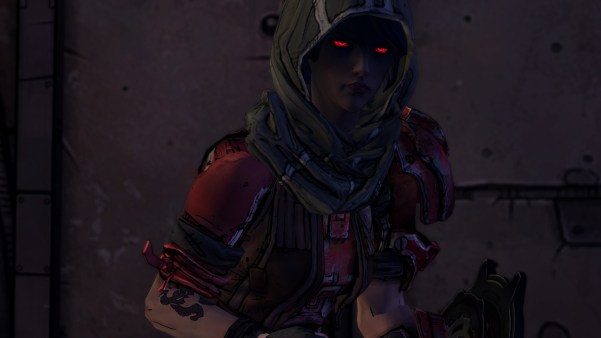
Athena

I don’t want to sound like a dopey fanboy, but… she’s so cool. She’s really, really cool.

All this is pretty grim and foreboding, so why do we like her? Well, because she’s pretty kick-ass and nothing if not independent. Athena would do her Greek namesake proud, she’s a tactical genius and an accomplished warrior with a taste for adventure. Anybody who can go to the gun-laden world of Pandora with a sword and shield and still be considered one of the most lethal people there, well, they’re clearly a force to be reckoned with.

She’s also a genuinely interesting character, with some semblance of morality that she constantly struggles with in her line of work, despite most other Pandorans having abandoned ethics years ago in favour of survival. She leaves the employ of Handsome Jack when she sees the monster that he becomes, and spends some time training the confidence trickster Fiona in combat so that she might have a better chance of living, something she was under no obligation to do.

She’s also incredibly brave, staring coldly down the barrels of a firing squad with no fear in her eyes, and she makes a rather sweet partner for the junk dealer Janey Springs, whom she deeply cares for and worries about often.

And yes, she’s killed people, but Borderlands has always enjoyed over the top violence, and this is Pandora, for god’s sake. Ninety percent of the population are psychotic bandits, and the rest are just plain psychotic. Christ, even the plantlife and certain rocks will try to kill you if you don’t keep an eye on them. Maybe there’s something in the water.

No, Athena deserves to be on the list for showing an uncompromising, independent spirit, tempered with a moral compass and the occasional glimpse of real tenderness beneath the tough emotional armour. Salute her, and whatever you do, don’t get in her way.


ALYX VANCE – HALF LIFE 2

Half-Life as a series has been nothing if not a pioneer. Aesthetic realism, interactive storytelling, physics engines, character development, facial animation – all of these and more have been pushed forward by this incredible series. To manage all of this and remain fun is an achievement. To manage all of this, remain fun, and create one of the most memorable female characters in gaming is something else.
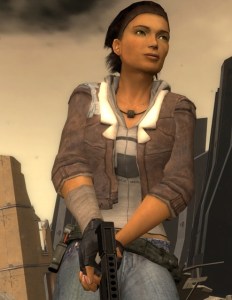
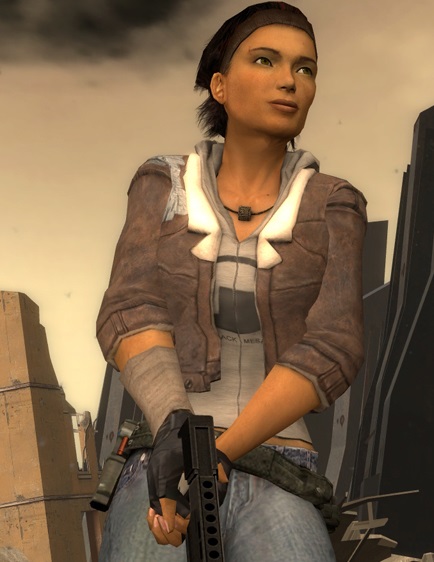
Alyx

And to top it all off, she photographs beautifully. That’s some top-notch gazing into the middle-distance there, Alyx.

Alyx Vance is one of those characters who is just a wonderful surprise in every way she presents herself. Neither an over-sexualised bimbo, a damsel in distress, or a generic action girl, Alyx is actually the heart of the story from the very beginning of Half-Life 2. I’ve heard some claim that she’s Gordon Freeman’s love interest, but that seems to be a stretch. Freeman is a camera with a beard, I don’t think he’s making many signals for her to respond to.

No, Alyx is her own person, through and through. She’s one of the most important members of the resistance against the alien Combine, utilising a variety of skills to overcome any situation. She’s a formidable hand-to-hand fighter with a great skill in firearms, an impressive athlete and gymnast, and she’s an incredible hacker and tech-head, able to reprogram any computer system, be it human or alien.

All this would be awe-inspiring on its own, but it’s Alyx’s personality that makes her shine. She’s a caring person with a real sense of vigorous optimism, all in a time where she should be miserable as hell. She cares about others and is especially empathetic, with an endearing sense of humour.

She really feels like a person, and it’s a sign of good story-telling that people found themselves getting attached to her. When she suffers loss, I feel sad for her sake. When she makes a dumb joke, I find myself grinning stupidly with her. And when she becomes injured at one point, I took the mission not to progress through the story, but because I really wanted to help her.

Alyx is symbolic of everything that is worth preserving in the human world, in a situation that threatens to take it all from us. Kindness, intellect, freedom, humour, emotion, empathy, she embodies them all, and still maintains her humanity in the situation where it is under the most strain.

Oh, and she has the best taste in robots. No, she really does. Watching her interact with Dog, the massive metal guardian that lumbers affectionately after her, is utterly adorable. And all I’ve got are those stupid fish in the utility room. Life really isn’t fair.


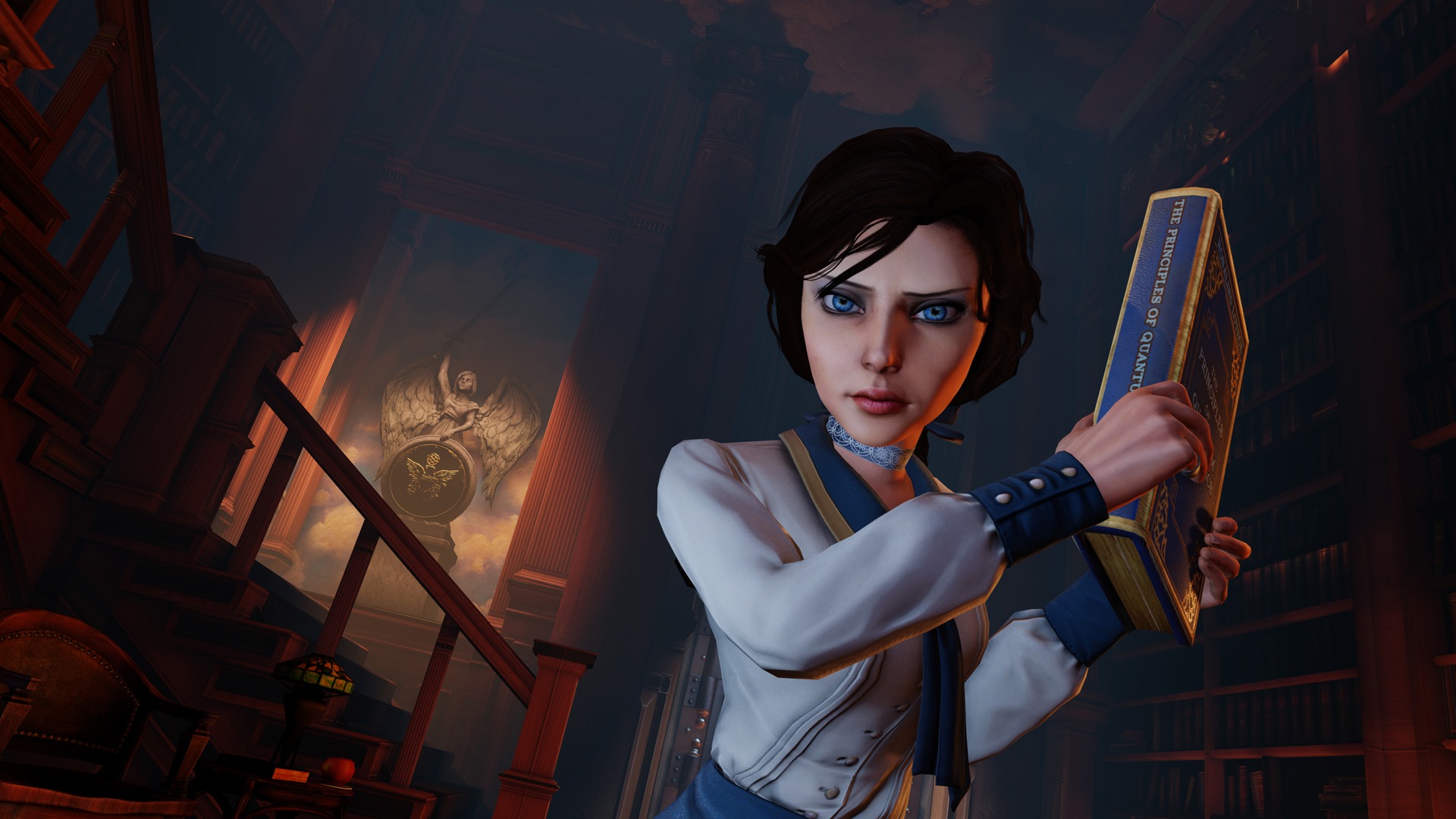
ELIZABETH – BIOSHOCK INFINITE

An important part of anybody’s life is coming to an understanding of who you are, not to mention the awkward transition to adulthood. Elizabeth is twenty when we first witness her in Bioshock Infinite, but appears a lot younger in her actions and mannerisms, something that’ll change before too long.

Bioshock Infinite is based in Columbia, a fictitious city in 1912 that floats several thousand feet above the ground on suspiciously out-of-place technology. It was founded and built by a religious nutcase named Father Comstock, who created a Christian cult that incorporates the morals of the Westboro Baptist Church combined with a ferocious obsession of the American Founding Fathers.

No, really. One of the first things you see in the city is a trio of statues that show Benjamin Franklin, Thomas Jefferson, and George Washington respectively, all dressed in angelic robes with people openly worshipping them. Of course, being horribly racist means they don’t like Lincoln much, but that’s fine. They just made a temple dedicated to John Wilkes Booth instead. Now THAT was a surprising statue to see.
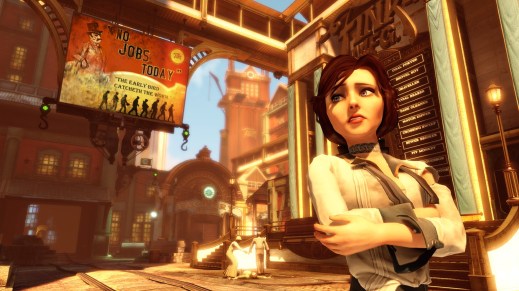
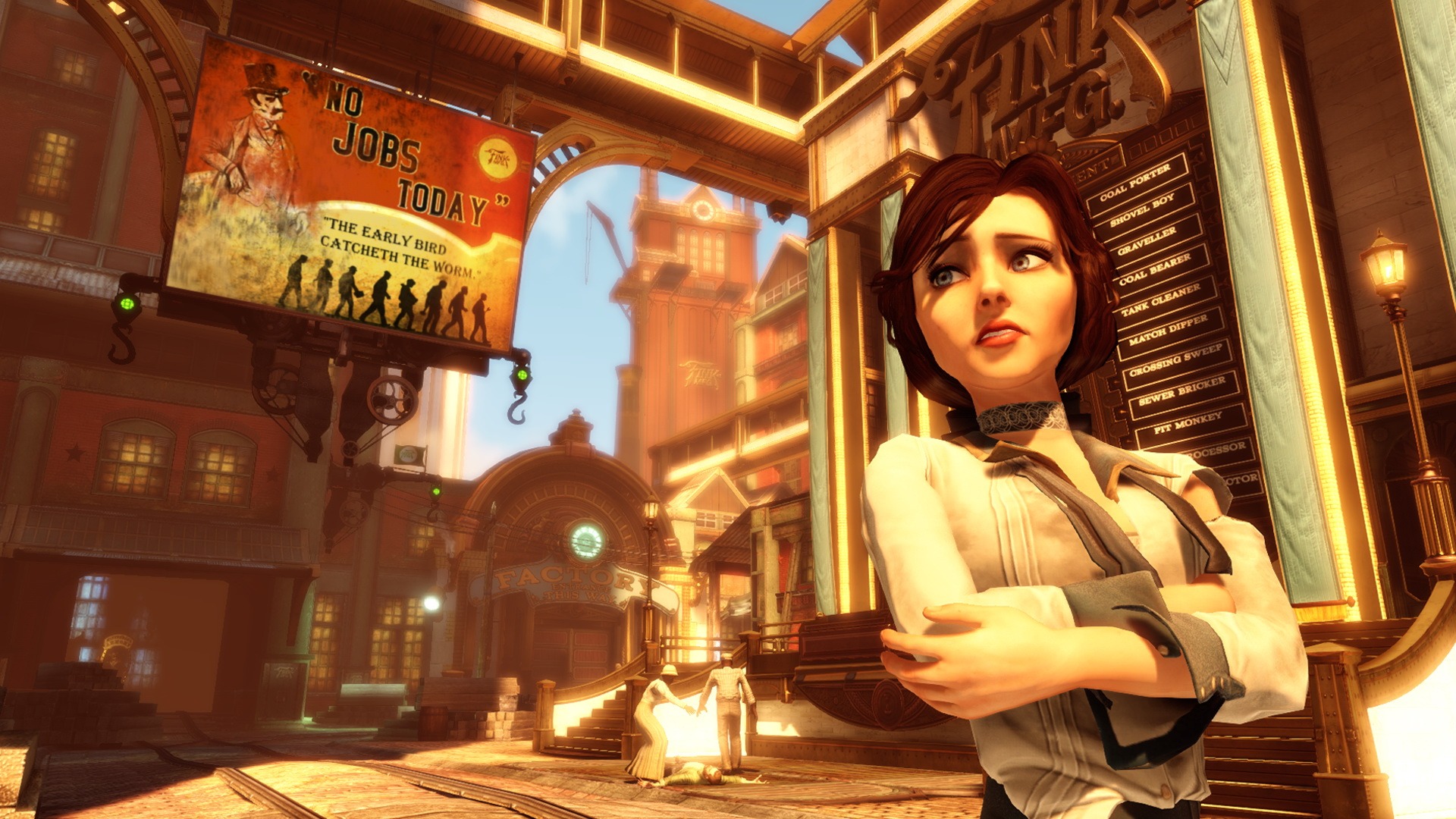
Elizabeth

When we say empower women, we didn’t mean to the level of a minor deity. That said, now I see it in action? It looks pretty cool.

But where does Elizabeth fit into this? Well, she’s Comstock’s daughter, destined to inherit the city once he finally kicks the bucket, but she’s not too keen on him or his patriotic Christian nonsense. Thus he’s kept her locked in a building since childhood until she changes her mind, with a huge artificial monster outside that is programmed to protect her from outsiders.

Of course, that’s not the only reason he does the whole Rapunzel shtick. Elizabeth has somehow unlocked strange abilities within her mind, allowing her to create tears between dimensions and even travel through time and space.

There’s something fascinating about this process and watching Elizabeth make use of it. Trapped in a tower with only books and pictures for company, Elizabeth begins to dream of escape and romanticises the city of Paris in particular, and she often opens tears so that she can witness it herself, though she’s never risked travelling through one.

In fact, Elizabeth is genuinely joyful for great periods of the game, to an extent where it almost becomes infectious. When freed from the tower, she ascends into childlike delight, experiencing every pleasure life has to offer, from food, to beaches, to dancing. When the protagonist, Booker DeWitt, suggests that he take her to Paris itself, it’s like she’s hit by lightning. An enormous grin spreads across her face and she almost seems ready to jump into the air with sheer joy.

That’s not all. Elizabeth is very well-educated, having grown up with only books for company, and occasionally quotes literature to highlight a point. She has a mischievous streak, but a harmless one and her strong will sometimes manifests as biting wit, though never to the extent where it’s tiresome.

The most engaging part of Elizabeth’s character is how it doesn’t remain the same. She matures over the course of the story and has to deal with many issues with which she can’t quite resolve herself. Violence unnerves her. Her deranged father frightens her. She can’t help but view the monstrous Songbird that imprisons her as a friend. And of course her powers get more potent with time, tempting her to use them to a greater degree.

It might sound like Elizabeth risks becoming overly weak and flawed, but she’s not, especially when you consider the dysfunctional way she was brought up. Besides, everybody in this game is bloody nuts and she seems quite stable in comparison. Not to mention that she, more than anybody else, overcomes her problems and really does change, whereas all the other characters are stuck in the same destructive cycles.

Elizabeth represents progression and the future. She’s idealistic, intelligent and filled with a love of life that’s impossible to ignore. She remains strong in the face of adversity even when she’s scared and resists the allure of power, wanting only to appreciate the finer things, like art and culture. She’s also highly reasonable and adapts her thinking in the face of better evidence or logic, but knows when she’s being manipulated and to hold her ground. It’s not Elizabeth’s purpose to be perfect, but instead to demonstrate the changes needed for perfection. And that’s a pretty noble cause in my book.


CLEMENTINE – TELLTALE’S: THE WALKING DEAD

Female heroes aren’t always limited by age. I have a special place in my cold, black heart for the bundle of violence and bright colours that is Hitgirl from the series Kick-Ass, and whilst some kids can be annoying in how they’re presented in games and movies, sometimes the creators get it just right.

Clementine from Telltale’s: The Walking Dead is one of those times. By the way, I trust the plot of The Walking Dead doesn’t need describing. It’s zombies… and you know the rest. Eating human flesh, resurrecting, shotguns, etc. If zombies could be reduced to a colour at this point, it would be a modestly faded beige.

Except that the whole point of The Walking Dead was the relative awareness of this fact. It knew that zombies were boring and that a character study of how people might try to survive in such an environment would be much more engaging to watch. Zombies hardly ever show up in that game, usually about once or twice per episode, and it’s often more tense that way because of how rare it is.

Of course, the other reason that it’s tense is because you’re fighting for two now. You play as Lee, a former university teacher who is stranded in the <yawn> zombie apocalypse, and has to survive the clammy hands of the undead.

Clementine

In a cav-ern, in a can-yon, exca-VATING for a mine… No? Just me?

Except that the first person Lee encounters is not another adult survivor, or a mad priest, or a wise-cracking action hero, but a young girl named Clementine, whose parents were in Savannah when the dead began to rise. Her babysitter became infected and attacked her, and little Clem demonstrated remarkable intelligence when everybody else descended into panic, climbing into her treehouse and pulling up the ladder with her, waiting for the moment where either she could escape or somebody would find her.

It’s not long before you show up, and the eight-year old girl immediately proves herself to be both useful and brave. When Lee is set upon by the undead caretaker, Clementine immediately finds a hammer for him to defend himself, without which he would’ve been killed. Minutes in and she’s established herself not to be just a burden, but a person who cares. She’s already miles above most kids in popular culture already.

Clementine is probably the video game character for whom I have felt the most empathy and emotion for in my life. If I had a daughter, I’d be proud to see her grow up to be like Clementine. Why? Because this little girl is probably one of the most endearing, adorable characters in games, certainly the most lovable child ever to come to the medium.

I can’t fault her on anything, I really can’t. Clementine is quiet and caring, worrying about others instead of herself and making actions with them in mind. She tries to take care of herself as much as possible so that others won’t have to, and even does her best not to cry because she knows that Lee will worry. God, I’d want to cry in her position. Clementine loses her parents, her possessions, her home and any stability remaining in her life, and yet she still worries about those around her. Can we find her a medal or something?

Clementine gives up so much that it made me want to give her what little I had left for myself. When I made a choice that would impact events, I always did it with Clementine in mind, knowing that her happiness was what mattered most. If I was given the option to make sacrifices, I made them for her sake. There was a point about halfway through the game where I understood that if I had to choose between her and Lee, I’d pick her every time. She really meant something to me.

Compare that to the little girl who dies in Watch_Dogs. Should I have been sad about that? Probably, I guess. I know the game was hoping I’d mope it up with the main character. But it meant bugger all to me, because the game had forgotten to tell me why I should care. She’s the protagonist’s niece, but that’s all you can say about her, she doesn’t have any definition beyond that fact. You never speak to her, or find out anything about her life. She’s just “that kid that died.” She’s not even a child, just the concept of one, and you won’t tug my heartstrings by having the heroes standing around staring blankly at a gravestone like they’re trying to work out if they can eat it or not.

But Clementine is a real person, to me at least. Everybody who played that game felt the same way I did, because we became invested in her. She meant something to us, even within the context of the story. That’s immersion for you. That’s what a good writer can do.

Clementine has meant different things to different people, but I’ll always see her as “The Motivation.” In a world filled with monsters, Clem is the reason to keep going, to keep fighting. If she wasn’t around, I almost suspect Lee would have committed suicide out of sheer despair and lack of purpose. But she gave both him and us a reason to keep pushing forward, struggling to keep her safe until she could finally become the adult she had to become to survive, and our job could be over.


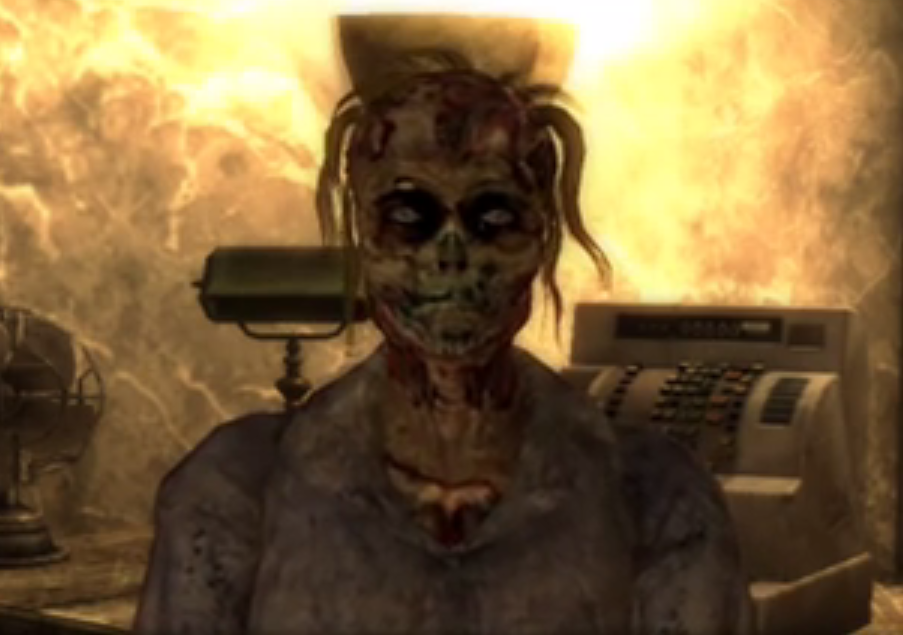
CAROL – FALLOUT 3

And in the same way that female empowerment is not limited by age, neither is it limited by species or genetic stability. This is easily the most obscure character on this list, but there’s something about Carol that stuck with me long after my completion of Fallout 3, and it’s tricky to say why.

I did go through a lot of thinking for this one. See, the other four characters on this list were fairly obvious to me, but I couldn’t think of a fifth one that really stuck out. Lara Croft? Nah. She started as a buxom Indiana Jones rip-off, before getting rebooted as nature’s punching bag. Samus Aran? Sorry, I haven’t forgotten about Metroid: Other M yet, so that’s not happening. And I’m not picking a fetish girl like Soulcalibur’s Ivy or Bayonetta, even if that song at the end of her game is pretty sweet.

No, I pick Carol. Say what you like about her, but she certainly isn’t overly sexy, not unless Bethesda are trying to market their games to necrophiliacs.

Carol started life as a regular human, but when nuclear Armageddon struck she was turned into a ghoul, a common subset of homo sapiens that are all afflicted with long life, rasping voices and decaying skin. They’re sometimes referred to as “zombies” by regular folk, and it’s not hard to see why. If I couldn’t scratch my ear for fear of it coming off in my hand, I’d start finding work with Romero myself.

Carol

I’d hug her, but I’m worried that it might dislodge something important. Like her skin.

By the way, when I say that ghouls get afflicted with long life, I really mean it. She’s over two hundred years old at this point, and shows no signs of slowing down. Good on her, I say. I hope I’m that sprightly at her age, though perhaps with a better complexion.

Anyway, Carol was lost in the irradiated rubble of Washington DC and found shelter in the Museum Of American History, which had escaped mostly unscathed. She was the founder of an entire ghoul society, one that promised shelter and safety to her brethren. She even went on to create her own B&B there, something which had always been her dream. Who says that nukes falling on you has to set you back? “Carol’s Place” is still standing strong, and there’s nowhere nicer to get a meal in all the wasteland.

What makes me really like Carol is that she’s just rather sweet. She’s seen her father die and the world reduced to ash, but she still manages to stay friendly and positive whenever you meet her. A pretty dress and a smile seem to make all the difference in a world where colour and cheer are being eroded, not to mention the offer of eggs over easy. It’s rather like going to see a cheerful aunt, albeit one who might have a finger fall off now and then.

She gets along fine in the Museum, with her partner Greta (must be going on sixty years now) and her adopted son Gob. And whereas the other ghouls can be suspicious or a little judgemental of a “smoothskin” in their town, Carol recognises a fellow traveller, tired from their troubles in the Capital Wasteland, and is always willing to set up a bed and get you some food.

Here’s to you, Carol. The end of the world is richer for you being in it.

SORRY, WE ALLOW GIRLS IN THIS CLUB TOO

<Exhale> OK, we’re doing this. We’re leaping headlong into what is possibly the biggest issue in the industry today, and I am going to point out right now that this is one of those things where I am free to admit that I probably don’t know what I’m talking about.

Yes, we’re doing a bit on sexism in the games industry. As a middle-class, white adult male (not to mention one who verges on Aryan), prejudice is something I’ve never had to deal with. But to my mind this is an important topic, just as necessary for discussion as horrible publishers and marketing scams. Whether or not there is a sexism issue (something that some people don’t agree with), it still needs to be talked about. Which is why I’m going to load up the Russian Roulette pistol of games journalism and hope I get an empty chamber – that is, hope I don’t say something blisteringly stupid and offensive. Who’s going to spin the barrel first?

MARKETING

So let’s be frank – there IS a sexism problem in games, or at least a conscious effort to consider the male audience more when designing and marketing them. Something that is in itself strange, as recent polls have come to show a roughly fifty-fifty split in player gender as you’d expect. There’s no reason for publishers to aim at a male audience so strongly, because there’s just as much money and success to be had from marketing towards women.

And yet, it keeps happening. Developers working on Remember Me claimed they had to fight tooth-and-nail to get a female protagonist, and in the cases of Bioshock Infinite and The Last Of Us, two superb games with female heroes, both were told that they had to drop the women off the box art if they wanted to sell any copies, something that was done by Bioshock Infinite in the end.

Elizabeth

Hi, Elizabeth. Yeah, it’s about the box art. We were thinking we’d go a bit more… Testosteroney? That cool with you?

But I’m not entirely convinced about his claim. Ken Levine, the mastermind behind the Bioshock series, admitted that the kind of people that were focus-tested for the cover were frat boys. Why? I know girls who like shooters, and even girls who like Bioshock Infinite. There’s no inherent disconnect between women and this game, so why are you acting like there is? Why are you trying to appeal to a young male demographic, when it seems to be the case that female customers are just as likely to get involved?

I can’t help but suspect that this is a self-fulfilling prophecy. Why do we only advertise towards men? Because they’re the only people interested in games. Why are they the only ones interested in games? Because they’re the ones we advertise for. Talk about going nowhere. At least a snake eating its own tail has the sense to choke to death sooner or later and save us all the bother of watching it.

Not to mention the fact that there’s money to be made here. Surely if history has taught us anything, it’s that the really big successes come when you sell to an audience that nobody else is selling to. If we want to get logical and mercenary about all this, surely it’s in the publisher’s best interests to sell to everybody, and not just one bloated demographic?

PRESENTATION OF WOMEN

This is one of the trickier ones, because for a while I agreed with the opinion that it’s not just women that are oversexualised, it happens to all genders in games. But I can’t hold onto that opinion anymore, it just doesn’t make sense. It might be slightly better if it were the case – after all, there could at least be a sense of camaraderie as we all get reduced to unrealistic physical archetypes together. But it’s not the way it is.

First of all, it’s hard to ignore the body trends that seem to follow female heroes. They’re all conventionally attractive at the very least, if not outright erotic. Even more independent characters like the new Lara Croft, Borderland’s siren Lilith, or the mysterious Chell from Portal, they’re all still beautiful, even if it’s a subtle form of beauty. When was the last time you saw an ugly female hero? I honestly don’t remember.

Old Man

Whatever you do, don’t mention the war! Which would be this war, I suppose.

But male heroes get to be ugly all the time. John Marston looks like he’s been cooked on the grill for too long. Marcus Fenix is a piece of beef in a flak jacket. Solid Snake in Metal Gear Solid 4 looks like elderly John Cleese. Agent 47 has a head like an easter egg with a scary face drawn on the front. Even Gordon Freeman is a scrawny geek in power armour, growing his own Walter White beard in time for Comic-Con.

Not to mention the fact that there’s a clear difference in attitudes here. Women are often presented as physical ideals, but tend to be quite passive or lack their own agency. Girlfriends need rescuing. Dead wives need avenging. Women are helpless until the male hero comes along. When was the last time you saw a woman protagonist out to avenge her dead husband? Or even have any non-romantic connection to men at all? It happens, but it’s rare. It’s still a surprise, and it shouldn’t be.

And men? Well, they’re often ideals in every sense. Even if they aren’t physically perfect (and they often are), they tend to be dynamic and macho and brave. They’re people we’re meant to aspire to be, in other words.

Kyle Crane, Talion, Masterchief, Grayson Hunt and any of those sickeningly patriotic soldiers from Call Of Duty are good examples of this. They do have flaws, sometimes, but only the bare minimum required to make for some half-hearted character arc before they get over them and reach the end of the story, more perfect than ever. And how did they get over these problems? By rescuing a girl. God, it’s painful to watch.

DEVELOPERS

Last year a poll revealed that 22% of games developers are women. It’s not a great figure, but it is rising. It was half that in 2009, so we can see some progress. But I suspect that may be why we see so many male-orientated games, because most people involved are men. I wouldn’t risk designing a game from a female perspective, I wouldn’t know what that’s like. It would almost certainly fail and be an embarrassment for all involved. Maybe it’s the same thing – all the writers are men, who only know how to write for other men, so that’s what they do. And the stench of stagnation bubbles up in droves.

The diversity of an industry can only be a good thing, because it means that all the interesting stuff is going to get made. Put thirty similar companies to work, and they’ll all make thirty similar products. But get some new people in there, and the really fresh content will arise, just because they have a new view on things that might be interesting or worth seeing. Would I try to write a game from the perspective of a lesbian woman from Paraguay, working in a forensics lab whilst simultaneously trying to market a new line of sun creams? Or about being an esteemed mathematician and pacifist from Kazakhstan with brittle bone disease, two kids and a crippling addiction to cocaine?

Of course I wouldn’t make those games, I wouldn’t know what either of those scenarios are like. I wouldn’t be able to do them justice. But would I play those games if they were made by people who know what they’re talking about? Definitely, they sound fresh and interesting. Look at This War Of Mine, a game that was fascinating to observe, because of how different it was and how engaging and exciting the concept turned out to be, after such a one-sided view in the industry.

This War Of Mine

We only get the interesting stuff like this when we get new ideas flowing. Er… It’s not all this depressing, I swear.

Besides, people won’t stop making generic, boring military shooters just because women get involved in the industry. It’s been proven that all that shlock can make money, so it’s going to keep happening without issue. But this massive industry is big enough for all opinions. You can have room for both, you do have room for both! They didn’t stop making platformers when shooters were made, you know. Now we get Rayman Legends and GTA V in the same year, I think we can agree that there’s some good variation going on.

I’ll also say this, to those who are worried about games becoming boring if feminine or maternal perspectives get too much space in gaming. Mad Max: Fury Road is a movie about female empowerment and Telltale’s: The Walking Dead Season 1 is a game about childcare.

And they are both utterly brilliant.

#GAMERGATE

Now let’s address the elephant in the room, and start by explaining how I don’t know what an elephant is. You see, for a long time I didn’t understand #Gamergate at all.

I don’t mean that I didn’t agree with the cause, I mean I literally didn’t understand it. I was on holiday when the whole mess occurred, and by the time I got back it had become a labyrinthine tangle of accusations, lies and spite that became too confusing to keep up with. It’s only recently that I’ve managed to get my head around some small portion of what was happening, and I feel we need to go over a few key points in case this happens again.

First of all, I do understand how some people might be unimpressed when games journalism and the core industry get a bit too buddy-buddy. The nature of game development is so riddled with cynicism and deception that the last thing people want is yet another agenda that has the player’s priorities last.

I really do get that, if nothing else, and it’s not a request for journalists to turn their noses up at, it’s not something to be dismissed as the excessive demands of a few radical lunatics. I’m not suggesting that writers pour their every detail out onto the internet for investigation, but there needs to be more honesty regarding gaming journalism in general, because gamers have been lied to and manipulated before, and we don’t like it.

Reading about it online didn’t help much. Some of the articles on these issues were shockingly dismissive of the few valid points made by their opponents, even discarding the misogynistic angle. In some cases it came across as patronising or smug, or even filled with snobbery and distaste. The vigour with which some of them held onto the sexism aspect made me wonder if they didn’t want the spotlight to move onto the proper arguments, like they were nervous of what the fallout might be.

Anita 2

Look, you don’t have to like Anita Sarkeesian. You really don’t. You can argue against her views, you can look for flaws in what she says, you can even recommend that people boycott her work, if you feel that strongly. But for god’s sake, treat her like a human being. That’s not too much to ask.

But let’s be clear – the hatred and vitriol that was spewing into the feeds of certain female writers and developers is absolutely unacceptable. There is no excuse for death threats, for rape threats, for hacking somebody’s private information. None whatsoever, whether you do it to writers or designers, women or men, those in the industry or just adjacent to it.

I feel shocked that this has to be said, but apparently it does. Any chance of rational debate died when you bastards (and you know who you are) showed just how nasty you can get, how utterly loathsome you could act when somebody threatens you in such a small way. All you did was damage your own cause, you idiots. Who’s going to consider you a worthy member of the argument now? You’re all seen as psychos with no sense of proportion and no idea of morality whatsoever.

I think that’s what depressed me most about the #Gamergate debacle – it didn’t get us anywhere. When there’s this much energy and clashing of opinions, sometimes something productive can emerge from what’s left, some new comprehension of the way things are. It can be exhausting and difficult, but it does happen.

But we didn’t get that here. Everybody just retreated to their own halves of the field, and it became a horrible “us or them” battle. One side saw a bunch of aggressive Neanderthals who weren’t worth listening to, and the other side saw an impenetrable clique of allegiances treating them like morons and trying to deceive them where they could.

Whereas the truth was that both sides had some valid points to make, but you wouldn’t know that over the cacophony. Anybody between the two extremes was pushed to one side sooner or later, and the whole thing became nothing short of pointless. It really was a miserable thing to see. How rare it is, to have so much heat and generate no light whatsoever.

I almost don’t think the sexism angle needed to get involved at all in this debate. There was a genuinely interesting discussion to be had here on the responsibilities of unbiased press and their connections to a heavily biased industry. But before long it became “Oh my god, how could a WOMAN make video games or talk about them?! That’s absurd! Better make horrible threats from anonymity, demonstrating I am brainless, heartless AND spineless all at once.”

EPILOGUE

There is a point to all this, but the point is that all this is… Well, pointless. Aside from the fact that it’s just a nice, moral thing to do, when it comes to the idea of getting everybody involved, there’s no downside. We don’t lose anything by opening ourselves up to all members of society, we just get more ideas churning.

It’s also not hard to fight these things, if you feel that you must fight them. If you don’t like the games that Brianna Wu makes, don’t play them. If you don’t like the articles that Anita Sarkeesian writes, don’t read them. If you don’t want to support Zoe Quinn, don’t support her. But the industry only becomes more diverse and engaging by having these people as part of the system, even if it would only be through the energy created by those opposing them. Nobody can take your games from you, nobody can change what they mean to you. You only make things better when you respond with open arms instead of clenched fists.

And to those who would look at half the human race and consider them worthless to a whole facet of entertainment? Yeah, you lot can sod off. I’m happy to say that you are a dead end, socially, ethically, culturally and, to my greatest amusement, sexually.

Seriously, all that discrimination? Very unsexy indeed. I couldn’t think of anything less arousing than somebody moaning about the uselessness of women. It’s not getting my engine running, that’s for sure. I mean it, nothing’s going down when you guys enter the room, you’re the equivalent of Radio 4 playing at a funeral. Might as well resign yourselves to the fact that none of you are getting descendants any time soon. Sorry, that’s just the way it is, I don’t make the rules. I just enjoy them immensely.

Have a good weekend, folks!

MORDOR WON’T BE CASTING A SHADOW ANYTIME SOON

Orcs! They’re like the P.E. teachers of the fantasy world; big, brutish and with the kind of intellect that makes you look for the nearest point of escape. Or maybe that’s just me.

Of course, when I say fantasy I mean Lord Of The Rings. You know, that one fantasy template, the one that everybody copies from when the idea bucket is running low and they just can’t be bothered any more. Why think up diverse and impressive worlds when you can just do what everyone else did and steal from the once-unique ideas of J.R.R. Tolkien?

The latest video game incarnation of Middle Earth to grab people was last year’s title, Middle Earth: Shadow Of Mordor. It’s a very good game, a mix of Arkham Asylum’s combat with Assassin’s Creed’s free-running, in which you waddle around Sauron’s backyard, sandbox style, frightening the orcs who live there and occasionally beheading them when you feel like it.

All of the above is a plus in my book, and though the story was basically forgettable, the game featured some interesting ideas. The one that stuck with people was the Nemesis System, perhaps one of the most innovative ideas for sandbox gameplay in years. Everybody I spoke to about it was certain that this would set the standard for these types of games, and I can understand why they’d think that.

See, whilst Mordor is flooded with your standard breed of orc, a few of them get to be captains, randomly generated and part of a tiered hierarchy into which they are inserted. Let me give you an example.

Eyeglaze

“These are awesome! Guys, come check out my new contact lenses!”

Let’s say you’re wandering through Middle Earth, picking your nose, and you get jumped by a gang of enemies. A random orc lands a fatal blow and suddenly he becomes a captain for having killed you, known as Flegmog The Bug-Eyed, or whatever. He gets put into the hierarchy at the lowest rank. A little later we hear reports that he’s been on a successful hunting trip, and has levelled up. He’s now more capable than before, but he’s still lowest rank.

Not for long. Flegmog has eyes on advancement, and thinks he might be able to take on his boss, Rabflib Headsmasher. Fleggy challenges him to a duel, and if he wins (something you can witness and even intervene in) he levels up again and also takes Rabflib’s place. One axe-swing later, he’s rank two, with the resources and power to match.

Meanwhile, this sort of thing is happening all over Mordor. Captains are competing, getting killed, getting promoted, getting trained. You can get involved at every stage, get invested and alter the events however you wish. If a captain you dislike is holding a feast, you can poison the grog to lower his standing or even kill him. Or, if you want to him advance, you can make sure that everything goes according to plan from the shadows and get him through the night, raising his standing with others of his kind.

This would all be good enough on its own, but later in the game you get the power to hypnotise and control orcs, including captains. This itself opens up a thousand new possibilities. Maybe you want the high warchief dead, but don’t fancy your chances in a direct fight.

No problem! Brainwash a lesser orc, make him become a captain and start working him up through the ranks, helping in his duels and the like. Finally, you can make him join the warchief’s entourage, at which point you telepathically suggest that he mash his leader to death with a hammer. If he wins then he’ll become the replacement warchief, a valuable asset considering that he’s still under your spell.

Controller

“And whilst you’re at it, can you put up some shelves in my living room?”

There’s other aspects I haven’t even mentioned, like how orcs have personal weaknesses and strengths to research and exploit, how they’ll remember details of previous encounters with you and even how some of them refuse to stay dead. At one point I threw a particularly fat orc onto a fire and watched him roast to death, before smugly walking away, action-hero style.

Unfortunately nobody had told fatso that this should have killed him, and as I was travelling later I suddenly heard a yell, and turned to see that Chubso Porkchewer had returned, albeit covered in horrible burns and screaming for revenge. He’d been training too, taking some effort to put down, but when I finally impaled him through the stomach and pushed him off my sword, I felt pretty good about myself.

Except that it didn’t work, and a few hours later my fat friend was back, his ample gut covered in bandages and promising that I wouldn’t get to stab him again. Bloody hell, forget Sauron. This psycho is the true villain of my game.

And I guess that’s the point, that it was specific to MY game. The whole thing was wonderfully organic, a real gem of an idea, and those I was talking to were insistent that this sort of thing was going to be seen more and more.

Well… No. At least, I don’t think so, not really.

Don’t take the wrong impression, there’s nothing wrong at all with the Nemesis System. In fact, it’s pretty awesome and one of the most memorable creations in recent triple-A gaming. I just think that this is a one-time deal. Maybe we’ll see variations of it come back a couple of times in the next few years, but I’m not convinced it’ll revolutionise sandbox gaming as everybody was saying it would.

For a start, I can only imagine how jaw-droppingly expensive this was to make, not to mention how many man-hours had to go into it. Getting the algorithms right, creating enough physical and statistical traits to keep the orcs fresh (relatively speaking), testing these new ideas and recreating them through trial and error – the final cost must have been staggering, the kind of numbers that make Bill Gates shocked.

This really is one of those projects that can only be done well by major game developers who have the capital to back them up. Maybe you could get lesser versions done with lesser budgets, but it’ll get old fast. Basically, this was one hell of a commitment and not something you can just drop into a game if you feel like it afterwards. This is something you had to work at, something you had to invest massive amounts of time and effort into creating. I don’t see many developers doing that, knowing that it won’t be as exciting the second time.

Not to mention that it’s hard to think of a game that would suit this system better. Somebody suggested a crime sandbox like GTA, with a structured system of Mafia goons, but I don’t think it would be as good without some serious changes. It seemed to me like Shadow Of Mordor was designed from the ground up with these ideas in mind, which is why it worked so well. Your own deaths are part of this cycle, your hypnosis powers are a fundamental aspect, two dynamics that could only be applied with a very particular type of story. One of the reasons that the Nemesis System was so effective was that it fit the concept like a glove, to the extent where I almost wonder if they came up with the mechanics first and made a game to fill the gaps around it.

It won’t apply so well in other games with different stories, not without some major restructuring, and even then people will see through it. They’ll look at these ideas and say “oh, it’s like Shadow Of Mordor – but less tightly designed and without all the options of the original. Better luck next time.”

Nemesis

“Oh, god! <cough, cough> Right, the second I brainwash you, I’m making you eat a whole crate of breathmints.”

That’s not to say people won’t try. If there’s ever a sequel to this game then I expect that it’ll have a similar thing, because people will expect it. And maybe a few other publishers will try to unsuccessfully imitate the process without understanding the subtleties, but it won’t take long for it to sink in that this is a faithful hound, one that can’t be given to a new owner without biting them quite badly.

The Nemesis System will, in that case, remain a brief firework, something that shone all the brighter for its inevitable disappearance. And that’s OK, there’s nothing wrong with that. It’s still a great game that people will remember for a long time. It would be nice if some other game managed to improve on it, but I don’t think it’ll happen. It’s fine already, and it’s OK to leave it alone now.

Think about it. Would Fawlty Towers have been improved with another season? Would Hamlet have needed a spin-off? Would Bioshock have needed a direct seque- Oh.

Well, I guess that proves it, then.