VIDEO GAME WOMEN? WE’RE CLOSER THAN WE THINK

So after the success of the last article, I realised that I’d made a bit of an error. See, whilst I did a lot to shout self-righteously about certain sexism issues within gaming culture, I wasn’t doing much to solve those issues. Don’t bring me problems, bring me solutions, right? Sure, you can tell your friend when he’s accidentally driven into a car crusher, but unless you wander round and find the “OFF” button it’s not going to do much to help him.

But not to fear, because there is a way. There are certain female characters in video games who to my mind, are aspirational and worth emulating, not just for women but for all genders. They avoid cliché character tropes, they have fully developed personalities, they don’t sell themselves on eroticism. They are, in other words, figures we can learn from.

That said, I’ve heard some people say we should see a realistic representation of women in society in video games, and to that I say: NO. For now and forever, no.

I’d say it if it were about men, too. I play video games for escapism, I do it to leave the outside world for a few hours. I can’t imagine anything more horrifying than getting dragged back into a digital recreation of the world I’m trying to ignore.

You know the kinds of games that follow that model? The Sims. Nintendogs. Farmville. If given the choice of playing a superhero or an office clerk, I’m going to stick with the first, regardless of what gender is involved. Games should be progressive, but we can’t throw fun out the window, no matter what.

Look at The Path, perhaps one of the most irritating games I’ve seen. Yes, it’s all a big metaphor for woman in the modern world and how we treat her. How is it as a game? Well, it’s boring, pretentious, and clearly thinks it’s so much smarter than it is, when it just comes across as hostile to the player. Surely these things are more harmful for the reputation of women in gaming than anything else? It makes it seem like feministic games are dull as ditchwater, with no sense of humour or joy to them. The Path makes me miserable, and not in the good way, like Spec ops: The Line. It’s a big, clunky message that begrudgingly allowed a game to be made around it. That’s not fun for anybody.

For that reason, all of the following characters are warriors, mutants and members of the apocalypse, and sometimes several of those at once. Does it matter? Of course not. They still have traits and aspects to them that are admirable, whatever the context they’re placed in. We can still like them for who they are and what they want from life. And let’s kick off with one who embodies the term “professional.”


ATHENA THE GLADIATOR – BORDERLANDS

Originally created as a side character in the DLC campaign, The Secret Armoury Of General Knoxx, Athena was a cool and calculating soldier for the Atlas Corporation’s Crimson Lance militia, then an assassin, then a defector. See, Athena was searching for her sister Jess on the world of Pandora, and was planning on quitting the military life once she found her sibling, so that they could go off and live in peace. Seems fair enough.

Unfortunately, Atlas heard about this and didn’t like what they heard. Athena wasn’t just a member of the Crimson Lance, she was the BEST member of Crimson Lance. They tracked down Jess before Athena could find her to a small village nearby, then ordered Athena to lead an attack on the settlement, believing that if Jess was dead then Athena would have no reason to leave the Lance. Ordered to wear heat-sensitive thermal goggles and unable to tell people apart, Athena stabbed Jess by accident and fled in misery when she saw whom she killed.

It wasn’t long, however, before she put the pieces together and realised that Atlas had betrayed her. Misery turned to anger, and she launched a calculated campaign of sabotage and war on her former employees that wasn’t just effective, it took Atlas off the planet of Pandora for good. After that she took up treasure hunting under the employ of Handsome Jack, which she took to incredibly well.

Athena

I don’t want to sound like a dopey fanboy, but… she’s so cool. She’s really, really cool.

All this is pretty grim and foreboding, so why do we like her? Well, because she’s pretty kick-ass and nothing if not independent. Athena would do her Greek namesake proud, she’s a tactical genius and an accomplished warrior with a taste for adventure. Anybody who can go to the gun-laden world of Pandora with a sword and shield and still be considered one of the most lethal people there, well, they’re clearly a force to be reckoned with.

She’s also a genuinely interesting character, with some semblance of morality that she constantly struggles with in her line of work, despite most other Pandorans having abandoned ethics years ago in favour of survival. She leaves the employ of Handsome Jack when she sees the monster that he becomes, and spends some time training the confidence trickster Fiona in combat so that she might have a better chance of living, something she was under no obligation to do.

She’s also incredibly brave, staring coldly down the barrels of a firing squad with no fear in her eyes, and she makes a rather sweet partner for the junk dealer Janey Springs, whom she deeply cares for and worries about often.

And yes, she’s killed people, but Borderlands has always enjoyed over the top violence, and this is Pandora, for god’s sake. Ninety percent of the population are psychotic bandits, and the rest are just plain psychotic. Christ, even the plantlife and certain rocks will try to kill you if you don’t keep an eye on them. Maybe there’s something in the water.

No, Athena deserves to be on the list for showing an uncompromising, independent spirit, tempered with a moral compass and the occasional glimpse of real tenderness beneath the tough emotional armour. Salute her, and whatever you do, don’t get in her way.


ALYX VANCE – HALF LIFE 2

Half-Life as a series has been nothing if not a pioneer. Aesthetic realism, interactive storytelling, physics engines, character development, facial animation – all of these and more have been pushed forward by this incredible series. To manage all of this and remain fun is an achievement. To manage all of this, remain fun, and create one of the most memorable female characters in gaming is something else.
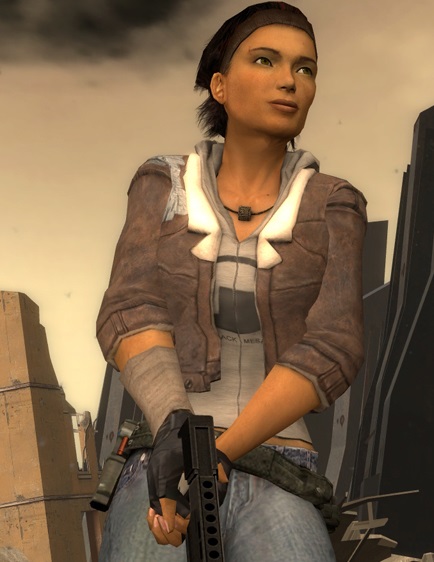
Alyx

And to top it all off, she photographs beautifully. That’s some top-notch gazing into the middle-distance there, Alyx.

Alyx Vance is one of those characters who is just a wonderful surprise in every way she presents herself. Neither an over-sexualised bimbo, a damsel in distress, or a generic action girl, Alyx is actually the heart of the story from the very beginning of Half-Life 2. I’ve heard some claim that she’s Gordon Freeman’s love interest, but that seems to be a stretch. Freeman is a camera with a beard, I don’t think he’s making many signals for her to respond to.

No, Alyx is her own person, through and through. She’s one of the most important members of the resistance against the alien Combine, utilising a variety of skills to overcome any situation. She’s a formidable hand-to-hand fighter with a great skill in firearms, an impressive athlete and gymnast, and she’s an incredible hacker and tech-head, able to reprogram any computer system, be it human or alien.

All this would be awe-inspiring on its own, but it’s Alyx’s personality that makes her shine. She’s a caring person with a real sense of vigorous optimism, all in a time where she should be miserable as hell. She cares about others and is especially empathetic, with an endearing sense of humour.

She really feels like a person, and it’s a sign of good story-telling that people found themselves getting attached to her. When she suffers loss, I feel sad for her sake. When she makes a dumb joke, I find myself grinning stupidly with her. And when she becomes injured at one point, I took the mission not to progress through the story, but because I really wanted to help her.

Alyx is symbolic of everything that is worth preserving in the human world, in a situation that threatens to take it all from us. Kindness, intellect, freedom, humour, emotion, empathy, she embodies them all, and still maintains her humanity in the situation where it is under the most strain.

Oh, and she has the best taste in robots. No, she really does. Watching her interact with Dog, the massive metal guardian that lumbers affectionately after her, is utterly adorable. And all I’ve got are those stupid fish in the utility room. Life really isn’t fair.


ELIZABETH – BIOSHOCK INFINITE

An important part of anybody’s life is coming to an understanding of who you are, not to mention the awkward transition to adulthood. Elizabeth is twenty when we first witness her in Bioshock Infinite, but appears a lot younger in her actions and mannerisms, something that’ll change before too long.

Bioshock Infinite is based in Columbia, a fictitious city in 1912 that floats several thousand feet above the ground on suspiciously out-of-place technology. It was founded and built by a religious nutcase named Father Comstock, who created a Christian cult that incorporates the morals of the Westboro Baptist Church combined with a ferocious obsession of the American Founding Fathers.

No, really. One of the first things you see in the city is a trio of statues that show Benjamin Franklin, Thomas Jefferson, and George Washington respectively, all dressed in angelic robes with people openly worshipping them. Of course, being horribly racist means they don’t like Lincoln much, but that’s fine. They just made a temple dedicated to John Wilkes Booth instead. Now THAT was a surprising statue to see.
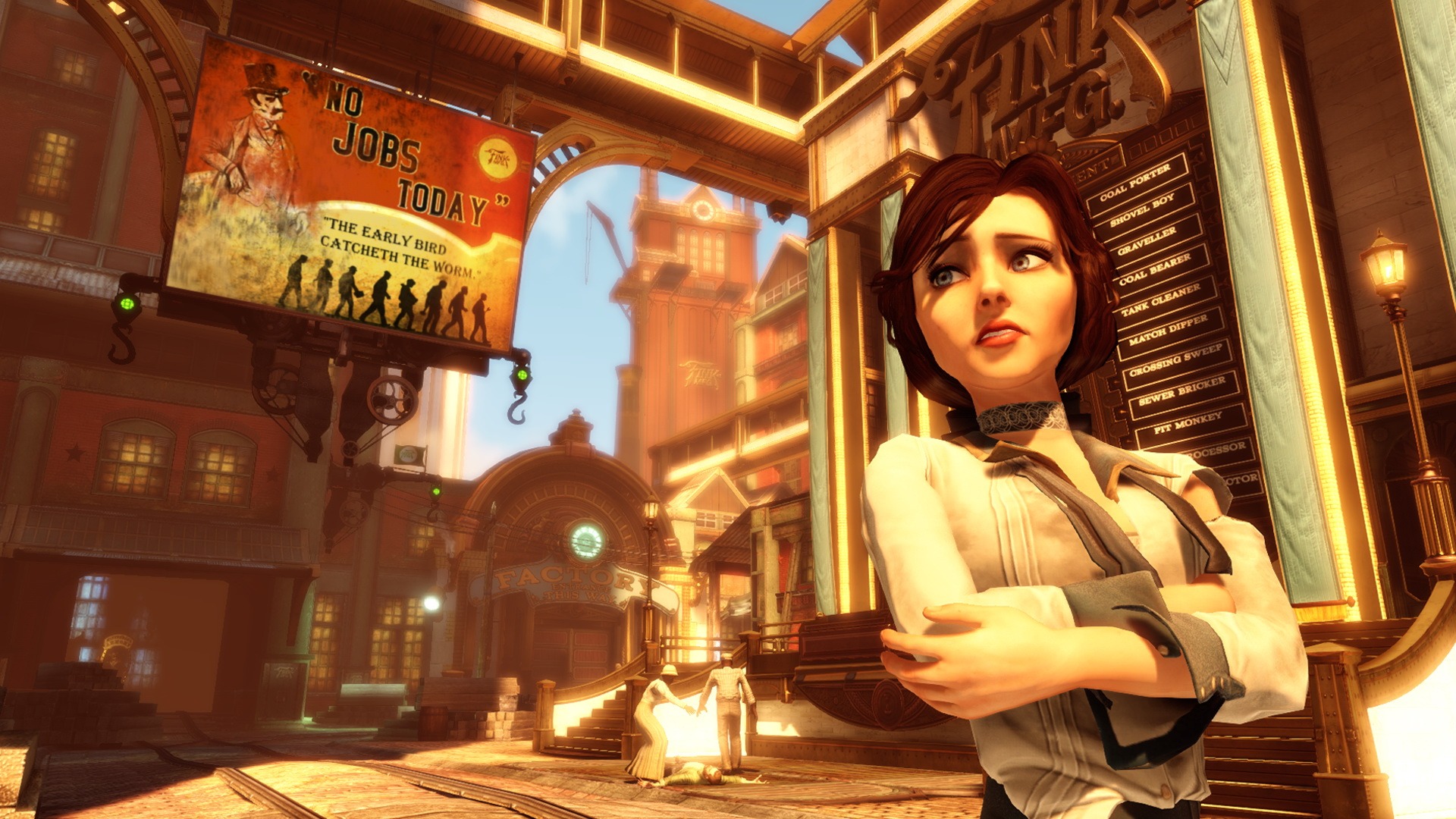
Elizabeth

When we say empower women, we didn’t mean to the level of a minor deity. That said, now I see it in action? It looks pretty cool.

But where does Elizabeth fit into this? Well, she’s Comstock’s daughter, destined to inherit the city once he finally kicks the bucket, but she’s not too keen on him or his patriotic Christian nonsense. Thus he’s kept her locked in a building since childhood until she changes her mind, with a huge artificial monster outside that is programmed to protect her from outsiders.

Of course, that’s not the only reason he does the whole Rapunzel shtick. Elizabeth has somehow unlocked strange abilities within her mind, allowing her to create tears between dimensions and even travel through time and space.

There’s something fascinating about this process and watching Elizabeth make use of it. Trapped in a tower with only books and pictures for company, Elizabeth begins to dream of escape and romanticises the city of Paris in particular, and she often opens tears so that she can witness it herself, though she’s never risked travelling through one.

In fact, Elizabeth is genuinely joyful for great periods of the game, to an extent where it almost becomes infectious. When freed from the tower, she ascends into childlike delight, experiencing every pleasure life has to offer, from food, to beaches, to dancing. When the protagonist, Booker DeWitt, suggests that he take her to Paris itself, it’s like she’s hit by lightning. An enormous grin spreads across her face and she almost seems ready to jump into the air with sheer joy.

That’s not all. Elizabeth is very well-educated, having grown up with only books for company, and occasionally quotes literature to highlight a point. She has a mischievous streak, but a harmless one and her strong will sometimes manifests as biting wit, though never to the extent where it’s tiresome.

The most engaging part of Elizabeth’s character is how it doesn’t remain the same. She matures over the course of the story and has to deal with many issues with which she can’t quite resolve herself. Violence unnerves her. Her deranged father frightens her. She can’t help but view the monstrous Songbird that imprisons her as a friend. And of course her powers get more potent with time, tempting her to use them to a greater degree.

It might sound like Elizabeth risks becoming overly weak and flawed, but she’s not, especially when you consider the dysfunctional way she was brought up. Besides, everybody in this game is bloody nuts and she seems quite stable in comparison. Not to mention that she, more than anybody else, overcomes her problems and really does change, whereas all the other characters are stuck in the same destructive cycles.

Elizabeth represents progression and the future. She’s idealistic, intelligent and filled with a love of life that’s impossible to ignore. She remains strong in the face of adversity even when she’s scared and resists the allure of power, wanting only to appreciate the finer things, like art and culture. She’s also highly reasonable and adapts her thinking in the face of better evidence or logic, but knows when she’s being manipulated and to hold her ground. It’s not Elizabeth’s purpose to be perfect, but instead to demonstrate the changes needed for perfection. And that’s a pretty noble cause in my book.


CLEMENTINE – TELLTALE’S: THE WALKING DEAD

Female heroes aren’t always limited by age. I have a special place in my cold, black heart for the bundle of violence and bright colours that is Hitgirl from the series Kick-Ass, and whilst some kids can be annoying in how they’re presented in games and movies, sometimes the creators get it just right.

Clementine from Telltale’s: The Walking Dead is one of those times. By the way, I trust the plot of The Walking Dead doesn’t need describing. It’s zombies… and you know the rest. Eating human flesh, resurrecting, shotguns, etc. If zombies could be reduced to a colour at this point, it would be a modestly faded beige.

Except that the whole point of The Walking Dead was the relative awareness of this fact. It knew that zombies were boring and that a character study of how people might try to survive in such an environment would be much more engaging to watch. Zombies hardly ever show up in that game, usually about once or twice per episode, and it’s often more tense that way because of how rare it is.

Of course, the other reason that it’s tense is because you’re fighting for two now. You play as Lee, a former university teacher who is stranded in the <yawn> zombie apocalypse, and has to survive the clammy hands of the undead.

Clementine

In a cav-ern, in a can-yon, exca-VATING for a mine… No? Just me?

Except that the first person Lee encounters is not another adult survivor, or a mad priest, or a wise-cracking action hero, but a young girl named Clementine, whose parents were in Savannah when the dead began to rise. Her babysitter became infected and attacked her, and little Clem demonstrated remarkable intelligence when everybody else descended into panic, climbing into her treehouse and pulling up the ladder with her, waiting for the moment where either she could escape or somebody would find her.

It’s not long before you show up, and the eight-year old girl immediately proves herself to be both useful and brave. When Lee is set upon by the undead caretaker, Clementine immediately finds a hammer for him to defend himself, without which he would’ve been killed. Minutes in and she’s established herself not to be just a burden, but a person who cares. She’s already miles above most kids in popular culture already.

Clementine is probably the video game character for whom I have felt the most empathy and emotion for in my life. If I had a daughter, I’d be proud to see her grow up to be like Clementine. Why? Because this little girl is probably one of the most endearing, adorable characters in games, certainly the most lovable child ever to come to the medium.

I can’t fault her on anything, I really can’t. Clementine is quiet and caring, worrying about others instead of herself and making actions with them in mind. She tries to take care of herself as much as possible so that others won’t have to, and even does her best not to cry because she knows that Lee will worry. God, I’d want to cry in her position. Clementine loses her parents, her possessions, her home and any stability remaining in her life, and yet she still worries about those around her. Can we find her a medal or something?

Clementine gives up so much that it made me want to give her what little I had left for myself. When I made a choice that would impact events, I always did it with Clementine in mind, knowing that her happiness was what mattered most. If I was given the option to make sacrifices, I made them for her sake. There was a point about halfway through the game where I understood that if I had to choose between her and Lee, I’d pick her every time. She really meant something to me.

Compare that to the little girl who dies in Watch_Dogs. Should I have been sad about that? Probably, I guess. I know the game was hoping I’d mope it up with the main character. But it meant bugger all to me, because the game had forgotten to tell me why I should care. She’s the protagonist’s niece, but that’s all you can say about her, she doesn’t have any definition beyond that fact. You never speak to her, or find out anything about her life. She’s just “that kid that died.” She’s not even a child, just the concept of one, and you won’t tug my heartstrings by having the heroes standing around staring blankly at a gravestone like they’re trying to work out if they can eat it or not.

But Clementine is a real person, to me at least. Everybody who played that game felt the same way I did, because we became invested in her. She meant something to us, even within the context of the story. That’s immersion for you. That’s what a good writer can do.

Clementine has meant different things to different people, but I’ll always see her as “The Motivation.” In a world filled with monsters, Clem is the reason to keep going, to keep fighting. If she wasn’t around, I almost suspect Lee would have committed suicide out of sheer despair and lack of purpose. But she gave both him and us a reason to keep pushing forward, struggling to keep her safe until she could finally become the adult she had to become to survive, and our job could be over.


CAROL – FALLOUT 3

And in the same way that female empowerment is not limited by age, neither is it limited by species or genetic stability. This is easily the most obscure character on this list, but there’s something about Carol that stuck with me long after my completion of Fallout 3, and it’s tricky to say why.

I did go through a lot of thinking for this one. See, the other four characters on this list were fairly obvious to me, but I couldn’t think of a fifth one that really stuck out. Lara Croft? Nah. She started as a buxom Indiana Jones rip-off, before getting rebooted as nature’s punching bag. Samus Aran? Sorry, I haven’t forgotten about Metroid: Other M yet, so that’s not happening. And I’m not picking a fetish girl like Soulcalibur’s Ivy or Bayonetta, even if that song at the end of her game is pretty sweet.

No, I pick Carol. Say what you like about her, but she certainly isn’t overly sexy, not unless Bethesda are trying to market their games to necrophiliacs.

Carol started life as a regular human, but when nuclear Armageddon struck she was turned into a ghoul, a common subset of homo sapiens that are all afflicted with long life, rasping voices and decaying skin. They’re sometimes referred to as “zombies” by regular folk, and it’s not hard to see why. If I couldn’t scratch my ear for fear of it coming off in my hand, I’d start finding work with Romero myself.
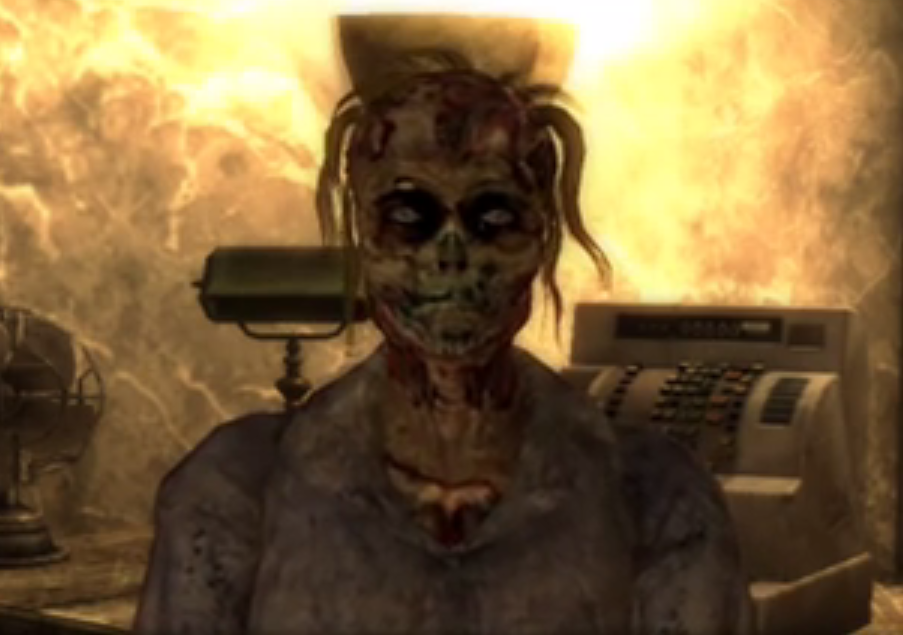
Carol

I’d hug her, but I’m worried that it might dislodge something important. Like her skin.

By the way, when I say that ghouls get afflicted with long life, I really mean it. She’s over two hundred years old at this point, and shows no signs of slowing down. Good on her, I say. I hope I’m that sprightly at her age, though perhaps with a better complexion.

Anyway, Carol was lost in the irradiated rubble of Washington DC and found shelter in the Museum Of American History, which had escaped mostly unscathed. She was the founder of an entire ghoul society, one that promised shelter and safety to her brethren. She even went on to create her own B&B there, something which had always been her dream. Who says that nukes falling on you has to set you back? “Carol’s Place” is still standing strong, and there’s nowhere nicer to get a meal in all the wasteland.

What makes me really like Carol is that she’s just rather sweet. She’s seen her father die and the world reduced to ash, but she still manages to stay friendly and positive whenever you meet her. A pretty dress and a smile seem to make all the difference in a world where colour and cheer are being eroded, not to mention the offer of eggs over easy. It’s rather like going to see a cheerful aunt, albeit one who might have a finger fall off now and then.

She gets along fine in the Museum, with her partner Greta (must be going on sixty years now) and her adopted son Gob. And whereas the other ghouls can be suspicious or a little judgemental of a “smoothskin” in their town, Carol recognises a fellow traveller, tired from their troubles in the Capital Wasteland, and is always willing to set up a bed and get you some food.

Here’s to you, Carol. The end of the world is richer for you being in it.
SORRY, WE ALLOW GIRLS IN THIS CLUB TOO

<Exhale> OK, we’re doing this. We’re leaping headlong into what is possibly the biggest issue in the industry today, and I am going to point out right now that this is one of those things where I am free to admit that I probably don’t know what I’m talking about.

Yes, we’re doing a bit on sexism in the games industry. As a middle-class, white adult male (not to mention one who verges on Aryan), prejudice is something I’ve never had to deal with. But to my mind this is an important topic, just as necessary for discussion as horrible publishers and marketing scams. Whether or not there is a sexism issue (something that some people don’t agree with), it still needs to be talked about. Which is why I’m going to load up the Russian Roulette pistol of games journalism and hope I get an empty chamber – that is, hope I don’t say something blisteringly stupid and offensive. Who’s going to spin the barrel first?

MARKETING

So let’s be frank – there IS a sexism problem in games, or at least a conscious effort to consider the male audience more when designing and marketing them. Something that is in itself strange, as recent polls have come to show a roughly fifty-fifty split in player gender as you’d expect. There’s no reason for publishers to aim at a male audience so strongly, because there’s just as much money and success to be had from marketing towards women.

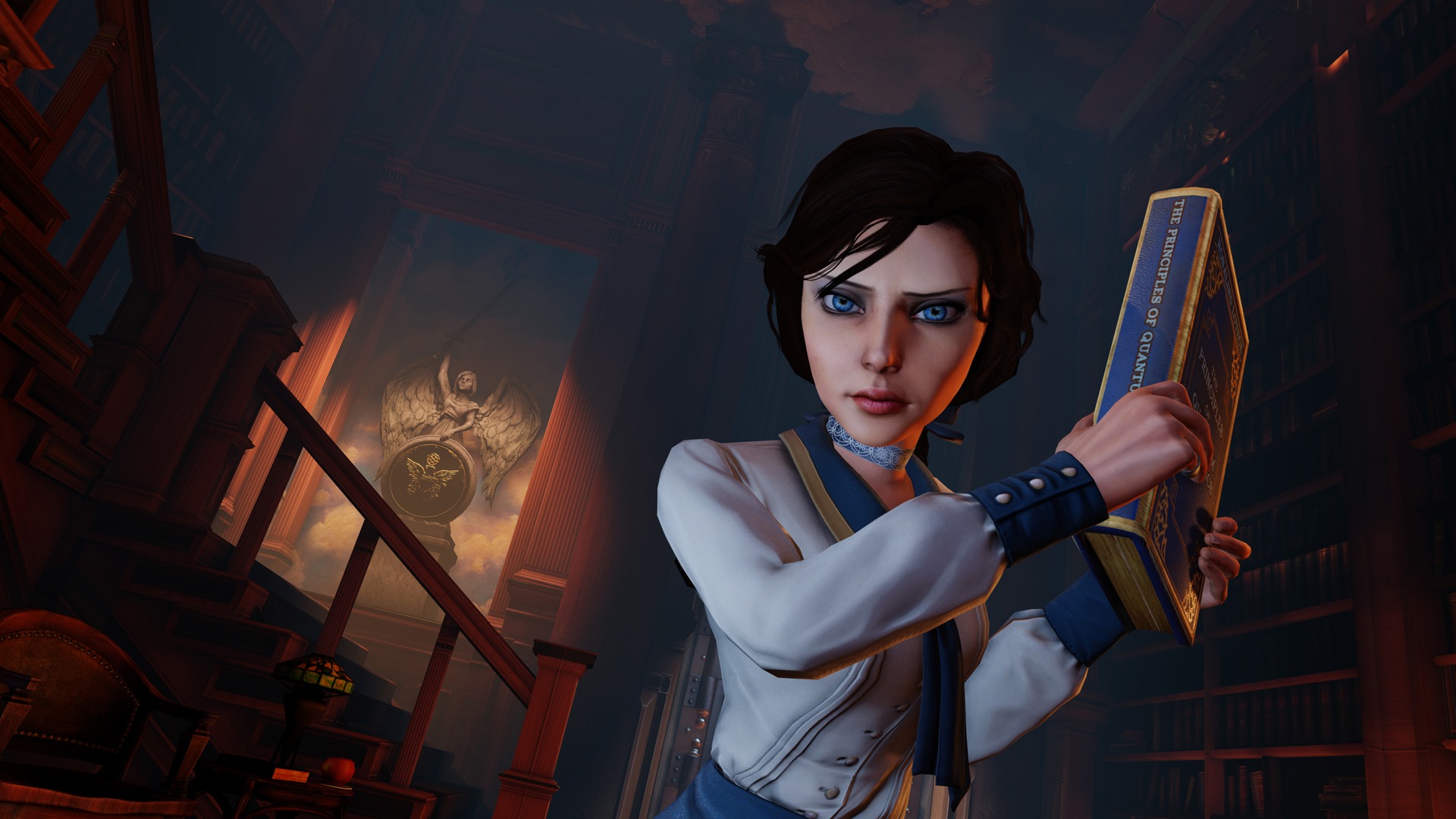
And yet, it keeps happening. Developers working on Remember Me claimed they had to fight tooth-and-nail to get a female protagonist, and in the cases of Bioshock Infinite and The Last Of Us, two superb games with female heroes, both were told that they had to drop the women off the box art if they wanted to sell any copies, something that was done by Bioshock Infinite in the end.

Elizabeth

Hi, Elizabeth. Yeah, it’s about the box art. We were thinking we’d go a bit more… Testosteroney? That cool with you?

But I’m not entirely convinced about his claim. Ken Levine, the mastermind behind the Bioshock series, admitted that the kind of people that were focus-tested for the cover were frat boys. Why? I know girls who like shooters, and even girls who like Bioshock Infinite. There’s no inherent disconnect between women and this game, so why are you acting like there is? Why are you trying to appeal to a young male demographic, when it seems to be the case that female customers are just as likely to get involved?

I can’t help but suspect that this is a self-fulfilling prophecy. Why do we only advertise towards men? Because they’re the only people interested in games. Why are they the only ones interested in games? Because they’re the ones we advertise for. Talk about going nowhere. At least a snake eating its own tail has the sense to choke to death sooner or later and save us all the bother of watching it.

Not to mention the fact that there’s money to be made here. Surely if history has taught us anything, it’s that the really big successes come when you sell to an audience that nobody else is selling to. If we want to get logical and mercenary about all this, surely it’s in the publisher’s best interests to sell to everybody, and not just one bloated demographic?

PRESENTATION OF WOMEN

This is one of the trickier ones, because for a while I agreed with the opinion that it’s not just women that are oversexualised, it happens to all genders in games. But I can’t hold onto that opinion anymore, it just doesn’t make sense. It might be slightly better if it were the case – after all, there could at least be a sense of camaraderie as we all get reduced to unrealistic physical archetypes together. But it’s not the way it is.

First of all, it’s hard to ignore the body trends that seem to follow female heroes. They’re all conventionally attractive at the very least, if not outright erotic. Even more independent characters like the new Lara Croft, Borderland’s siren Lilith, or the mysterious Chell from Portal, they’re all still beautiful, even if it’s a subtle form of beauty. When was the last time you saw an ugly female hero? I honestly don’t remember.

Old Man

Whatever you do, don’t mention the war! Which would be this war, I suppose.

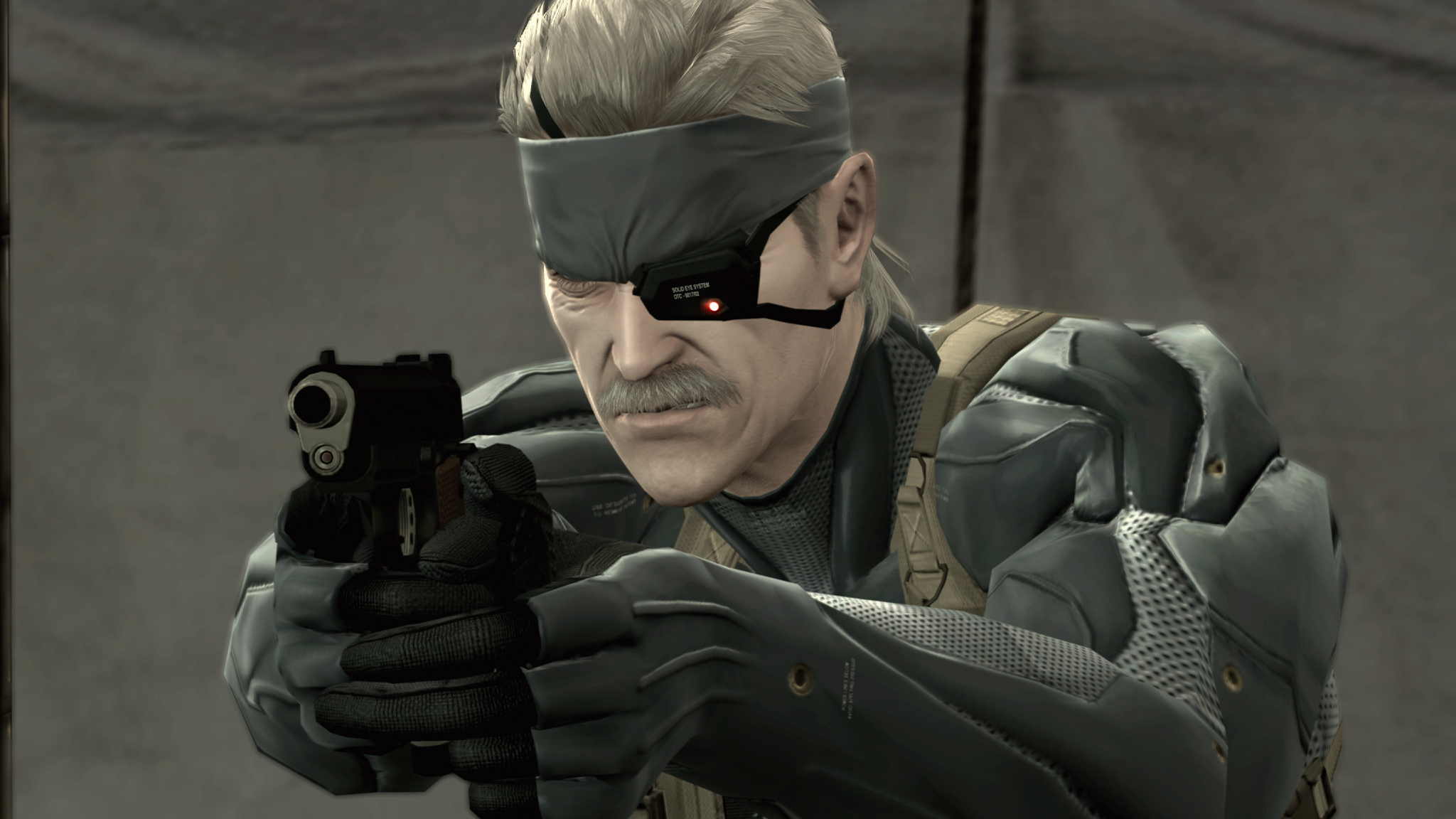
But male heroes get to be ugly all the time. John Marston looks like he’s been cooked on the grill for too long. Marcus Fenix is a piece of beef in a flak jacket. Solid Snake in Metal Gear Solid 4 looks like elderly John Cleese. Agent 47 has a head like an easter egg with a scary face drawn on the front. Even Gordon Freeman is a scrawny geek in power armour, growing his own Walter White beard in time for Comic-Con.

Not to mention the fact that there’s a clear difference in attitudes here. Women are often presented as physical ideals, but tend to be quite passive or lack their own agency. Girlfriends need rescuing. Dead wives need avenging. Women are helpless until the male hero comes along. When was the last time you saw a woman protagonist out to avenge her dead husband? Or even have any non-romantic connection to men at all? It happens, but it’s rare. It’s still a surprise, and it shouldn’t be.

And men? Well, they’re often ideals in every sense. Even if they aren’t physically perfect (and they often are), they tend to be dynamic and macho and brave. They’re people we’re meant to aspire to be, in other words.

Kyle Crane, Talion, Masterchief, Grayson Hunt and any of those sickeningly patriotic soldiers from Call Of Duty are good examples of this. They do have flaws, sometimes, but only the bare minimum required to make for some half-hearted character arc before they get over them and reach the end of the story, more perfect than ever. And how did they get over these problems? By rescuing a girl. God, it’s painful to watch.

DEVELOPERS

Last year a poll revealed that 22% of games developers are women. It’s not a great figure, but it is rising. It was half that in 2009, so we can see some progress. But I suspect that may be why we see so many male-orientated games, because most people involved are men. I wouldn’t risk designing a game from a female perspective, I wouldn’t know what that’s like. It would almost certainly fail and be an embarrassment for all involved. Maybe it’s the same thing – all the writers are men, who only know how to write for other men, so that’s what they do. And the stench of stagnation bubbles up in droves.

The diversity of an industry can only be a good thing, because it means that all the interesting stuff is going to get made. Put thirty similar companies to work, and they’ll all make thirty similar products. But get some new people in there, and the really fresh content will arise, just because they have a new view on things that might be interesting or worth seeing. Would I try to write a game from the perspective of a lesbian woman from Paraguay, working in a forensics lab whilst simultaneously trying to market a new line of sun creams? Or about being an esteemed mathematician and pacifist from Kazakhstan with brittle bone disease, two kids and a crippling addiction to cocaine?

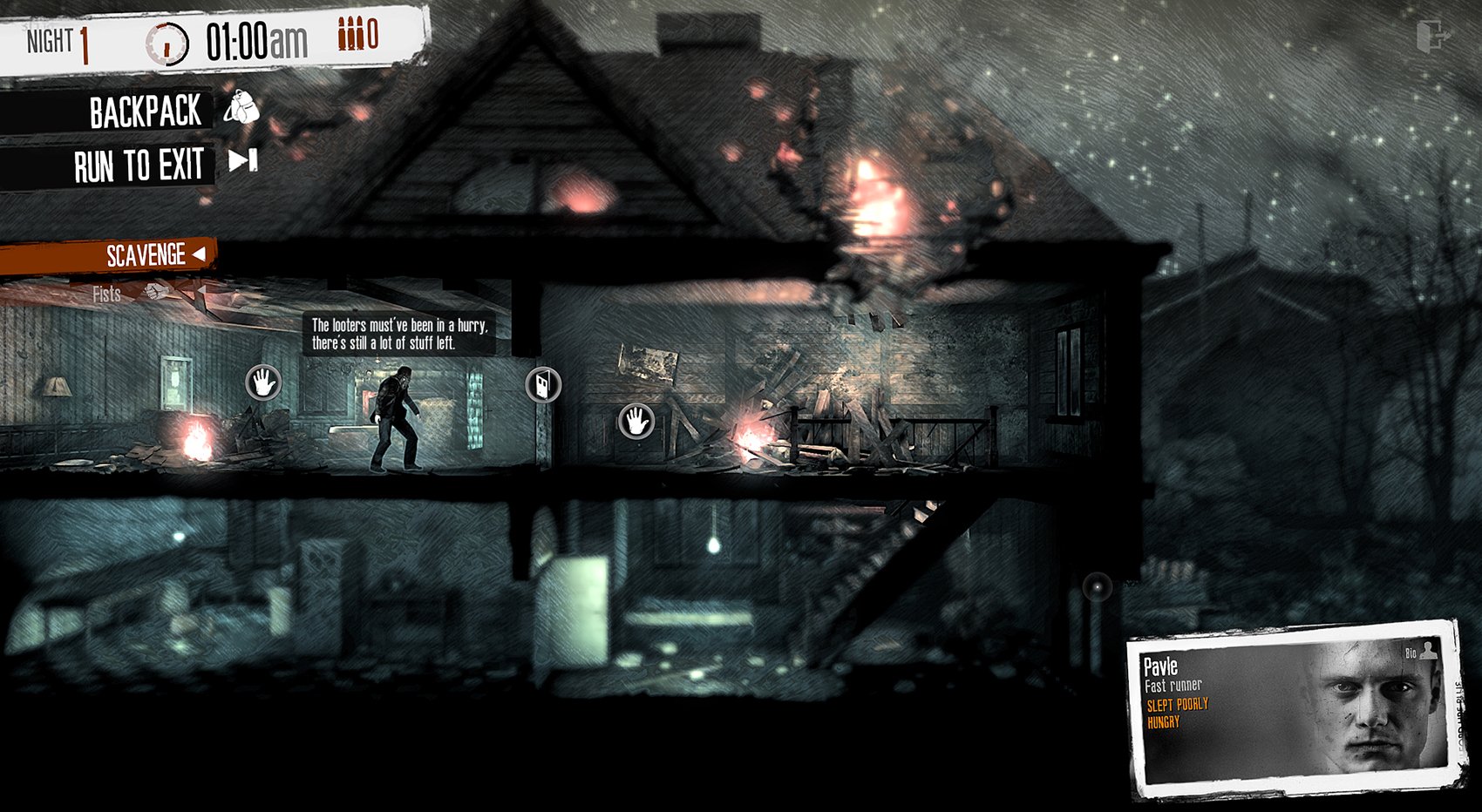
Of course I wouldn’t make those games, I wouldn’t know what either of those scenarios are like. I wouldn’t be able to do them justice. But would I play those games if they were made by people who know what they’re talking about? Definitely, they sound fresh and interesting. Look at This War Of Mine, a game that was fascinating to observe, because of how different it was and how engaging and exciting the concept turned out to be, after such a one-sided view in the industry.

This War Of Mine

We only get the interesting stuff like this when we get new ideas flowing. Er… It’s not all this depressing, I swear.

Besides, people won’t stop making generic, boring military shooters just because women get involved in the industry. It’s been proven that all that shlock can make money, so it’s going to keep happening without issue. But this massive industry is big enough for all opinions. You can have room for both, you do have room for both! They didn’t stop making platformers when shooters were made, you know. Now we get Rayman Legends and GTA V in the same year, I think we can agree that there’s some good variation going on.

I’ll also say this, to those who are worried about games becoming boring if feminine or maternal perspectives get too much space in gaming. Mad Max: Fury Road is a movie about female empowerment and Telltale’s: The Walking Dead Season 1 is a game about childcare.

And they are both utterly brilliant.

#GAMERGATE

Now let’s address the elephant in the room, and start by explaining how I don’t know what an elephant is. You see, for a long time I didn’t understand #Gamergate at all.

I don’t mean that I didn’t agree with the cause, I mean I literally didn’t understand it. I was on holiday when the whole mess occurred, and by the time I got back it had become a labyrinthine tangle of accusations, lies and spite that became too confusing to keep up with. It’s only recently that I’ve managed to get my head around some small portion of what was happening, and I feel we need to go over a few key points in case this happens again.

First of all, I do understand how some people might be unimpressed when games journalism and the core industry get a bit too buddy-buddy. The nature of game development is so riddled with cynicism and deception that the last thing people want is yet another agenda that has the player’s priorities last.

I really do get that, if nothing else, and it’s not a request for journalists to turn their noses up at, it’s not something to be dismissed as the excessive demands of a few radical lunatics. I’m not suggesting that writers pour their every detail out onto the internet for investigation, but there needs to be more honesty regarding gaming journalism in general, because gamers have been lied to and manipulated before, and we don’t like it.

Reading about it online didn’t help much. Some of the articles on these issues were shockingly dismissive of the few valid points made by their opponents, even discarding the misogynistic angle. In some cases it came across as patronising or smug, or even filled with snobbery and distaste. The vigour with which some of them held onto the sexism aspect made me wonder if they didn’t want the spotlight to move onto the proper arguments, like they were nervous of what the fallout might be.

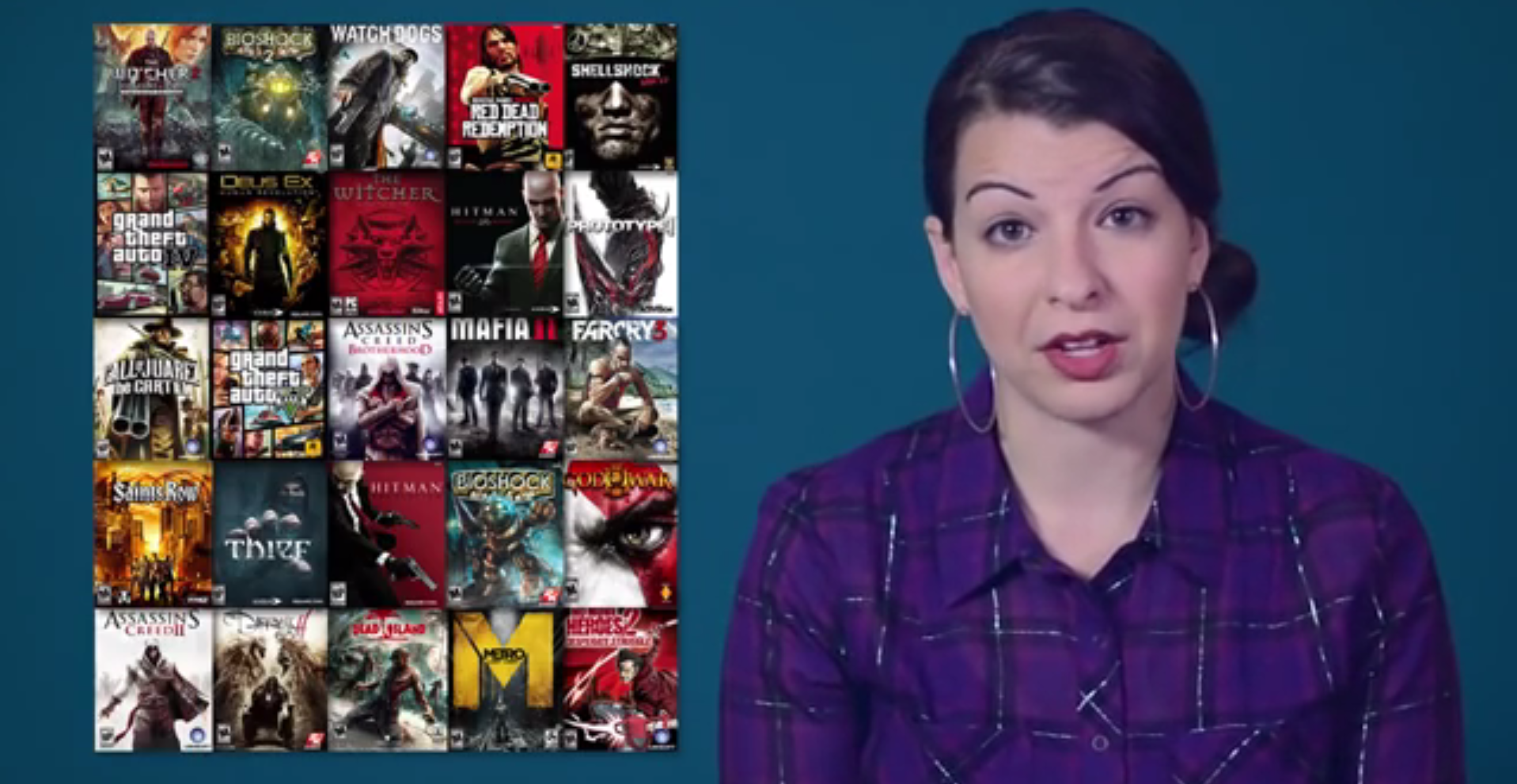
Anita 2

Look, you don’t have to like Anita Sarkeesian. You really don’t. You can argue against her views, you can look for flaws in what she says, you can even recommend that people boycott her work, if you feel that strongly. But for god’s sake, treat her like a human being. That’s not too much to ask.

But let’s be clear – the hatred and vitriol that was spewing into the feeds of certain female writers and developers is absolutely unacceptable. There is no excuse for death threats, for rape threats, for hacking somebody’s private information. None whatsoever, whether you do it to writers or designers, women or men, those in the industry or just adjacent to it.

I feel shocked that this has to be said, but apparently it does. Any chance of rational debate died when you bastards (and you know who you are) showed just how nasty you can get, how utterly loathsome you could act when somebody threatens you in such a small way. All you did was damage your own cause, you idiots. Who’s going to consider you a worthy member of the argument now? You’re all seen as psychos with no sense of proportion and no idea of morality whatsoever.

I think that’s what depressed me most about the #Gamergate debacle – it didn’t get us anywhere. When there’s this much energy and clashing of opinions, sometimes something productive can emerge from what’s left, some new comprehension of the way things are. It can be exhausting and difficult, but it does happen.

But we didn’t get that here. Everybody just retreated to their own halves of the field, and it became a horrible “us or them” battle. One side saw a bunch of aggressive Neanderthals who weren’t worth listening to, and the other side saw an impenetrable clique of allegiances treating them like morons and trying to deceive them where they could.

Whereas the truth was that both sides had some valid points to make, but you wouldn’t know that over the cacophony. Anybody between the two extremes was pushed to one side sooner or later, and the whole thing became nothing short of pointless. It really was a miserable thing to see. How rare it is, to have so much heat and generate no light whatsoever.

I almost don’t think the sexism angle needed to get involved at all in this debate. There was a genuinely interesting discussion to be had here on the responsibilities of unbiased press and their connections to a heavily biased industry. But before long it became “Oh my god, how could a WOMAN make video games or talk about them?! That’s absurd! Better make horrible threats from anonymity, demonstrating I am brainless, heartless AND spineless all at once.”

EPILOGUE

There is a point to all this, but the point is that all this is… Well, pointless. Aside from the fact that it’s just a nice, moral thing to do, when it comes to the idea of getting everybody involved, there’s no downside. We don’t lose anything by opening ourselves up to all members of society, we just get more ideas churning.

It’s also not hard to fight these things, if you feel that you must fight them. If you don’t like the games that Brianna Wu makes, don’t play them. If you don’t like the articles that Anita Sarkeesian writes, don’t read them. If you don’t want to support Zoe Quinn, don’t support her. But the industry only becomes more diverse and engaging by having these people as part of the system, even if it would only be through the energy created by those opposing them. Nobody can take your games from you, nobody can change what they mean to you. You only make things better when you respond with open arms instead of clenched fists.

And to those who would look at half the human race and consider them worthless to a whole facet of entertainment? Yeah, you lot can sod off. I’m happy to say that you are a dead end, socially, ethically, culturally and, to my greatest amusement, sexually.

Seriously, all that discrimination? Very unsexy indeed. I couldn’t think of anything less arousing than somebody moaning about the uselessness of women. It’s not getting my engine running, that’s for sure. I mean it, nothing’s going down when you guys enter the room, you’re the equivalent of Radio 4 playing at a funeral. Might as well resign yourselves to the fact that none of you are getting descendants any time soon. Sorry, that’s just the way it is, I don’t make the rules. I just enjoy them immensely.

Have a good weekend, folks!

THERE’S ALWAYS ROOM FOR DOOM

Well, well, well. Of all the things to pop back up out of the woodwork, who expected Doom? Nobody born after 1995, that’s for certain. I was surprised that anybody remembers what Doom is this far forward.

But yes, the new Doom game was revealed at E3, and it’s got all the subtlety and temperance of a suicide bombing, though I don’t think it’s without its charms, in a weird, homicidal way. It seems to have shrugged off the sludge of modern shooters pretty well, avoiding aspects like cover and regenerating health, whilst focusing more on psychotic murder sprees and beating a monster to death with its own leg.

I have to admit that I started grinning when the double-barrelled shotgun made a sound like a sledgehammer coming down on a bob-bomb, and all that was left of the victim was a couple of surprised legs that slumped to the floor a moment later. I’m even willing to ignore the fact that this was stolen from Bulletstorm, so happy was I to see something that was just so… Gleeful? Is that the right word? I hope it isn’t, but I suspect that it is.

You can’t help but be slightly stunned by how much Doom clearly delights in wretched amounts of gore. Gunshots leave visceral splatters, melee takedowns involve terrifying feats of brutality, and one puzzle is solved by watching a monster kill someone before finding the victim’s corpse, so that you can rip his arm off and slap it on a palm scanner. How about next time we just go with a keycard, yeah?

Doom hands

Look, will you hold still? I’m just trying to get the sand out of your eye!

I will say that I hope that Doom doesn’t try to do horror at any point. The gameplay made it clear that the Marine is the most powerful thing since Superman on steroids, so any attempt to threaten him is going to seem silly when he’s just ripped out a demon’s intestines and garrotted it with them. You can’t say it’s not tonally consistent for there to be horror, but I’ll be honest – it would surprise me if any demon had a kill-count anywhere near that of the protagonist’s by the end of this game. Perhaps I’m getting the wrong impression, maybe this is the set-up for an Alien: Isolation style game in which you play a frightened Revenant, trying to avoid the evil, unstoppable Space Soldier who will think nothing of murdering you in the most awful way possible. Huh. Now I kinda want to play that too.

I do wonder if it’s in Bethesda’s interests to resurrect Doom from the grave this late. The old Doom titles have a great lineage and demand respect, and nothing pisses off a fanbase more than a company bastardising the memory of an old franchise so they can make some cash from name recognition. Thief, Syndicate, Prince Of Persia, XCOM, and the embarrassing mess that was Duke Nukem Forever, they’re all examples of this. The only way to get away with that is to make the best game you can, and I’ll be damned it if doesn’t look like they’ve done that.

Let me add that I much preferred the Doom presentation to the Fallout 4 one. That’s what I wanted to see, Bethesda, ten minutes of uninterrupted and varied core gameplay giving a good indication of what we’re going to be experiencing, not dialogue trees and the most boring combat scenes in the game. If village maintenance reared its ugly head in Doom, it would get a fist pushed so far into its face that it would be able to smell its own brain. And speaking of utter absurdity through violence, let’s look at the game properly.

Doom scanner

The most intellectually sophisticated thing in the gameplay trailer was centered around ripping off a man’s arm. I’m strangely OK with that.

As mentioned earlier, the guns look nice and cathartic, with two exceptions – the plasma rifle and the chainsaw. The former is easier to explain, it just looks boring, making generic pew-pew noises with no sense of weight or impact to it. But the chainsaw seems odd, almost a bit pointless. The game already established that we can kill an enemy if we’re close enough, and not only that, we can do it quicker than the chainsaw, which takes longer and runs the risk of breaking flow. Though that isn’t going to stop me from using it often – I mean, it’s a chainsaw for killing demons. Even if I had to break my fingers every time, I’d still do it, because IT’S A FUCKING CHAINSAW FOR KILLING DEMONS.

I’m also very much in favour of how the game keeps a fast pace by having enemies drop health. Good action games like Saint’s Row 4 have remembered this, it’s a fantastic way of rewarding reflexes and going on the offensive, and of course Doom is nothing if not offensive. I like how you move really fast, I like that there were no directional icons when the puzzle bit came up, I like how you can hold more than two weapons, and I’m definitely going to find a place in my stony heart for the Heavy Assault Rifle, a gun that wouldn’t look out of place on top of an aircraft carrier and was so powerful looking I’m pretty sure you could bring down a planet with a couple of clips worth of ammo.

So at the end of the day, I guess Doom looks pretty good. I’ll be interested to see what kind of story there is – “Hell invades Mars” is all very well for the nineties, but I’d like to see a bit more thought put into it this time, just to contextualise it nicely. But if that hits the mark, then I’ll definitely be on board. Here’s hoping that E3 was actually honest today – because if not, then I’m going to be very disappointed.

STOP MAKING ME GLIDE EVERYWHERE, I LIKE MY SUPERPOWERS TO BE SUPER-POWERED

You know how I like to spend a lazy Sunday afternoon? Well, sometimes I like to lie on the sofa with a bar of chocolate and a good book. Other times I like to go for a walk, which reminds me of how much I hate the countryside and the outside world, at which point I go home and head straight for the sofa again, Cadbury bar at the ready. But mostly I think I like leaping from skyscraper to skyscraper, picking up lorries with my bare hands and shooting lasers out of my palms, all done through the power of spandex and suspended disbelief.

Everybody has their own way of relaxing.

I really like the superhero sandbox genre, because if you’re lucky they’ll be some fascinating new take on the whole thing. Running, driving, shooting, occasionally climbing, there are a billion games that offer those kinds of activities, and it’s very rarely new or original.

But playing as a super-powered ponce in tights usually means that driving around in a car is the choice for noobs, when you can always just bounce up into the ozone layer with a single push of your radioactive thighs, and drop down to make a crater in your chosen location. Why use a gun, when you could charge straight at your foe, deflecting his machine-gun fire with your nose, and headbutt him into the next postcode? Why pick a lock, when you could bash it down with single flex of your unrealistic pectoral muscles?

But there’s some things I wish I saw more of in superhero games, things that always seemed like obvious choices to me, points that they so often miss, and we’re going to start with a particular bugbear of mine: what’s the obsession with gliding?

Don’t get me wrong, I guess gliding is vaguely cool, but it always seems so agonisingly close to the more exciting option, that of unrestricted flight. The very few games that allow the player to fly are always really kick-ass, but so many others get all coy when the option is brought up. All the big super-sandboxes contain gliding, yet there would have been nothing wrong with letting us take to the skies that I can see. Let me show you what I mean.

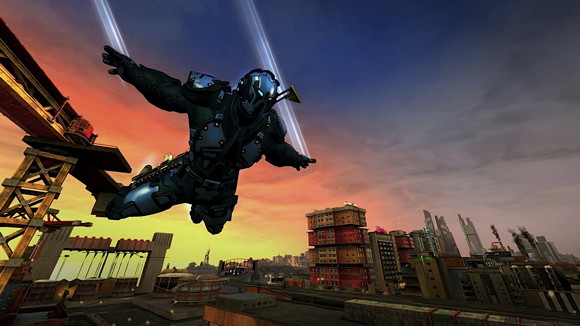
Prototype contained gliding, when there was nothing in the map that would have been ruined by flight. Crackdown 2 opted for gliding, yet another mistake it could add to its roster. Saint’s Row 4, intended to be one of the craziest games in world, only allowed true flying with the “Gat Out Of Hell” stand-alone expansion release, and even then it had to be within the designated areas. And sure, I guess it wouldn’t have made sense for Batman to get that upgrade to his cape in Arkham City, but why not let us get in that fighter jet he has and zoom around in there?

Glide

Gliding! It’s like falling, but less interesting.

I think there’s something irritating about gliding, because of the fact that it means you constantly fall short of your destination and break all flow of movement. You know what I mean. Leaping from the Empire State Building to the next skyscraper along is awesome, and even if you miss, you land with a crash and can just bounce back up with the next jump. But if you throw yourself towards it and start to glide, it’s slow and painstaking, breaking any sense of flow, and of course, you’re constantly uncertain if you’ll actually make it there, which makes it all the more infuriating on the times where you don’t.

On the regular occasions where you do fall short of the rooftop, you end up scraping your head against the side of the brickwork for a bit, as you slowly and embarrassingly float down like a discarded piece of paper, cursing the harsh mistress that is gravity and wishing that stupid kid could’ve gotten his own balloon back. What an inspiration to the city you are, masked hero. And now your secret identity is safe even without the mask, because you left most of your face peeled off against the east wall of the Chrysler Building.

OK, it doesn’t have to be flying that you swap it out for, but there’s enough games where you can pretend to be a disinterested kite that I think gliding is something we’re saturated on now. Why not think of something new? 2004’s Spider-Man 2, one of my favourite comic-book games of all time and the first truly brilliant super-sandbox, treated the webslinging as something dynamic, and it really was. It was something you actually had to work at, timing your swings and measuring angles to maintain the fastest speed possible, making it very organic and fun, treating it less like a method of travel and more like an extreme sport.

So movement needs to be as engaging as possible. Don’t just give us sprinter’s legs and a hang-glider before you call it a day, go for something a bit more. But what about combat?

SP 2

Look, I’m sorry you’re getting mugged in an alleyway, but I’m having too much fun!

To my mind, the name of the game here is power fantasy. Fine, sometimes it’s going to be smart to throw something of equivalent strength at the player, such as a giant monster or another berk with superpowers. But individual human enemies should be as easy to take down as a drunk Essex girl in a nightclub, and I can tell you why.

Combat is often at its most fun when we’re fighting vast waves of highly inferior foes, knocking them down until they have a new appreciation for tenpins in a bowling alley. The numbers make up the difference in strength, and of course, no matter how it goes you’re still going to look like a badass, because even if you lose, you’ve downed forty people armed with assault rifles along the way. One of my favourite sequences in Arkham City has you fight infinitely spawning enemies, but they’re all as substantial as water balloons and go down in a single hit. Now that was fun.

But if you drop next to a mugger with an uzi and barely have time to say “What’s all this, then?” before he turns around and reduces you to Swiss cheese, then you’re going to feel a bit ineffectual. Even if you win the game at that power level, the inevitable city-sized boss fight at the end is going to seem a bit silly, when you know deep down that Smackhead-Joe and his brakka-brakka toy could have sorted it out just as well. So keep the player powerful, or at least the most frequently powerful figure with the exception of big bosses. It makes it nice and cathartic.

And finally? Well, I’d quite like to see some cool new powers. That’s a stretch, I know, I don’t think there are many good ones left, certainly not many original ones. It’s a good thing that abilities aren’t copyrighted by superheroes as they’re acquired, or else things could get problematic. “Well Timmy, you were the perfect distance from that lab explosion to gain superpowers, but I’m afraid that the legal team have advised against the standard stuff like flight, strength and laser eyes, so that just leaves you with the ability to turn your bones into jam.”

Actually, whilst it might be a little tricky to think of new abilities at this point, I still think it can be done. Even reskinning the old stuff goes a long way to giving a new sort of feel to a game, just by how it looks and how it affects enemies.

Say if you’re making a water-themed character, why not tweak the dodge function, so instead of him just rolling to one side like everybody else, it has him turn into water, so an attack passes harmlessly through him? That sort of thing can make a big difference. And swapping out generic energy blasts and fireballs for something else more memorable, like a cheese grater beam or a gun that shoots tigers, is the equivalent of a funky signature at the end of a letter. It might not be enough to truly change our opinion of the content, but we will appreciate the individuality of the experience. And superhero games at their best have always been individual, a new experience that really stands out when swinging swords or using firearms inevitably becomes tiring or mundane.

Basically, that’s the lifeblood of a super-sandbox. Originality. Excitement. Something to throw away all preconceptions and focus on the good time you’re about to have, as you take to the skyline and discover that you want powers that you had never even thought of before.

Think about it – who wouldn’t want to play a game where you’re bitten by a radioactive cactus, or exposed to the energy derived from a basket of beach towels? Everybody would be craning their necks to see what was happening. And I’m not saying that I’m planning a game in which you get the proportionate strength and speed of a Kookaburra. Or a game in which you realise that your power to vomit missiles comes from the fact that your father was a Harrier jet. I’m not confirming that at all. But I bet you want to play them. That’s the true power of the innovative super-sandbox, people want the experience, they want to feel super-human.

On an unrelated note, can anybody help me make a Kickstarter account?

THE BEGINNER’S GUIDE TO VIDEO GAMES PART 7: TEAM FORTRESS 2

TEAM FORTRESS 2

This was the hardest choice by far, because generally I don’t like multiplayer much, and yet I knew that this horrible niche needed dealing with, sort of like firing somebody or putting down a beloved family pet. The interaction between man and world via broadband is as fascinating as it is demoralising. You can’t truly say you know humanity until you’ve heard a nine year-old brat shriek obscenities at you through your headset, or seen the word “faggot” come up so often you’ll think you’re stuck in a revolving door in a British butcher’s shop.

Multiplayer is also an odd duck, because you can’t really recommend a game if it doesn’t still have a viable community that plays it. Many online games flourish in their first few months, but as they become more repetitive, people drift away, and suddenly there’s nobody playing it anymore. And then it’s useless, you might as well use the disc as a frisbee, or delete it from your hard drive to make more space for Facebook pokes, or pornography, or videos of people getting injured in terrible camera phone quality, whatever you kids are into these days.

Speaking of, I did consider the quality of the community that plays each game before I made any firm decisions, so don’t get hopeful for anything in the Call Of Duty franchise or GTA V. They all fell before the first hurdle, and to that I can only say “Good riddance,” and that I hope they get trodden on while they’re down there. Perhaps there’s something about games that are joylessly obsessed with leaderboards or creepy weapon fantasies that causes absolute wankers to congregate on them. In all the games above, I had most of my attempts to play them ruined by people who seem to have no other ambition but to act their worst. At least, I hope they’re acting their worst, because I can’t think of any way to be more loathsome, except perhaps for wearing Osama Bin Laden’s face as a Halloween mask.

It really makes you despair for the human race, this behaviour. Of course, what you do then is look for something that makes you happy. Very happy. And thus, in comes Team Fortress 2, also known as TF2, also known as the best thing since somebody had the sense to take sliced bread and put an enormous piece of grilled meat inside it. Yes, TF2 is the steak sandwich of online gaming. There can be no higher praise.

I realise I’ve come full circle here, with the first game and last games I picked for this list both being part of the Orange Box collection, released by Valve in 2007, but that’s the weird thing about Valve. They’re always reliable creators of excellent games, but they hardly ever make any, just fiddle about with the already-excellent online Steam store interface. It’s rather like if people went to Van Gogh and said “Wow, you do really good paintings. I hope you keep doing them, they’re unmatched artistically.” And Vincent stroked his bearded chin, ignoring the pain in the side of his head, and said thoughtfully, “Well, I suppose so, but you know what’s interesting me at the moment? These picture frames I’ve been seeing. They’re excellent, I really like them as a medium for holding artwork. I think from now on I’m just going to ditch this painting rubbish and focus on making these frames, for ever and ever.”

Cue awkward silence.

Anyway, back to Team Fortress 2, the online first-person shooter. Immediately it scores two major points in my book, one for having one of the most memorable and enjoyable advertising campaigns I’ve ever seen, featuring the kind of trailers that would be made if a Pixar animator had a bad Vietnam flashback. And secondly, it’s free! Completely free! No payment, no subscriptions fees, no online service costs. It’s free now, and free forever.

Well, sort of.

It’s hard to explain this to somebody who isn’t aware of it. Originally it did cost money to buy TF2, until Valve decided to change that and make it free to download. Fair enough, it had been around for a while, they probably weren’t making that many sales this long after release. Except that now there’s a new element that wasn’t around when it started: Unlockable hats and weapons.

Whenever you die in TF2, you have a very small chance to get a random gun or a customisable piece of clothing to change how your characters look and fight. I admit, it takes the sting off death when a box pops up afterwards, telling you that for the incredible achievement of having been shot in the neck twelve times, you have been rewarded with a rather natty fez, or a gun that shoots urine.

Except that you can buy these bits of gear if you want to speed up the process, and it’s surprisingly hard to fight the urge to do so. More playstyles unlock with different weapons, so it just makes sense to want those, but the need to buy hats is harder to put your finger on. I think it’s that players want to have their own identity within the game. All the classes are identical until they’re altered with equipment, and those who are using stock characters are always recognised as newbies and inexperienced members of the community.

So putting a Roman Legionnaire’s helmet on your soldier and giving him a rocket launcher that shoots lasers or kittens – that’s just your way of announcing your individuality. It’s a lot like having a face piercing. In that and many other respects.

But how does the actual gameplay hold up? Pretty damn well, I should say. To start off, there are nine diverse classes, all nicely balanced, but with wildly different methods of play. The heavy has more health than god and a minigun not yet seen detached from the wing of a harrier jet. The spy can become invisible and disguise himself as members of the other team. The scout makes Usain Bolt look slow and unwieldy, and can jump a distance equivalent to the average marathon. Even the engineer can build turrets, teleporters and ammo dispensers, just to keep things interesting. There really is something for everybody, and then there’s even sub-categories of gaming style. Sure, the pyro is all about getting in close to burn people with the flamethrower. But shuffle around your loot a bit, and suddenly you have a build that’s all about melee damage, setting them alight with your primary weapon before quickly swapping out for the axe that does huge damage on burning targets.

Every class is like this, having more options open up as you collect more gear, but I also like that the game loves keeping up a fast pace, rather than having you plod from one side of the battlefield to the other. Remove chest high-walls from your mind, you’re going to have to keep moving if you want to survive here.

That said, even the flimsiest characters tend to have a fair bit of health, so it means that if you’re attacked you usually have time to react before you’re killed by the next burst of gunfire, and I like that. There’s no satisfaction in just being shot in the back and immediately going down, it feels cheap and boring, another problem I always had with the Call Of Duty series. But TF2 prides itself on manic battles and emphasises huge, chaotic fights, in which bullets fly like raindrops and explosions are the local currency. Valve knows that the only way to make this sort of thing last is to give everybody enough health to actually get involved, rather than getting blown to high-heaven before the fight has even begun. Not only that, but the maps tend to be small and compact, and respawn times are negligible, making this buoyant, violent lunacy as common as possible.

There’s also a co-operative mode which I like. You and half a dozen johnnies have to work together to fight off huge waves of robots that mimic the appearances of your characters to an uncomfortable degree. It escalates well and there’s a fair few maps, and unlike the normal multiplayer you can acquire upgrades for yourself mid-game as you kill more bots and find more money. It’s a good way of elevating the gameplay as you progress, though bear in mind that some of the later co-op missions can be quite unforgiving.

But I think the thing I like most about TF2 is that it just looks bloody brilliant. I didn’t use that earlier comparison to Pixar lightly, Valve put great work into the visual design of their characters, giving them exaggerated features and emotive faces, and there’s lots of clever things about them that aren’t immediately obvious.

For example, all the different classes have vastly distinctive figures and frames, meaning that the second you look at a person, you can tell what his job is. A slim silhouette with long limbs? It’s a spy. An shorter, angular body that’s leaning forward? It’s a scout. A straight-standing figure with a large backpack? Sir, you see a medic. It makes fighting less trail-and-error than other games, in which the only way you can tell if an enemy has heavy ordinance is to start shooting at him and hope he doesn’t fire a nuclear missile back.

But there’s more to the graphical style than just helping the player mechanically, the imagery is what gives it such charm. The cartoon visuals and heightened reality help the whole thing stay jovial, stop it from getting grim and depressing. Yes, you’ve been blown to pieces by a grenade launcher, too bad. But your killer was a man with a comically strange Scottish accent who ran past holding up his kilt and wooping, his green wig bobbing merrily in the breeze. That’s worthy of a smile, surely?

And TF2 does make me smile. It makes me grin from ear to ear. The chaos, the madness, the disarmingly surreal atmosphere. Not to mention the fact that Valve clearly has great love for both the game and the characters, as regular updates add more content and maps each time. There’s even a well-written webcomic that comes out for no cost on their site, and as a lover of graphic novels that suits me to a tee.

So strap on your pink crash helmet, join me in the dusty outback, and let’s while away the hours racking up a higher body count than Burger King and Hannibal Lecter combined. Team Fortress 2, I think this is the beginning of a beautiful friendship.

If you have the stomach to deal with the rest of the world online, there are good games to do it through. Halo 3 is an old favourite of mine, an excellent shooter with a vast array of customisable maps and game settings. Elite: Dangerous is a recent space-fairing MMO, set in a vast recreation of the Milky Way that offers a rather pleasing amount of freedom. Or what about Payday 2 and Valve’s other recent creation, Left 4 Dead, both of which tend towards an emphasis on co-operation with other players?

Thanks for following over these first seven days! Articles won’t be every day from this point, but expect at least a couple every week. Remember, if there’s a topic or game you’re interested in, post a comment and we might just oblige.

THE BEGINNER’S GUIDE TO VIDEO GAMES PART 6: XCOM: ENEMY UNKNOWN

X-COM: ENEMY UNKNOWN

Well, we can’t give this one points for originality, I suppose. Killing aliens in video games is about as innovative an idea as “Zombie apocalypse” or “Press X to start.” But sometimes the old ideas can surprise you, and I am very glad that this one did.

The history of this series is a slightly confusing one. In 1994 a game came out that was called UFO: Enemy Unknown. Except for when it was in the USA, where it was named X-COM: UFO Defense. Jesus, there’s only been one game and they’re already trying to bewilder us. Out of both of these titles, X-COM was the one that stuck, and a whole litter of turn-based strategy sequels were spawned, up until 2001 with the less than popular shooter title: X-COM: Alliance.

Everybody thought that was it for the veteran series. It faded into history, until, suddenly, another entry was announced in 2010! Another XCOM game! Oh, wait. It’s not the highly celebrated turn-based mechanics that everybody loves, it’s another bloody shooter. You know, just like the terrible X-COM game that everybody would rather just pretend didn’t happen, like the Star Wars prequels or paedophile priests.

The overall response from the public to this news was a considered and surprisingly tame: “Fuck off.” Considering that the worst game of the series so far had been a poorly-made shooter, nobody was feeling too excited about what seemed to be a terrible attempt to jump on an already-overstuffed bandwagon. Perhaps it was this that caused Firaxis Games to bristle and create X-COM: Enemy Unknown, albeit two years later. It was a loyal recreation of the original game, but with a much more intuitive design, a fascinating combination of base and resource management mixed with tactical turn-based combat, and a constant motivation to keep playing, in order to learn more about a mysterious antagonistic force. An enemy that is unknown, if you will.

You still not sure? OK, think about this. The very first thing that happens in the game is a quotation from Arthur C. Clarke. I mean, this thing couldn’t be any more smart science-fiction unless downloading it would cause my laptop to get up and walk down the hallway.

The premise of the game is this – you are the head of an international (but pointedly not interplanetary) organisation known as X-COM, put together when bobble-headed aliens start to show up and liquidise anyone who wanders past them. Funded by the countries of the world and tasked to repel the little plasma-wielding sods, you must oversee technological breakthroughs, consider smart investments, and advise the useless squad of girl scout recruits you were given with on how best to deflect laser beams with their faces.

Yes, there is one obvious critique of X-COM, and we’re brushing against it now – the game is bloody unforgiving. Newly hired soldiers have stats equivalent to that of battery hens, and training them, whilst effective, still takes a while and can only be done through successful missions. You will growl like a lion seeing his girlfriend getting chatted up by a gazelle, after watching a useless newbie turn into a hard-bitten killer of xenomorphs, only to let him make a wrong turn in a flying saucer, get hit by a E.T.’s super missile and turned into raspberry jam.

And because the game ramps up the difficulty with no thought for how well you’re doing, a bit of unlucky gameplay means you could have all your good marines squashed in a single firefight, and then you’ll have to send in the useless, untrained rookies to deal with the psychic hyper-aliens and triple-armoured beserkers. And good luck squire, because you’ve about as much chance of winning then as you do of winning Eurovision with a ball gag.

To be fair on X-COM, this isn’t always the case. Most of the campaign is randomly generated, producing different maps, enemies and challenges at different times. This makes it enormously replayable, because every person’s experience is different. No person ever goes through the same thing when playing it through, and I like that a lot. Also, there are a ton of tactics and ways to go about playing, but they’re all deceptively intuitive and come across very organically. As you direct your squad around the city streets or alien bases, you’ll notice that you’re making decisions that you weren’t even aware you were considering, such as sending in your assault troops first whenever you go into unknown territory, or working to protect the medic in the group.

And the tactics apply even out of missions. OK, you’ve just finished a bit of research on a Jawa’s propulsion technology and now you have a jetpack. Awesome. But building them is expensive, so who gets the only one you can afford? Your sniper, allowing him to pick off enemies from the skies and render their cover useless? Your heavy, giving him good angles to drop grenades and rockets, like he’s a man pretending to be a Dambuster? Or the psychic guy, because, um… He thinks more clearly when he’s got fresh air? Alright, not the psychic then.

And what are you going to research now that you’ve got the lab free? New weapons? Armour? Aircraft? The weaknesses and biological traits of our foes? Wait! No time for that now, that satellite you started building last week is done! What country are you going to position it over? China’s offering the most money for it, but you haven’t got any over South America, and Brazil is considering withdrawing from the project and needs placating. Well, whilst you’re umming and erring, a spaceship the size of Andre The Giant’s big brother has started heading for Berlin, so pick a couple of customised fighter jets and let’s try to stop it, preferably before it turns Germany into a crater and starts putting probes in peoples frankfurters.

This might sound like an intimidating amount of information to be crammed into one game, but I assure you it’s not. It builds on the basic rules slowly and gradually over time, developing before our eyes and evolving into a glorious network of supporting mechanics and ideas that fit together like nothing you’ve seen.

Now if you’ll excuse me, the Sectopod robot just got reinforcements in, and the mutons are approaching from the east. I may be gone for some time.

Of course sir, turn-based strategy is gameplay for the distinguished gentlemen. Perhaps now you’re done with your starter, you might enjoy the complex flavours of Shadowrun: Dragonfall, the assorted platter of Civilisation V, or the rather spicy dish that is FTL: Faster Than Light. And for dessert, the venerable Pokemon series and some of the older Final Fantasy games. Bon appetit.

TOMORROW: AT THE END, WE COME FULL CIRCLE.

THE BEGINNER’S GUIDE TO VIDEO GAMES PART 5: MINECRAFT

MINECRAFT

Alright, this one is here to fulfil a couple of niches that I felt needed addressing, because they shouldn’t be ignored and this game amply killed two birds with one stone. Think of it like this – did you like Lego as a kid? Of course you did, Lego is awesome. If I were doing a list of the best non-electronic games, then Lego would be number one, and numbers two through ten would simply state “See number one.” Well, Minecraft is like Lego, but with monsters, TNT, and the power of flight added in. And that’s an upgrade not to be sniffed at.

Minecraft satisfies two criteria I wanted to talk about, namely survival games and creativity games, and also proves a pet theory of mine – that you don’t need good graphics to sell. The whole thing looks like it’s made out of a mixture of cardboard, Playmobil, and kiddie’s wooden blocks, but comes together quite well, giving it has a sort of unfinished charm in its appearance. And that’s kind of cool on its own.

As you start a new game you’re provided with two choices – either creative or survival mode, and this is really going to impact what kind of game you play. It’s not like picking a difficulty setting or whether you want subtitles, this will change everything until you start a new game.

Creative mode makes you immortal, allows you to spawn any item you want, and gives you the power of flight just to top it off. It encourages you to build statues, structures, massive and awe-inspiring projects. Perhaps you’ve seen the life-size Starship Enterprise that hangs in the air in the exact way a continent does not, or the fully functional digital clock that somebody made with the few redstone assets that the game gives you. I myself have made a castle the size of a large city, and also a city the size of a large castle. Just because I could, and it was very satisfying. The large dimensions of the individual blocks and pieces mean that structures go up fast, but there’s a diversity to these assets that means that the constructs never look rough or weird-looking, at least once you’re building creations above a certain size.

On the other hand, survival mode limits you to the ground, forces you to mine for resources and hunt for any materials you want, gives you an empty stomach that needs constant refilling, and finally throws in the occasional monster hoard for you to bat away with a stick. There is an end to the game, sort of, which involves dropping into a couple of other dimensions to beat a surprised-looking dragon to death, but it’s not an obvious one and you wouldn’t know it was there without the wiki to hand.

Speaking of, you are going to have to alt-tab out of the game a lot to check the internet, in order to know what’s what and how it helps. Crafting is a big part of this game (of course it is, it’s in the title), but the game doesn’t tell you how to craft anything unless you’re playing the console version, and some of the more elaborate objects can be completely obscure. Perhaps watch a couple of the eighty-bajillion “let’s play” videos out there before you start, so you know what you’re doing. Otherwise, things might get ugly when hissing green death comes to your door.

But once you do know what you’re doing, you’ll recognise two important things. Firstly, that there is nothing more annoying than collecting enough rare metals and gemstones to embarrass a professional rapper, before plummeting head-first into lava and losing it all like a subterranean brother of the Three Stooges. And secondly, that it has been seven hours since you started playing.

It’s hard to explain to somebody who hasn’t experienced it. Time does weird things when Minecraft is turned on, so you’ll probably make the startling realisation that you’ve unintentionally pulled an all-nighter more than once.

Oh, it’ll start subtly. “I’ll just build a small house for me to put all my equipment in, then I’ll go to bed and get some shut-eye. Actually, I’m going to want some windows whilst I’m making that, so I’ll pop down to the beach and grab some sand. That shouldn’t take long. Ooh! A bit of iron in an exposed cliffside! I’ll just chip that out for later. Except damn, I left my pickaxe back home, so I’ll just head to the forest to get the wood for one, so I can get at that those resources. Hold on, a village! I wonder what I can find there? Emeralds, eh? Those seem useful, I’ll put those in a chest so that I can trade them later, only I can see a herd of cows over there, and I need to grab some meat so I can – Wait, why is my alarm ringing?”

Minecraft is a one of those curiously addictive games that combines limitless ideas with some very simple objectives. Have at ’em, my friends, and tell the creepers that I said “Hi.”

If you liked Minecraft, you’ll probably like Terraria, because it’s essentially a 2-D adaptation. Or why not give Don’t Starve a go?

TOMORROW: TURN BASED-ALIEN INVASION!

THE BEGINNER’S GUIDE TO VIDEO GAMES PART 4: BATMAN: ARKHAM CITY

BATMAN: ARKHAM CITY

God, this was a hard one. I knew I needed a “Sandbox” game in here somewhere, something big and expansive, ripe for exploring. I knew I needed something that would give the player a sense of total freedom, and a bunch of titles went through my mind before I could even blink.

The first one was Dark Souls, but I crushed that urge before it could grow legs and make its escape. I love that game more than my own family, but even I know that it’s an acquired taste, mainly because it’s about as friendly to newcomers as a land mine. No, Dark Souls appeals to a niche market, and that’s not what this is about. Other sandbox games occurred to me, GTA V, Red Dead Redemption, Skyrim, Elite Dangerous, The Fallout Series, Spider-Man 2, even the baffling chaos of Just Cause 2 and Saint’s Row 4 were tempting me, with their open worlds and strange movement systems, the cheeky little harlots.

I knew that the game I picked needed to have one of two things. Either a method of travel that was fun and engaging (hence Just Cause 2) or a game world in which you couldn’t walk for five minutes without getting caught up in something interesting (hence Skyrim).

But then, why not both?

The Batman: Arkham series is one of those things that nobody expected to do as phenomenally well as it did, a bit like Portal. The first game, Arkham Asylum, introduced a fantastical, yet dark and twisted tone that fit the core theme perfectly, a reflection of the madness that so dominated the plot. It had one of the most revolutionary systems for melee combat devised in the last decade, it had stealth mechanics that worked wonderfully and made you feel like the monster in somebody else’s horror game, and it was topped off nicely by a strong plot with an excellent rendition of the Joker by Mark Hamill. It was sixes across the board.

And the second game, Arkham City? Well, it took all of those things, and put them in a section of city filled with a bunch of angry men who were all very hungry, and the only thing that would satisfy them was a knuckle sandwich. Go get ’em, bats.

In all seriousness, the first game is probably slightly stronger (though only just), but the second game really took the “sandbox” idea to heart and flourished because of it. Ziplining out of an alley in a heartbeat, launching yourself above the skyline and opening your cape to glide ominously above the city, like some badly-dressed bird of prey – that was an awesome thing. You could go from street level to a hundred feet in the air and back down again in seconds, all flowing naturally together and without seeming disconnected or confusing. In fact, everything in this game flows like water. The movement, the combat, the stealth. The only flaw I can think of is that the plot stumbles a little in the mid to late periods, but you’ll be so enamoured with their Joker that you won’t really care that much. I know I didn’t.

Oh, and the game actually came close to presenting Robin as cool. When you can do that, you can do anything.

Infinitely huge worlds are always a laff. Drop in to any of the above, they’re all worth your time, but my preferred contenders are Dark Souls, Red Dead Redemption, and Fallout: New Vegas.

TOMORROW: IT COMES AS NO SURPRISE…

THE BEGINNER’S GUIDE TO VIDEO GAMES PART 3: SUPER MARIO WORLD

SUPER MARIO WORLD

Some games age badly. We know this, and interestingly, it seems to be those that overreach themselves when they’re released. Any game that started by selling itself on cutting-edge graphics and new technology tend to be those that are hardest to go back to, as the graphics and tech soon become the norm, then the old, and then the comparatively awful. I suspect this is one of several reasons that World Of Warcraft has lasted as long as it has.

Games with a cartooney aesthetic tend to age quite well, because what looks chirpy and fun at one point still looks chirpy and fun ten years later. Or, to put it more precisely, twenty-five years later, and now I feel really old, because this game and myself aren’t aged too far apart and it’s still doing better than I am when it comes to the ageing process.

Super Mario World, then. Originally for the SNES as a launch title, the classic platforming pioneer found more love from the public than an unregistered assault rifle does from a republican redneck, and the weird thing is that this hasn’t changed. The thing is just gorgeous in its every aspect, it really is the apex of what a 2-D platformer could be. Bright and colourful, endlessly imaginative, with a memorable eight-bit music score that will have you humming along with it long after it’s over, and a bizarre amount of exploration for something that was having to make do without the luxury of a z-axis. Sure, you could ride bareback on that big-nosed dinosaur to the regular exit, if you’re boring and square. All the really hip cats take the flying cape express up to that pipe and on to Star Road. Wait, you don’t know Star Road? Or Special World? Or any of the other dozens of beautifully designed levels that remain hidden long after you’ve completed the game, making it endlessly replayable? Well, guess you’ve got something to occupy your time from now until doomsday.

I realise now it was a little unfair of me to say that games that push the technological boundaries of the time tend to age poorly. Let me be clear, it’s bad news for those that only rely on their swanky graphics and physics engines. Super Mario World was pushing the boundaries of the SNES as far as it could at at the time, and Shigeru Miyamoto, the creator of Mario himself, was making as much use of the expanded memory as possible. Yoshi, so iconic to the series for being that loyal and steadfast steed that you would drop like a hot potato if you thought you weren’t going to make that jump, would have been in earlier games if not for the limitations of consoles at the time. But the creation of the SNES allowed Miyamoto to add all the ideas he’d never had room for, and you can see it in the way it plays. Big, bold, beautiful. It could only have been more progressive if it had been marching down a gay pride parade.

Mario as a franchise now comes across as dry and dessicated, all the interesting parts removed to keep it safe and risk-free, meaning other platformers and most games in general have long since surpassed it. But Super Mario World is a joyful reminder of when that fat little plumber earned those stars he’s so famous for, back when he was king and nobody would dare dethrone him. If Nintendo can make a game half as revolutionary and charming as that now, I dare say he could reign again.

Like jumping around 2-D worlds like there’s a jetpack up your arse? Why not give Rayman Legends or Battleblock Theatre a try?

TOMORROW: SANDBOXES AND SUPERHEROES

THE BEGINNER’S GUIDE TO VIDEO GAMES PART 2: SPEC-OPS: THE LINE

SPEC-OPS: THE LINE

Bloody hell, I can’t believe I thought I knew what horror was before this game. Strong titles like Amnesia or Alien: Isolation had led me to believe that the definition of horror was wandering around semi-linear environments, hiding from whatever hideous aberration wanted to eat my skin and wear the flayed corpse like a Duchess’s stole. But boy, was I wrong. Horror is not avoiding a creepy monster with moments to spare as you listen for the footsteps to go away. True horror is looking in the mirror, and thinking “YOU are the monster.”

Spec-Ops: The Line is the game I go to when people ask me to provide a game with a truly phenomenal story. Hell, I’ll say it – Spec-Ops is nothing less than a true work of art, because those writing it clearly understood that gaming is a medium in a unique position – one where they can immerse the player more than any other, and make them feel responsible for whatever decisions have to be made. You can’t do that with a book or movie, those events are always happening to somebody else, and we are only observing. But in Spec-Ops, YOU are the one at fault. Don’t kid yourself with this one, you are coming out of this story with blood on your hands.

A bit of context is useful here, I think. The game was released back in mid-2012, a point when the brain-dead, meathead shooter was riding high and mighty. We’d had Modern Warfare 3 and Battlefield 3 the year before, and no end to either series in sight, when both titles were long past their prime and getting dull. But Spec-Ops actually had a story that mattered, and reminded us of two very important things. First, that when you pull the trigger that there is a human being as complicated, and as flawed as you are at the other end of the barrel. And second, that ethics are something you may have to give up on if you want to get through this. They are the first casualty of war. In fact, Spec-Ops does a good job of deceiving you at the start, making you think that it’s going to be like all the others. You’re an elite group of commandos, you the experienced leader, with a pair of jovial squadmates behind you, cracking off one-liners and gunfire alternatively

But it’s not long before you’re in a true hell, navigating death and terror as your mind and morals break away. You want to live? OK then. Let’s see what you’re willing to do to stay alive.

Bear in mind that I am recommending this game only for the story, mind you. There’s nothing inherently wrong with the gameplay, but there’s not much inherently right either. It’s a very standard form of third-person, cover-based shooting, that does its job alright and there’s not much more to say on it, quite frankly. If you want a kick-ass shooter when it comes to mechanics, go to Team Fortress 2. But if you want a game that will challenge you morally, intellectually, and emotionally, Spec-Ops: The Line can kick you in the balls like no other. I wouldn’t have it any other way.

Love being dropped into immersive narratives and fascinating worlds? Once you’re done with this one, give Star Wars; Knights Of The Old Republic and The Wolf Among Us a look-see, or even the Bioshock series, as long as you ignore the second one. Seriously, that just isn’t worth it.

TOMORROW: THE ULTIMATE CLASSIC