FALLOUT 4 – LET’S GET SENSIBLE

So Fallout 4 got announced today after a “mysterious” online countdown, and everybody on the internet either cried, fainted, or stained their underwear en masse.

Not that there’s anything wrong with that. I’ve been super-hyped about games before, most people have. Not to mention that the Fallout Series has a proud lineage of some genuinely excellent games, as well as one of the most charismatic interpretations of a nuclear wasteland I’ve ever seen, a sentence I never thought I’d say. Bethesda are pretty good at delivering high quality games, and sandbox has always been their bread and butter, so yeah – this one’s probably worth getting a little excited over.

Fallout 4 trenchcoat

Tex Murphy? What are you doing here?

No, what I want to talk about is the way it was announced and the events leading up to it. I realise that this is the second article this week about ad campaigns, but I felt rather startled by the relative clarity of Fallout 4’s announcement. It was all very smooth, very clear, it all just made sense, whilst keeping us in the dark just enough to make us curious. It wasn’t only me who thought this – a friend of mine, the biggest Fallout fan I know, agreed with this too. The whole thing just ran like watery clockwork.

That said, I guess they didn’t want to make people too suspicious or to act too coy about it all, because there’s some rather raw history there. There was a rather famous hoax a couple of years ago, when somebody made a false site themed with nuclear imagery, also utilising a countdown, but this one went for two weeks before the lie was revealed. Everybody got really excited about it then, too, and of course got very, very angry when they found out the truth. Meanwhile, I had my fist in my mouth and was trying desperately not to laugh.

I know, people got upset by it, but a buddy of mine got upset when he was hit in the head by a Frisbee, and I laughed at that too.

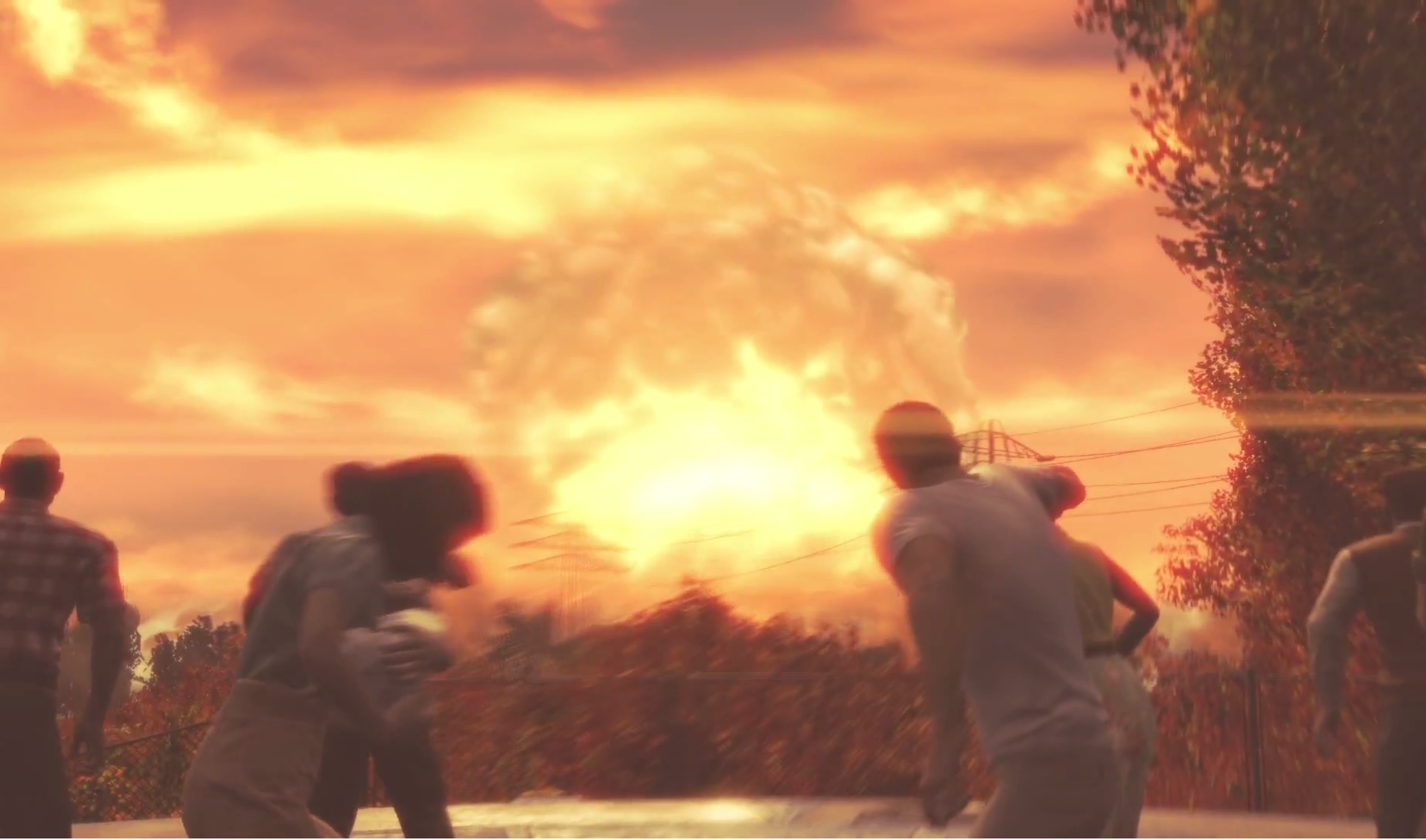
Fallout 4 explosion

H- Honey? Did… Did you happen to leave the gas on?

But I rather admire Bethesda’s methodology here. They start with the mysterious countdown, except everybody knows it’s not THAT mysterious, so no chance of people’s imagination running away with them. On top of which, it only went for 24 hours, so that should stop any of the more extreme conspiracy theories about it being Nuclear Skyrim or Half-Life 3 getting any traction in the short time period. Of course, the countdown, though brief, did last long enough to get everybody who was on the lookout for such an event aware of it. Gold star there.

The trailer? Well, it’s pretty good. It shows the pre-war aspect of the Fallout universe, something we’ve never seen in much detail. It shows epic pirate ships, an updated version of the old deathclaws, and what looks like the killer Zeppelin from the end of Alan Moore’s “The League Of Extraordinary Gentlemen.” Enough to remind us of the stuff we love, mixed in with enough mystery to awake our curiosity, the most powerful urge we have. Now I WANT to know more, it’s the same as the XCOM 2 trailer we saw on Monday. There’s a lot of footage that looks like it’s from the game, though no gameplay itself, sadly. Except that at the same moment it was released Bethesda chirped that we get to see gameplay at E3 later on. Fair enough, now I know where to go for that info if I want it. Gold star again.

It may sound like all this is fairly normal or self-explanatory, but games are so often the subject of bizarre or damaging ad campaigns. Whether it’s Aliens: Colonial Marines lying to the public outright, or Ubisoft refusing to contextualize the cover of Far Cry 4 in order to stop it from looking racist (which it wasn’t in the end, but I wish we knew that), a lot of publishers will do weird things to advertise their games. It’s simply not true that all publicity is good publicity, at least not for games. So why do publishers indulge bizarre methods when it comes to getting the brand out there?

They get especially odd when it comes to leaked information. If a bit of gameplay info gets out onto the internet without clearance, the first thing everybody does is look to the developers, one eyebrow raised. Yes or no? True or false? And remember that if they say nothing, we’ll probably believe it anyway.

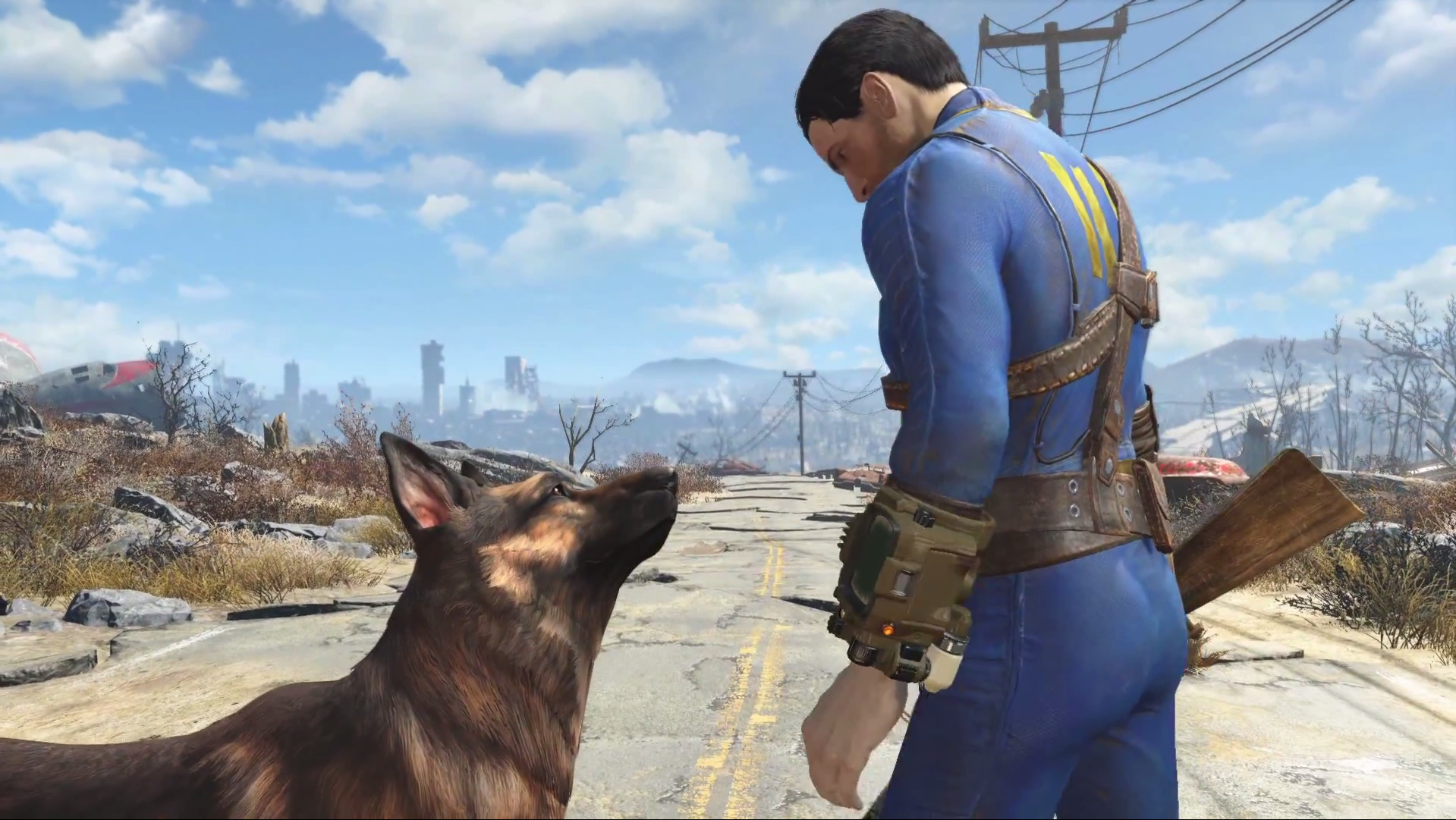
Fallout 4 Dog

Let’s not get too affectionate, Gromit. I may have to eat you before this adventure is over.

But they always go quiet, always go still. Like a crocodile lying at the bottom of a river, they’re waiting for the perfect moment to strike. Except that whilst they’re waiting, a lion has already killed the prey by the riverbank, and is starting to drag it off to eat. But still that crocodile just lies there, determined to come out when he’s ready, regardless of how badly he’s ballsed up his strategy or how much the world has altered in ways not to his advantage.

You see, I suspect that the publishers always have a Plan. A big, proper Plan. The kind with charts and folders and the like. You know the kind I mean, it would probably go something like this:

  • Month one: make suggestive noises in an interview, but don’t commit to anything.
  • Month two: surprise everybody at a convention with gameplay.
  • Month three: Lie through your teeth, because anything will fly with enough hot air beneath it.
  • Month four: Rent forklift truck to carry our pre-order money back to the office.

And whether out of pride, terror, stubborness, or just plain idiocy, they can never deviate from that Plan. Even when it’s in their best interests to give it up and just do something much more sensible, they never do. Too much investment, perhaps, or they just can’t work out how to react to events that fast. That’s why a rough plan, or one that is very simple, is much more beneficial. It’s less of a house of cards, less dependant on everything else. That’s why Fallout knows what it’s doing in this regard. Keep it simple, keep it memorable, keep it short. A+.

Now to remind myself of the series properly. Except for Little Lamplight, of course. That sequence can go suck on the business end of a MIRV.

THIS CLOWN’S DEATH IS NO JOKE

THIS ARTICLE CONTAINS SPOILER FOR BATMAN: ARKHAM CITY. JUST A HEADS UP.

Alright, so this one is probably one of few articles where I might actually know what I’m talking about. You see, I’ve always been a comic book geek. I don’t own back catalogues of every issue of Bacon Man, or Mr. Asbestos, or even, god forbid, Squirrel Girl, but I do know a fair bit more than the average punter and have an interest to match. Admittedly, I don’t have a very wide perspective on the industry – my usual tactic is to find one series that suddenly means absolutely everything to me, and read it until my I can no longer think, at least not without a white cloud filled with text appearing above my head.

For this reason, I never really understood Batman in the depth that I’d like to. The absurd amount of history I’d have to catch up with, as well as the prohibitive cost of such an experiment – well, it was generally all enough to keep me too intimidated to approach the series. Kind of appropriate, really.

But I have read a few examples of this ancient franchise, and the one that always sticks with me is the Killing Joke. I won’t spoil much for those who haven’t read it (who really, really, REALLY, should, by the way), but it’s basically about the Joker, and what sticks with me is what Batman tells him at the very beginning, the statement from which the whole story stems – the fact that one day, one of them is going to kill the other. They can both see it coming, in the same way that people falling off cliffs can see the ground coming towards them. Big, lethal, unavoidable. Only a matter of time.

And I think Batman was right. Whilst I don’t believe that the comics industry would ever let the Clown Prince Of Crime die (it’s been tried, and they keep fighting it), we could all see that no matter how this went, it would end in blood.

And in the 2012 game: Batman: Arkham City, it did end that way. The Joker died. THE Joker. Not a copy, not a clone, not a disguise or another character or a parallel universe version, or any of that other nonsense that the comics industry likes to pull. He was killed outright, poisoning himself through a combination of foolishness, ambition and failing to trust Batman to do the right thing. You can’t say it wasn’t fitting.

Joker

RIP, Joker. You’re killing angels in Heaven, now.

People were rightly sceptical, usually because games that are adapting or drawing from some larger franchise are always scared of upsetting the status quo. Theories went around, speculating on how “Mister J” pulled off his greatest practical joke ever, faking his own death right before Batman’s eyes. But months went by, DLC was released, and he didn’t come back. In the end, Rocksteady Studios confirmed it – he’s gone. He’s not coming back, he’s not going to be in Arkham Knight.

Perhaps this is all smoke and mirrors to hide the fact that he WILL return triumphant in the final game, which is coming out in less than a month. Maybe it will all come full circle, but it doesn’t have to. The game looks good, it can survive without him in it, if they do it right, but that’s the point. I have a nasty suspicion that my feelings about the Joker’s death at the end of this series aren’t going to be “What a bold direction,” or “Such fascinating implications.” I suspect I’m going to be thinking one thing only.

“…Was that it?”

Killing the Joker is not forbidden ground, but it is at the very least sacred, so show it some bloody respect. Remember that this is not just some villain who happened to be in the first game. This is a figure who has become so infamous in our culture that he has risen to the level of minor deity. And what was he in his own fictitious world? Insanity given form. If the Grim Reaper is the manifestation of death, then the Joker has ascended to become the manifestation of madness, the true embodiment of it.

It’s a hell of an achievement. Removing such an icon from the world should have consequences, it should feel important, you know what I mean? This wasn’t just a man that died, it was The Joker.

But Arkham City ended too fast to really appreciate that. We don’t see the impact that such a loss has except for a brief bit of DLC about Harley going nuts, and Arkham Origins was just footling around until this next game, the important one, was finished.

But Rocksteady have been so vigorous in their denial that he’s returning, not to mention the fact that he’s gone unmentioned in the advertising campaign for so long, that I can’t help but feel uneasy. Have they forgotten about him? Are there only going to be token references to him before he’s swept under the rug to be replaced by less interesting characters like the Mad Hatter and Catwoman?

Mad Hatter

No. No! It’s… It’s… IT’S A MUCH LESS INTERESTING VILLAIN! AAAAAGH!

I’m starting to feel that this is the case, and it feels wrong. Joker is a fascinating figure, the strangely intimate relationship he has with Batman is worth exploring on its own. His death? Well, that’s worthy of its own franchise, but it’s not going to get that much space. It’s got to share now. And the other villains don’t seem very willing to make much room for it.

Don’t get me wrong, I’m not some mournful fanboy whining for my favourite characters to come back. I wouldn’t have been bothered if the Joker had just been put back in the Asylum for Arkham Knight, in order to give the other villains time to shine. But they KILLED him. The writer in me feels the need to rebel at how ignored such a fascinating concept is appearing to be. Maybe the final game will do the event justice, but I’m not feeling confident about it.

Demolishing a beautiful building can be acceptable, if you plan to build something better where it stood. It’s risky, but admirable when it comes to intentions. But don’t kick down a palace in order to build a block of tenement flats. And more importantly, just to keep this rather endless metaphor going, don’t forget the foundations you’ve built on.

Preg test

I’m still annoyed that nothing happened, but it’s probably in the hypothetical child’s favour. Who’s his godfather going to be, Killer Croc?

It won’t be the first time Rocksteady have pulled this rubbish. The worst example was what I can only think of as “the pregnancy scare” in the second game. It might’ve been an even more interesting plot device than the Joker’s death itself. It was simple, subtle, clever. As we walk through the hideout shared by the Joker and Harley Quinn, in the corner of one room is a used pregnancy test.

It’s reading positive.

My mind boggled at that. It was such a simple idea, brimming with promise. The Joker, a father? What would he be like in those circumstances? What would the child be like? If Harley Quinn had to choose between them, what would she do? Could Batman ever trust the child when it grew up?

I can almost hear somebody yelling “spoilers,” so let me stop you right there – it’s not a spoiler. At some point after the game, I can only assume that the writers panicked, decided they had bitten off more than they could chew, and hastily tried to fill in the hole they had dug for themselves. In the DLC that takes place several months later, we see the room again, and this time it’s full of pregnancy tests, all reading negative, and the box they come in now has a footnote we hadn’t seen before, stating that you might get the occasional false result and it’s best to be sure.

That sounds smart to me. You know, being certain before you commit to anything. You wouldn’t want to feel really excited and hopeful about something that wasn’t really happening, would you? Because that would be rubbish.

WHAT ARE WE WILLING TO PUT UP WITH?

OK, so full disclosure: I haven’t played the Witcher 3. I don’t want to play the Witcher 3. I tried playing the first game in that series, and the combination of a slow story, aggressive interface, and what I can only think of as startlingly boring combat drove me away within hours. Perhaps the second and third games are better, but everybody who recommends them to me has also been a fan of the snooze-fest that was Witcher uno, so I don’t quite trust them enough yet.

But what caught my eye was a bit of news going around – World War Witcher 3 has been given a massive patch to sort out what apparently is a huge amount of bugs, glitches, and general fuck-ups in its code, the kind not seen outside of the genetic structure of the Lannister family.

Witcher Bird

FLY UP, YOU STUPID BIRD. HE’S ON A HORSE, NOT A POD RACER.

But that can’t be right. Last time I saw Metacritic, “Glitcher 3” (snarf, snarf) was getting nines and tens across the board, people were getting in line just to kiss its feet like it was some disinterested saint. Surely a game as hostile to being played as this one can’t be doing so well?

Alright, let’s consider a game I DO know, and can refer to with confidence: Batman: Arkham Origins. I bought that game on release, I loved its predecessors, I was really excited to start punching badly-dressed villains again. I dragged it into Steam like a fisherman dragging some humongous trout onto the riverbank, only to cut it open and realise that this trout had quite a few parasites going.

Let’s be frank, the game was absolutely toxic. It faulted and crashed with clockwork regularity, the frame rate dropped like a cartoon anvil, one bug stopped me completing a side mission altogether, and of course there were clipping issues and all of the other things you can expect from a game that has hasn’t so much been crafted, as it has been coughed up.

In actual fact, that game itself was alright. Not amazing, just vaguely OK. But I don’t remember thinking that at the time. I only remember shouting with rage at a game that had just conned me out of forty pounds. Another reason never to pre-order anything ever, I thought, and don’t think I’m not going to write an article on pre-orders at some point too.

The terrible glitches weren’t even at their worst for me. A friend of mine got three-quarters of the way through the game, at which point it had some sort of panicky stroke and corrupted all his save data, forcing him to begin anew. Then it set his Xbox on fire and attacked his granny with a knife, just to hammer the point home.

Joker

You might think that you’re evil, Joker, but have you seen the quality that this game was released in? That’s much worse than murder and theft.

But it didn’t hammer the point home. Nobody remembers the glitches anymore, not really. Nobody brings them up when you talk about Arkham Origins, not unless you remind them. But this seems bizarre to me – how on earth did they truly get away with this? Sending out something of this meagre quality, not to mention a title from such a prestigious series as the Arkham games, it’s inexcusable. It should have clung to their reputation like a permanent bloody stain, not a slight bit of dust for them to brush off at their convenience. It took about a month for Origins to finally get patched to the quality where it could be played, and quite a lot longer after that for it to be properly clean.

And Witcher 3 is apparently just as bad. The site I saw the news of the patch on was followed by a comment section longer than À La Recherche Du Temps Perdu, all of which was messages from players, rightly complaining about the problems they’d been having, some of which sounded pretty game-breaking.

But something tells me that in the long term, nobody will remember these glitches. The Witcher 3 will just deal with them when it feels like it, and the gaming public will just smile and thank CD Projekt Red for being so nice as to sort out its broken title that we paid money for. How generous of them, how thoughtful, when what actually should be happening is that they should get on their hands and knees and apologise, hoping and praying that the public is generous enough to buy whatever DLC and later titles they make.

The surreal thing is that this attitude is limited to games. Imagine if a film was released where the scenes were in the wrong order, or a book was sold that had a dozen pages where the ink had run and made it illegible. Neither would sell a single copy, the people responsible would be fired in a heartbeat. At the very least there would have to be some sort of show of apology. Because that ISN’T acceptable, not at that level. Releasing a broken or ineffectual product is a cheat, it’s a lie. It shouldn’t happen and there is no excuse, bar corporate sabotage by a rival company. They’re not doing you a favour by patching it, they’re trying to pull their career and reputation out of a nose dive.

At least, that would be the case in other media. But there’s something unhealthily submissive about gaming culture. We sit plaintively, hoping for any scraps that the big businesses might throw us, forgetting that we aren’t dependant on them. They’re dependant on us, and it’s about time we reminded them of it, because when they sell you something that malfunctions like Apollo 13 in the hands of a technophobe, they deserve to be called out on it. They don’t respect you enough to give you a working form of the product. And don’t kid yourself, they didn’t miss the fact that it’s filled with glitches. They built the thing, they knew what was coming out.

ASU

I prefer the using the road, myself. Or are you scared you’re going to clip straight through it?

So the next time a game is released that’s buggy and sickly and doesn’t want to be played, show it the same feeling – don’t play it. If it’s buggy, don’t buy it. Wait until it’s been patched, wait until it actually works, because that will make the publishers sweat like nothing else in the world. First-week sales mean everything to them, so if you hear that it’s faulty, just wait seven days. If everybody did that, there wouldn’t be any more of this shameful behaviour.

Look at Assassin’s Creed: Unity. That game might have been dreadful, but I kind of like it now, just because it brought us all together against a common enemy. It showed what happens when the industry tries to push too far – it gets pushed right back, by something far stronger than it could ever hope to be. Ubisoft gave in when it realised it couldn’t get away with the unbelievably bad quality of Unity, and had to jump through about fifty hoops just to placate the audience. And even then, the game will be remembered as “the broken one in the series.”

So that’s my advice. Do now what you did then if you see some bug-ridden game. Ignore it. And if you bought it without knowing what it was like, don’t let the developers forget it. Demand your money back, get on their case, threaten to boycott later titles. Because if you wait for bugs to leave, they’ll just start multiplying. But if you stamp on them now, and stamp hard, they’ll think twice before they come back.

DARK SOULS – A LESSON IN TENACITY THAT NOBODY WANTED

You know when you see somebody treated horribly by their spouse or loved one over and over, and yet you can never quite persuade them to leave the abusive bastard? Well, I have new sympathy for that mindset. You see, I just completed the first Dark Souls, having died so often that I could have made a bridge out of all my old corpses, straight over all the enemies and right to the final boss.

This is normal. This is Dark Souls, it’s what it’s famous for. Christ, the tagline for the game was “You will die,” so I don’t have the right to complain about it being hard. It was warning me about its cruelty before I picked it up, and everybody who played it was telling me that it wasn’t joking around. The number of hours I spent banging my head against the Taurus Demon boss fight, I can safely say that the game was happy to abuse you, like you were a punching bag and Dark Souls was a boxer, one with anger management issues and a stepfather made of padded leather.

But actually, I like that it was difficult. It was an intrinsic part of the game, it contributed to the atmosphere of futility and the integral sense of danger being around every corner, making you feel like something very small and insignificant. Beating the enormous bosses was always tough, but very rewarding when you did, and rarely felt implausible because of the fact that you’d been doing it so much that sooner or later the laws of probability had to be on your side and you’d manage to win through sheer luck.

I’m almost a little disappointed though, because the legendary difficulty of Dark Souls is all that anybody remembers of it, or at least the topic that everybody keeps going back to.

“By the way, I just got to the Four Kings.”

“I remember that. Boy, that was a hard fight.”

“Yeah. I haven’t had this much trouble since the Iron Golem.”

“Ah, now that was a hard one.”

“Yeah, really hard. Not as hard as Quelaag though.”

“Oh, THAT was hard.”

And so on, infinitum. Barely seems worth the effort.

In fact, Dark Souls was a fantastic achievement of gaming that stands firmly in my top ten games, and practically hit the mark on everything it tried to do. For one thing, the level design was varied and interesting, creating vast labyrinths within the world that featured massive castles, verdant forests, terrifying catacombs, and one of the most visually striking cities I’ve seen in a game, that of the beautifully sculpted Anor Londo, which looked like something that would’ve been created if Michaelangelo had been given celestial power and a continent of marble.

Anor Londo

Anor Londo, twinned With Berkely-On-Sea

All this beauty concealed detailed, non-linear mazes that took the “metroidvania” style and ran with it until its feet caught fire, prevented from being dull and boring by huge amounts of aesthetic variation. Hell, there’s a reason that people leave signs everywhere saying “Gorgeous view.” They’re usually right, and I can only assume that my little undead avatar doesn’t have a camera phone, because otherwise he’d be snapchatting the scenery for hours.

There’s other ways in which the game shines. The story is probably my favourite aspect, because it would be hard to think of another medium besides video games that would bring it across so well. You see, Dark Souls has only one proper cinematic, right at the beginning, featuring gods, monsters, heroes, and even a naked dragon, all fighting each other over the title rights to the next big civilisation. Suddenly the game leaps forward several zillion years to the point where the empire they were all so desperate to lay dibs on is already ending, and those deities that built it have all died or gone absolutely bananas.

In fact, the whole universe seems to be ending, and not for any reason we can do something about – its just aged beyond the point where it can sustain itself. It’s entropy, it’s the final bit of juice in the battery dying out, and this heavy, terrible sense of emptiness and loss fits the game perfectly. I don’t mind that it’s depressing, it’s still a powerful message and tone that I love experiencing.
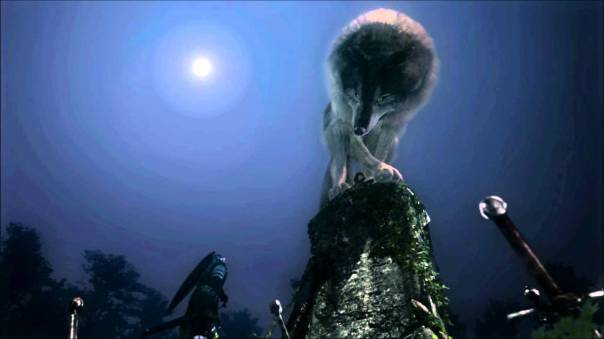
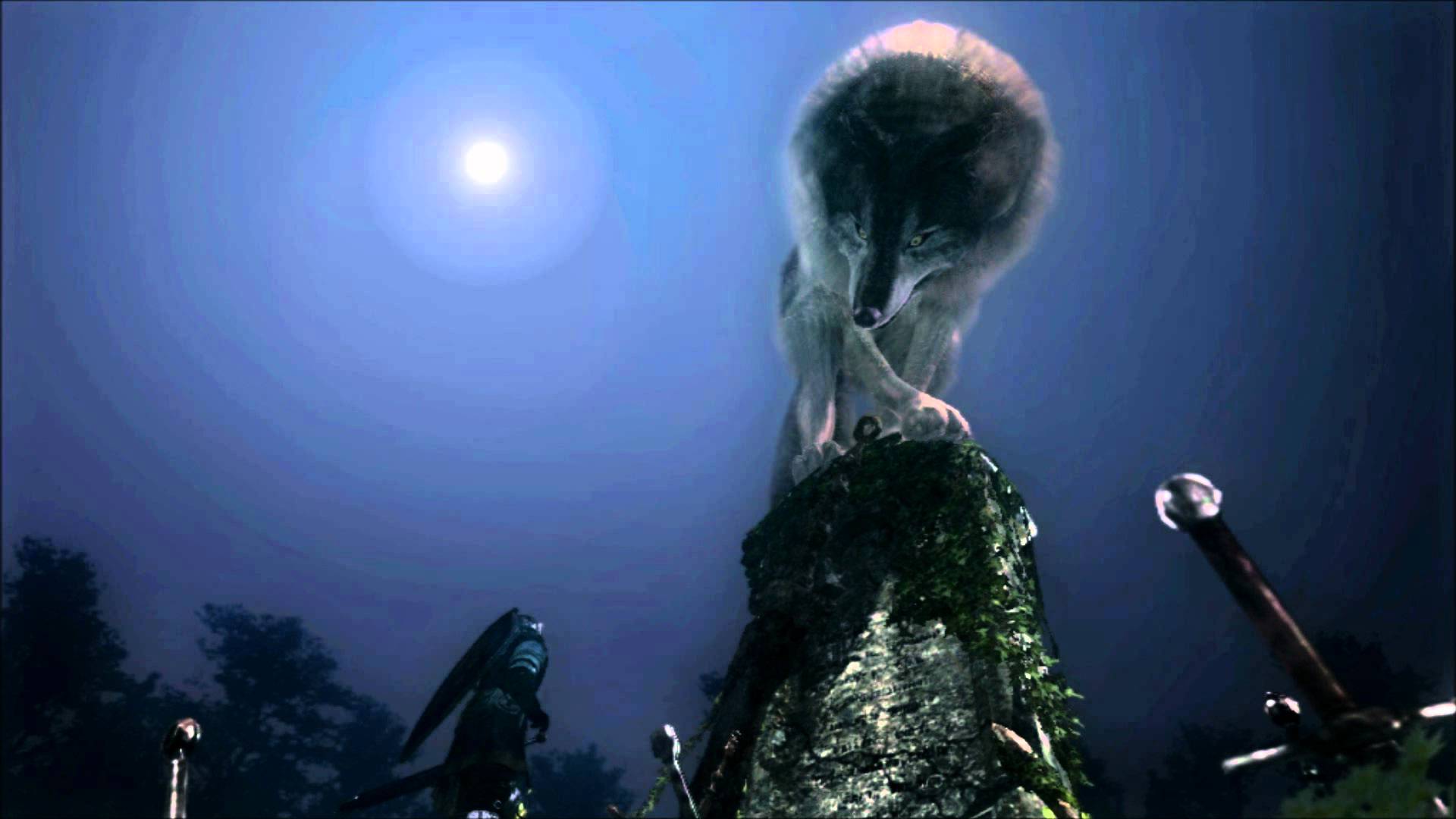
Sif

God, that’s a dangerous looking mutt, but at least it doesn’t know how to use that big swoAARGH!

Meanwhile, every character you saw in that opening cinematic (and about a thousand more besides) has had a long and interesting history during that period, and now you can go and discover it all. Or not. The level of involvement and immersion is completely up to you. There is a reason why there’s an enormous tree in the middle of Hell, but you don’t have to find out if you’re not fussed, they’re cool with it. There is an explanation that tells you why a woman with a spider instead of a pair of legs was hanging out beneath Blighttown, but you don’t have to care, you can just grab your halberd and go mad while she vomits lava like the Human Torch with a stomach bug.

This method of story telling really made sense to me – nobody cares about you here, nobody’s around to do so, and anyway, the joy is in the discovery and guesswork, running through your own little conspiracy theories of how and why it all tied together. It would have felt too easy to have Lord Cliffnote of the Explan Nation show up halfway in and take you carefully through a clear timeline of events. Instead, Dark Souls just sprinkled little jigsaw pieces of info all around the world, and told you that you can grab them if you want or leave them behind, no biggie either way.

Quelaag

Get me a double-D bra and a can of bug spray – I’m sending this bitch back to where she came from.

And the combat mechanics? Well, they were varied, suitably tricky, had a good core system based around stamina management and supported most playstyles. It could have used some minor balancing – I picked up a special halberd about a third of the way into the game and never needed anything else, because all other weapons were slower or weaker, and faithful Stabsy could hit somebody in the next postcode with a single thrust. But other than that the combat worked well and the enemies distributed between each bonfire checkpoint felt tough but fair, a statement that could’ve also been the game’s tagline.

Dark Souls even managed to do online elements without compromising the lonely, isolated feeling. The mechanic by which players can leave notes on the ground for others only highlighted how alone you were, not to mention watching the misty ghost of some other player in a different game die horribly, in a way you could never prevent. Even assisting other players or invading to kill them still somehow feels empty and sparse, most likely because they still look faded and ethereal, and you can’t communicate with a headset, only with pre-made gestures.

In fact, the Dark Souls community seems weirdly courteous when it comes to interaction. Do you know what the last guy to invade me did before attacking? He bowed. Seriously! I couldn’t believe it! I almost expected him to slap me across the face with a glove and demand me to choose a time and weapon! I can’t imagine a Call Of Duty or GTA V player doing that, most likely because half the audiences of those games tend to be so young that they have to shout insults from the comfort of their mother’s womb. Perhaps that’s part of the good design of Dark Souls – the gameplay has frightened off those who weren’t committed, and tamed those who stayed into good behaviour. Kudos to you, From Software.

But actually, I’ve stumbled onto the problem – people WERE frightened off. You see, the really great pieces of art need to be known, need to be witnessed. We understand this on some very fundamental level, we know that the really phenomenal creations were made to elevate us and the culture they’re part of. The Mona Lisa hangs in a public place, and people would rebel if it were anywhere else. The British museum and the National Gallery are free and open to all who wish to see the masterpieces within them. Well, unless you come from the places where the British Museum stole the artefacts from. Then you have to pay for a plane ticket, but I’m sure you get my point.

Don’t get me wrong, it’s not like I’m saying that Dark Souls should be given away for free. If any company deserves the money to make games as humbling as this one, it should be From Software. But this is the nub of the matter – Dark Souls was so aggressive, it hurt itself in the process.

I can demonstrate what I mean, and to do so I have a challenge to those of you who have played and loved the game as much as I do. You’ve undoubtedly recommended it to your friends, because this is a story that needs to be told. Now, be honest here – did you encounter resistance? I bet you did, at least once. I know of several people who stated that they would’ve been interested if it weren’t for the crippling difficulty, and that’s what frustrates the hell out of me, more than any Bell Gargoyle ever could.
Mouth Dragon

For something that’s all mouth, it really wasn’t into diplomacy.

Dark Souls needed one of two things – either an easier entry to the game, or a difficulty setting at the beginning. Leave the vicious gameplay that we know and love alone, but either make it optional, or try to build up to it. I was almost turned off by the beginning when I first tentatively stepped in, and I know of others who were too, because the difficulty curve practically bends right back round to bite your arse before you’ve left the first area, and people just aren’t used to it. Maybe twenty years ago you could have gotten away with it, but not any more.

And it’s a shame, because the game is at its best later on, when the world opens up like a blooming flower and there are more paths and secrets and challenges than an entire season of The Crystal Maze.

It’s almost ironic, because the game tends to become easier as you progress. Don’t get me wrong, the bosses only get bigger and angrier and covered in more fire as you get further in, but improvements in gear and constant practice make for much easier gameplay. I had more trouble with the first couple of bosses than with the rest of the game combined, because you’re basically working with a butter knife and a plank of wood strapped to your arm, whilst a thirty-foot Mr. Blobby or Godzilla’s Minotaur cousin both sharpen their axes and wait for you to arrive. Sure, the last boss is a lightning super-god who could kill a man with a well-aimed movement of his eyebrow, but you’ve had time to comb the world before that point and you’ve acquired enough magic loot and levels to get your own, equally tough eyebrows with which you can take him on as an equal.

But I digress. The point was that Dark Souls was a game that wasn’t just good – it was genuinely amazing, something new and fresh in every aspect it presented. A new form of story-telling, a new take on multiplayer, a new angle on classic fantasy, and even a new direction when it came to something as basic as gameplay difficulty. Think back to the most recent triple-A games you played. I suspect they were pretty easy. I suspect you had regenerating health, that you often had NPCs with you, that failure meant only a brief penalty, if there was one at all. I didn’t realise how much I missed a game that was willing to challenge me, truly goad me into a tooth-and-nail fight where we both had to give it our all if we wanted to succeed.

And bloody hell, it felt good. Hammering against that final boss, I could feel my teeth gritting, my hands gripping the controller ever tighter, and even my eyes beginning to ache, as I focused so hard on the attack patterns of my foe that if I had been staring any harder my eyeballs would have pushed my glasses off my nose. When I finally won, I actually wooped out loud! I’m one of the most jaded people imaginable, but I felt like my triumph over Dark Souls was an actual victory, something very rare in video games these days. And it is a victory, for me, for those who have played it, and for those who have loved it. But more people need to love it, it deserves that kind of status. That’s why the difficulty options needed tweaking just a little bit…

Gwyn

Should somebody tell grandpa that his beard’s caught fire? No? Ah, we’ll leave it then.

I’m not saying that designers should cater for every whim, homogenise every game to the point where they’re barely distinguishable from each other, because that’s how we end up with brown military shooters being sold every Christmas. But this is something that people need to experience, and I don’t think those tiny, but oh-so-important changes would have crippled the game. Hell, wouldn’t a basic difficulty option have been fine? To leave the original experience with all its glorious teeth, and to make an entry-level playthrough to hook those who were more cautious, or who weren’t convinced quite yet?

Some might say I’m asking for too much, or that these alterations would irrecoverably alter the game for the worse, but I don’t think so. Could you really say that adjusting the stats on the Asylum Demon would have poisoned everything beyond then? I can’t see it being the case, quite honestly.

Anyway, time to throw myself into Dark Souls 2. After all, we have to get our kicks somehow. I get mine from saving stamina, halberding horrors and praising the sun like a boss. God bless you, From Software. If only I could be so grossly incandescent.

THE ART OF COMMERCIAL WAR

Oh my god oh my god oh my god! A trailer was just released for XCOM 2! I’m so excited! I feel like a little girl about to meet some handsome boy band! Oh, I must be sure to sniff its hair and steal its sweatband.

But hold on, something is strange. Something feels… Different. I haven’t felt like this about a trailer for a while, but why is that? Let’s reverse-engineer this delight and compare it to something else I saw a trailer for recently: Star Wars: Battlefront.

Quite frankly, I didn’t feel fussed at all when I watched that one. Just kind of unimpressed, and a little bit annoyed. But that doesn’t seem right, surely? I have great nostalgia and love for both the Battlefront and XCOM games, I’ve sunk many hours into both, probably more into Battlefront, actually. So why now do I feel the need to stand on one side so firmly? And no, it’s not because Battlefront is made by EA. The game hasn’t been released yet, and if it’s good then people should buy it, because that’s what promotes good things and keeps people making them. If it’s a micro-payment littered pile of garbage, then I’m not interested, and yes, people should leave it on the shelf.

But I digress.

I think one of the reasons that SWB left me so limp (metaphorically speaking) was that there actually wasn’t anything new in there. No new angle on Star Wars as a concept, nothing to suggest any progression.

Desktop 01-06-2015 17-54-00-57

“Look, I’m sorry, but I don’t kiss on the first date.”

It really is the same old thing. Rebels fight in bulky green outfits and all speak in broad American accents. The Empire is English-exclusive, and uses strangely-designed vehicles built by the lowest bidder. I’ll be honest, I’ve seen it all before, and then, just to give you no credit, Darth Vader and Boba Fett pop out of nowhere and for no reason, except to make all the fanboys swoon like women from a nineteenth-century romance novel. But where’s the twist? Where’s the movement forward? For a series based around travel across the galaxy, Star Wars really doesn’t want to go anywhere.

XCOM, on the other hand, gives us nothing but questions. The whole world appears to have changed since the last game, which was essentially the world we live in now, albeit subjected to the occasional alien invasion. But now we seem to be living with the bug-eyed monsters from Mars. In fact, the little sods seem to be in charge! I spent a lot of time trying to beat them back, I’m rather miffed about how easily they got in. Honestly, you leave for ten minutes and everybody just gives up.

Desktop 01-06-2015 17-47-19-177

What you can’t see is the bumper sticker on the back that says “My other car is also a Porsche.”

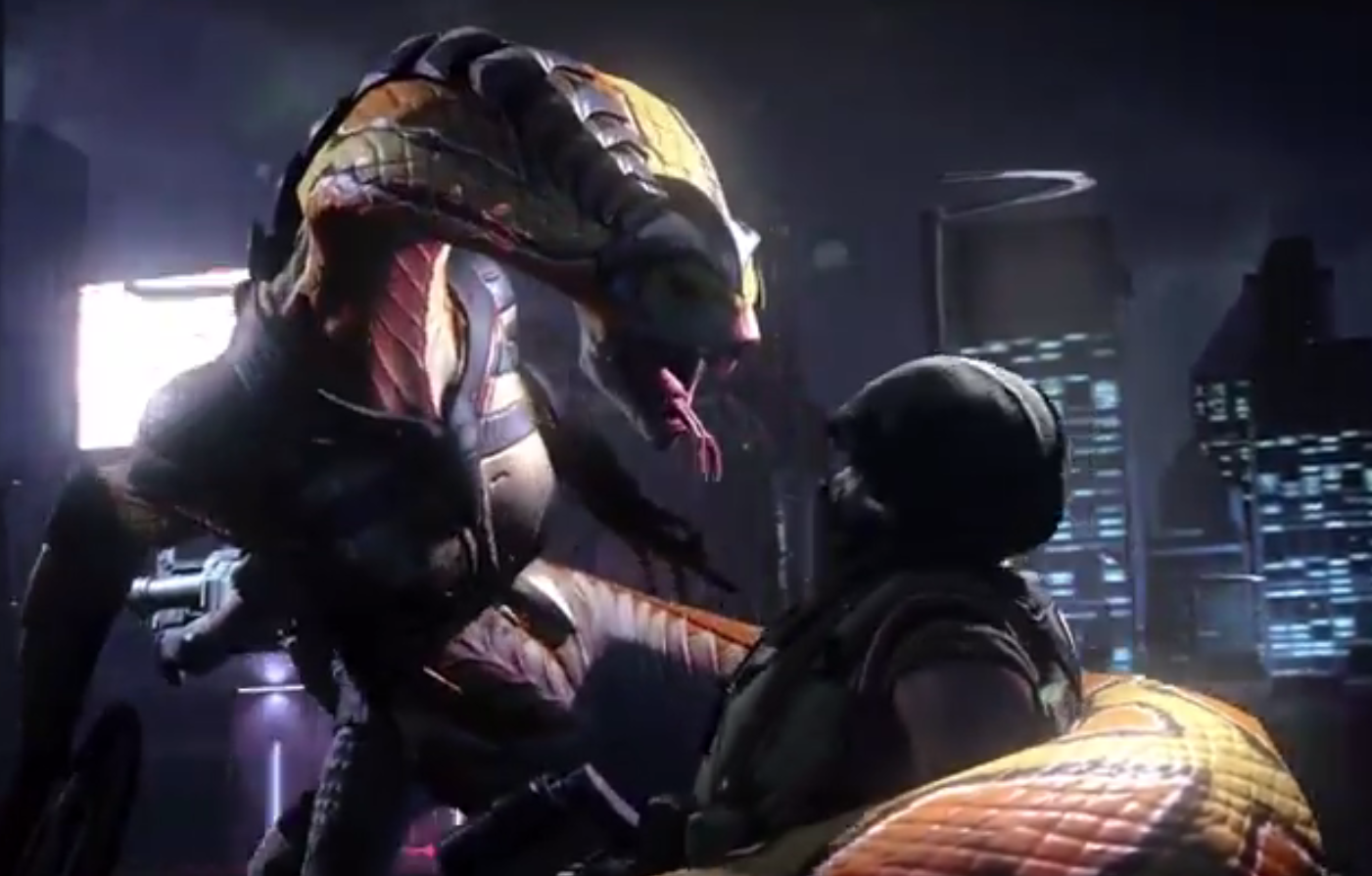
I like the tone of the trailer as well. There’s a touch of Blade Runner and 1984 to the whole thing, with aliens stopping humans in the street for random tests, and massive TV screens smilingly telling us to do what our new overlords ask, with no pause to think for ourselves. THAT’S intriguing. That makes me want to play, to find out what happened. They’ve sparked my curiosity now. Not only that, but there’s new sorts of aliens to feast our eyes on. We see the Ethereals from the first game, making some strange messiah-pose on a billboard, but we also see a snakey-looking thing that wasn’t around before, power-armour soldiers who are unnervingly faceless, and what appears to be a big brother to the classic sectoid enemies. In fact, let’s be honest, that thing is absolutely terrifying. I think I’d rather be trapped in a room with a rampant muton beserker than left for a minute with one of those.

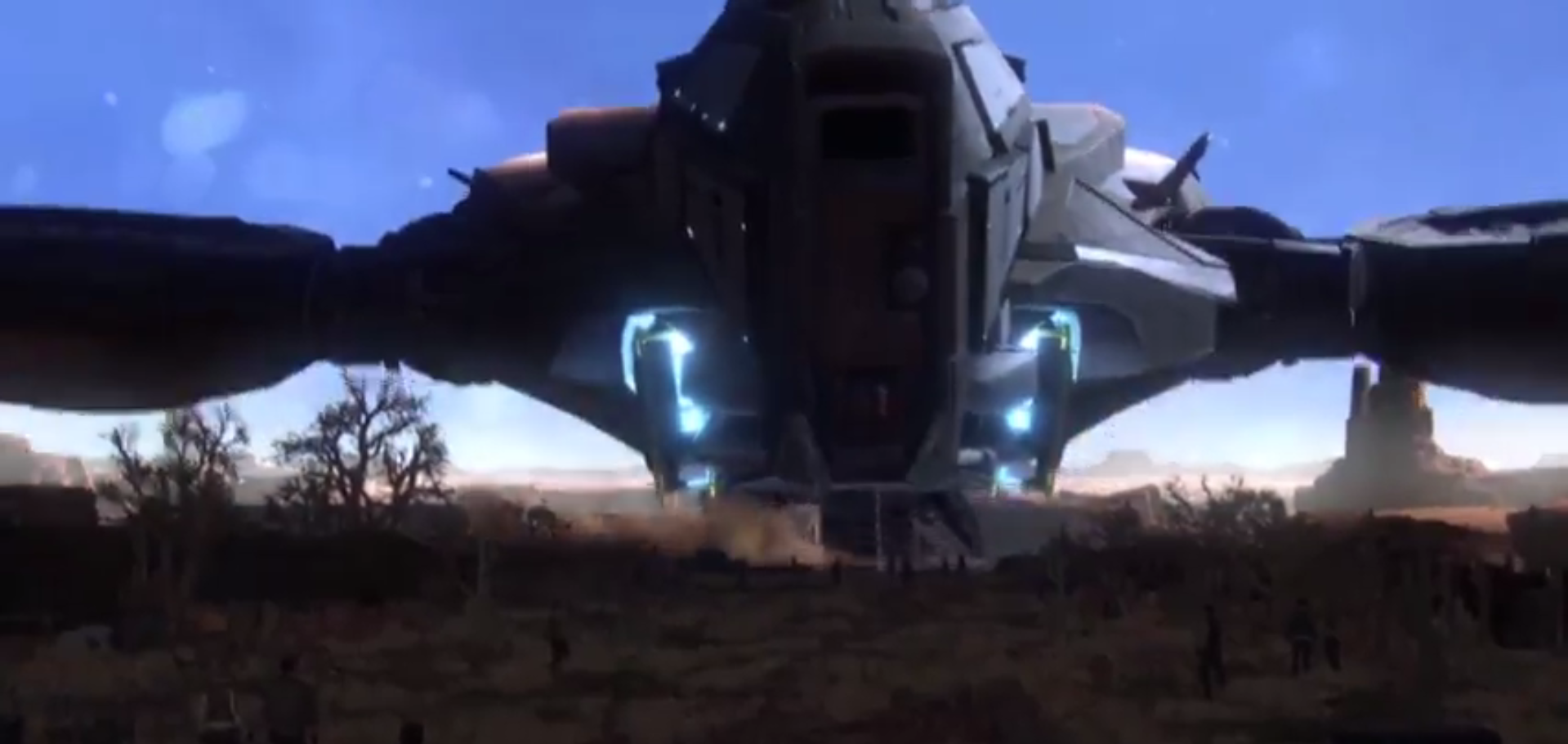
Scared isn’t bored, though. And I’m not bored, I’m fascinated. This world is one I want to explore, to find out about. I want to leap on board the giant XCOM helicarrier they showed us at the end, I want to pilot that angry little taser drone that zapped one of the bad guys, and most of all I want to give those aliens another good hiding. This has all made me ready for round 2.

Desktop 01-06-2015 17-54-21-701

What do we think? Good news or bad news?

But Star Wars? Well, there’s a saying that fits. Been there, done that. The game might still be good, but the trailer didn’t get me excited for anything, I’ve done it all before. EA aren’t offering any new ideas, they’ve just put the old ones in a different game. And be honest with yourself, even though the trailer was made with the game’s engine, do you really think you’re looking at what the game is actually going to be like? I doubt it, because if the gameplay was that amazing… Well, they’d have shown us gameplay, not a movie wearing the skin of a video game.

Remember, neither of these evaluations are evaluations of the final product. Battlefront might be awesome, XCOM might be a load of old arse. But it doesn’t look like that here. XCOM is intriguing me, being rather coquettish and winking from behind its paper fan. Star Wars, on the other hand, has basically walked into the middle of the room and thrown off its dress, showing me everything it has, warts and all. And I don’t want warts. Yes, XCOM might have warts in the end, but it’s done a masterful job of hiding them, and I don’t think it only wants to do the missionary position, Star Wars. You could learn a thing or two here.

(Joel Franey would like to make it very clear that he has never paid for physical affection, except in the strictest sense of karmatic justice. He’d also like to make it very clear that women with warts aren’t necessarily doomed to loneliness and may still find love with another. Just not with him.)

I intended to release a longer piece on Dark Souls today, but this trailer came out a couple of hours ago and I thought was worth writing about whilst we remembered it. Expect Dark Souls soon.

YOU CAN WATCH THE XCOM TRAILER HERE, AND THE STAR WARS TRAILER HERE.